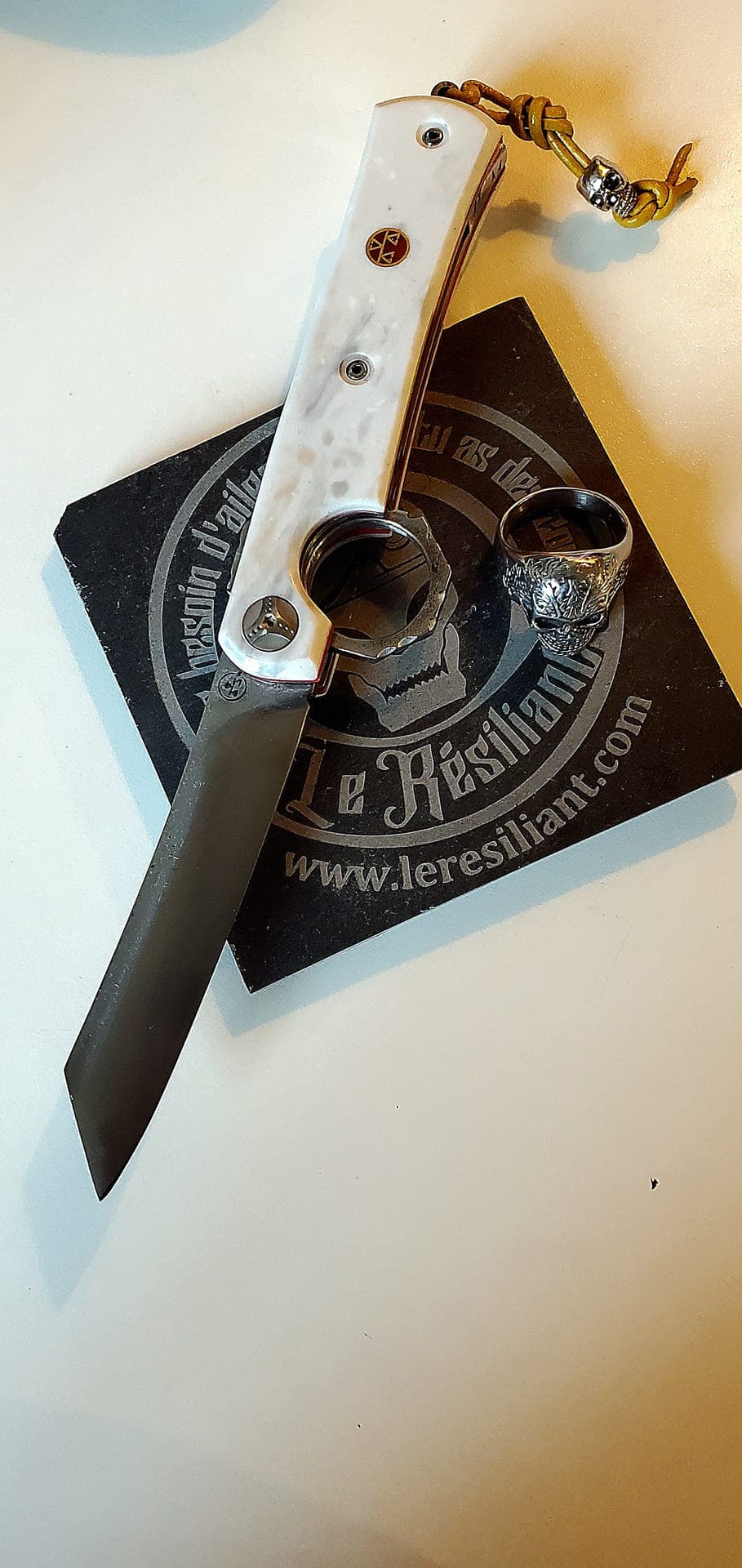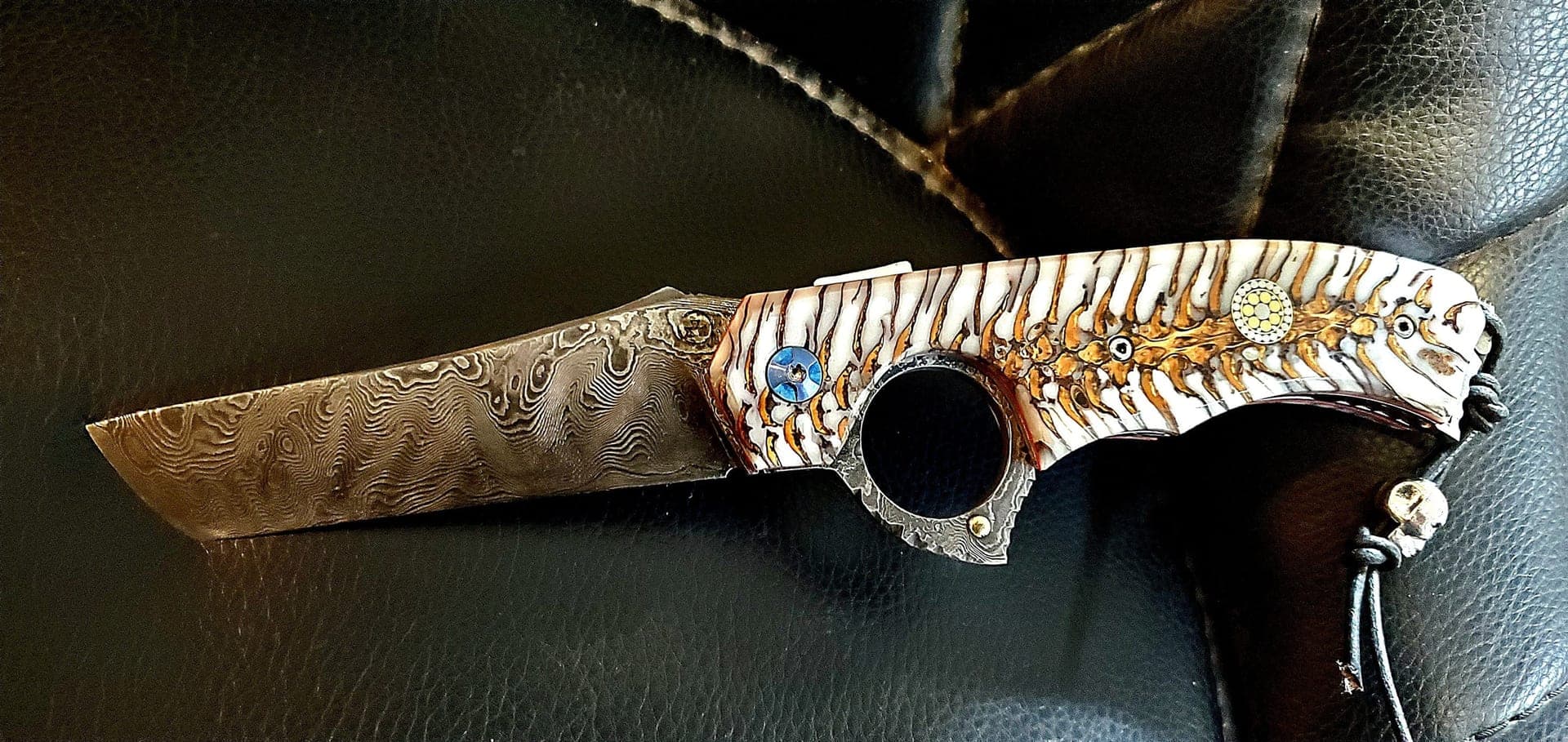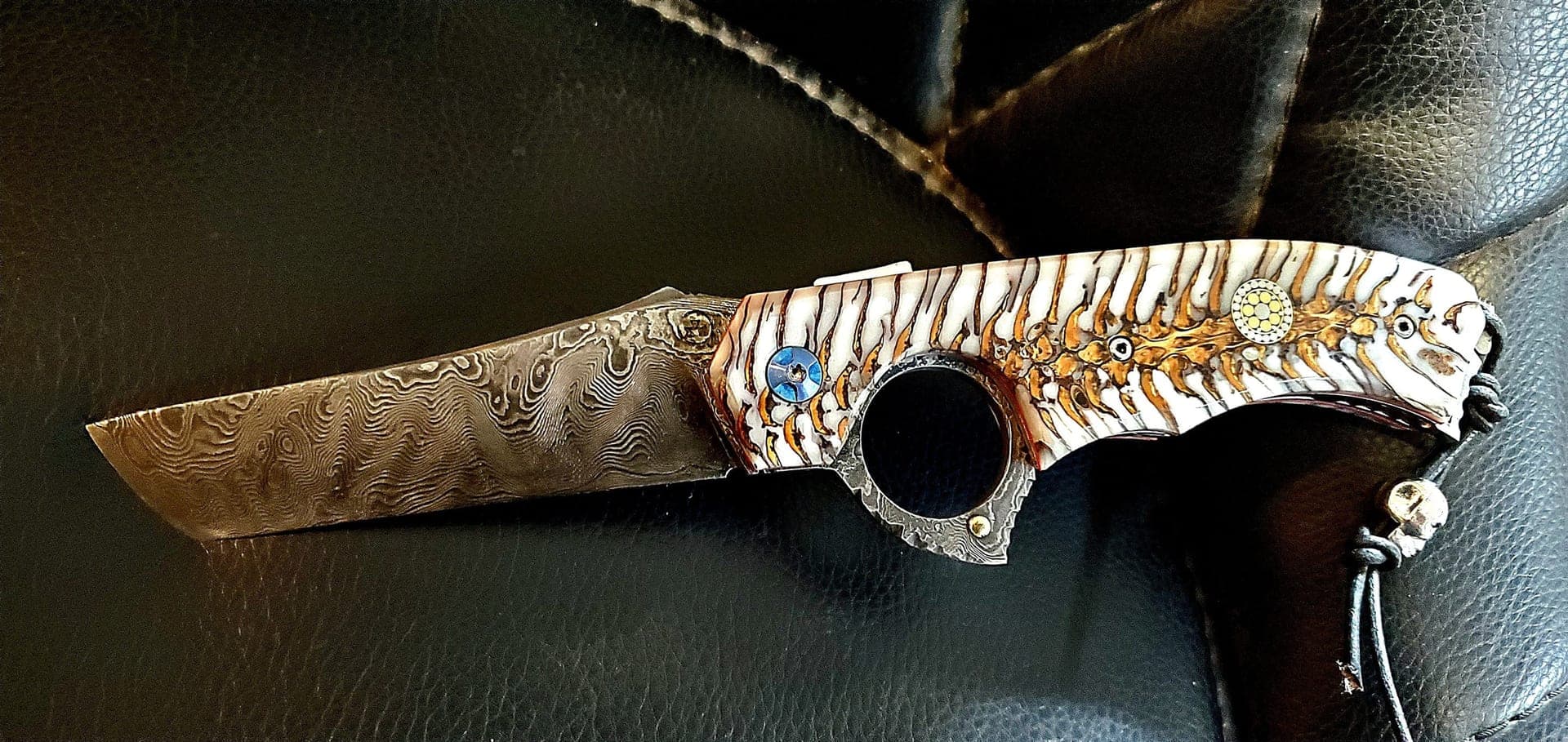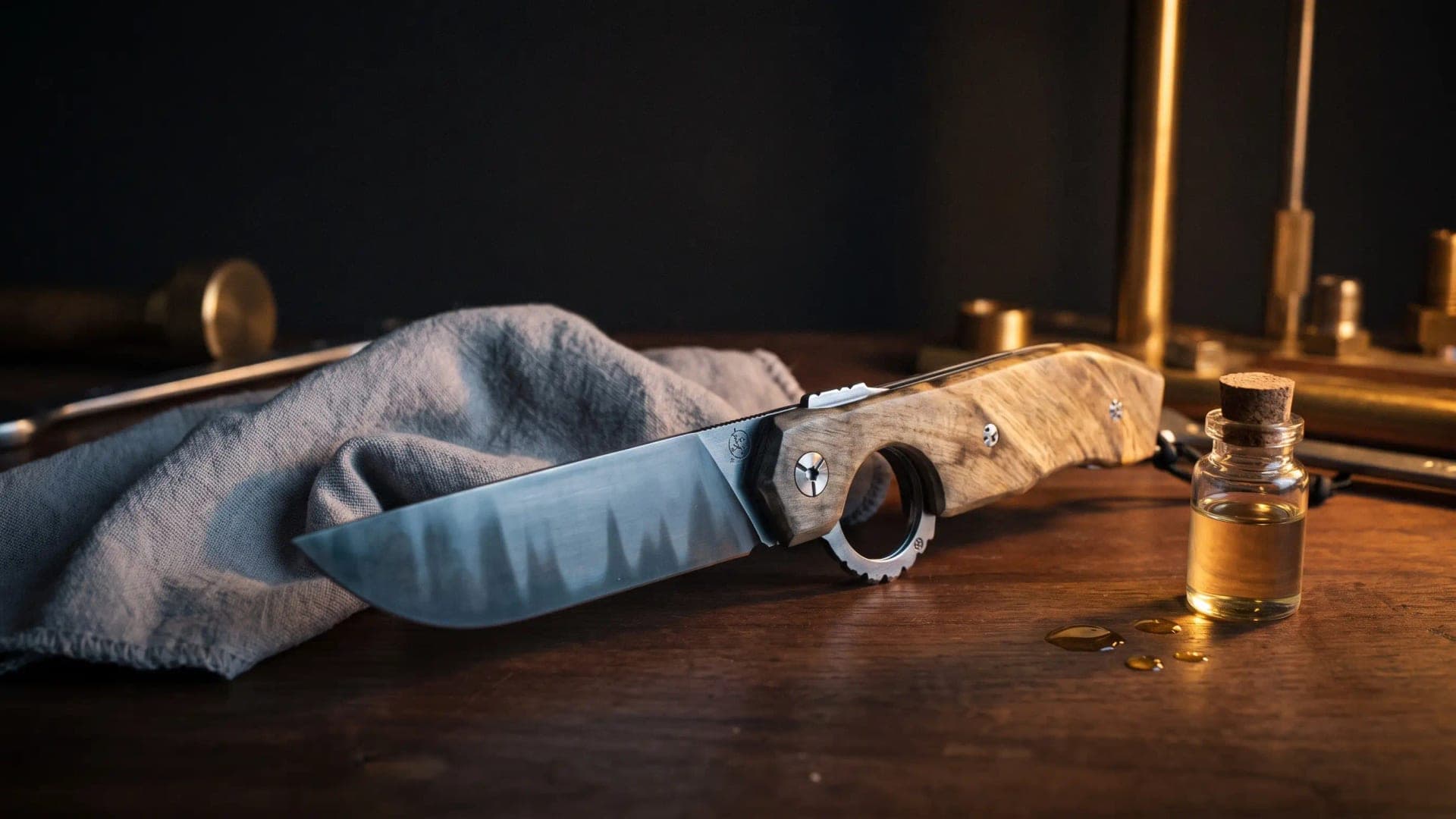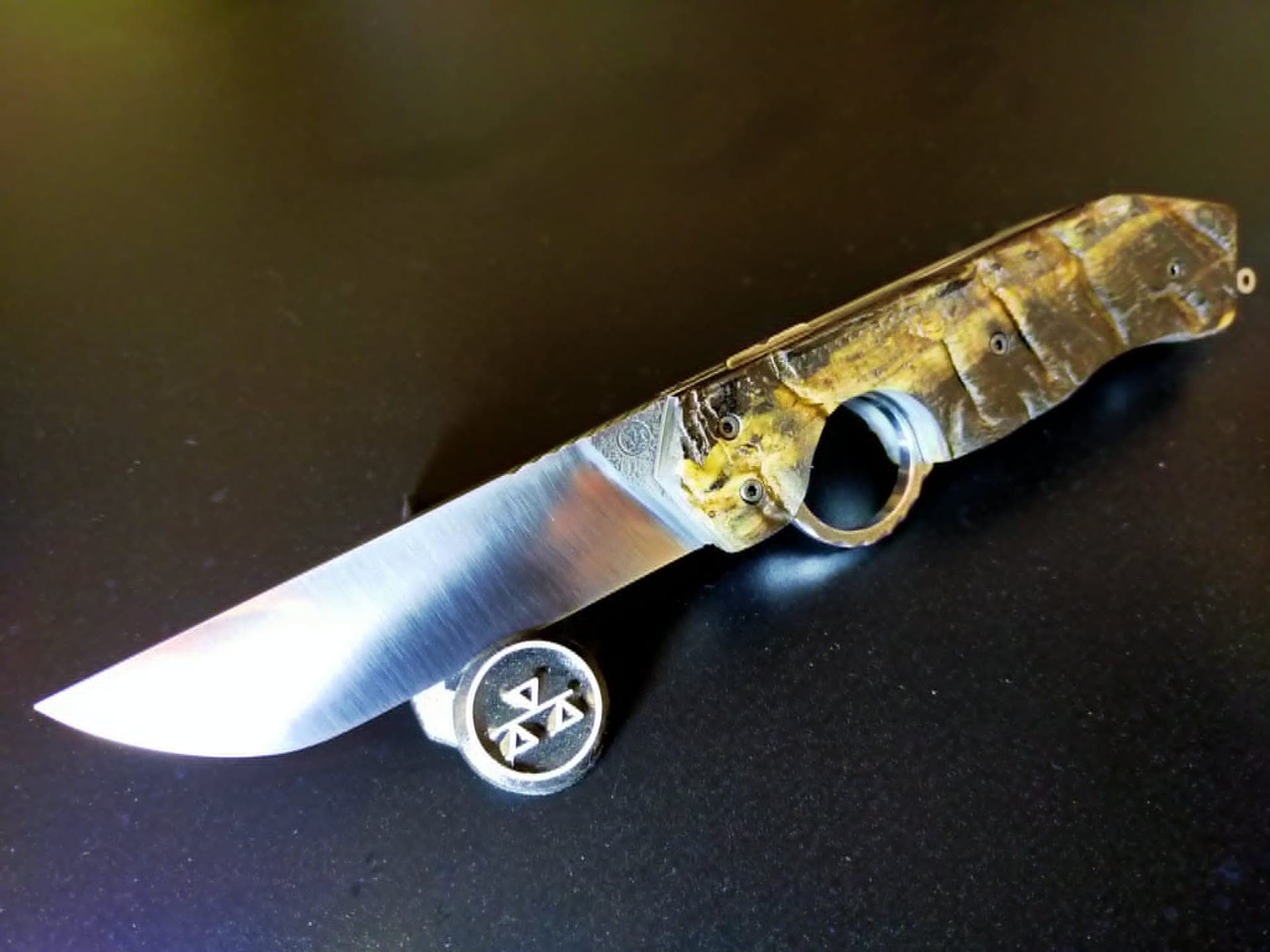
Two Résiliants set side by side on the workbench tell the same story in two voices. The first, a 2.0, carries a blue grey veil across its blade, the mark of regular use and of a steel that lives with its owner. The second, a Tracker, keeps the same clean polish as its first day, as if use had not yet touched it. Same workshop, same tempering furnace, same hands for assembly and adjustment: what sets these two blades apart comes down to one word, the steel.
There is no such thing as the best steel for a knife, only trade-offs chosen with full knowledge. Carbon, stainless, semi-stainless: these three words come up constantly on a product page or in a workshop conversation, without always saying what they actually change for whoever uses the blade daily, cares for it, or leaves it damp for a night without thinking.
Here is what each steel family gives and demands, what a semi-stainless grade like D2 changes, why tempering matters as much as the choice of steel itself, and how these elements translate into a simple decision when choosing a model.
Carbon, stainless, semi-stainless: three families, one compromise
A carbon steel contains between 0.05 and 2.1% carbon and very few other alloying elements: it takes a very fine edge but rusts easily. A stainless steel must contain at least 10.5% chromium, which forms a protective layer against corrosion. In between, a semi-stainless steel carries chromium without enough of it to be called stainless.
Choosing a knife steel always means weighing three qualities that never move forward together: hardness, which holds the edge, toughness, which keeps the blade from chipping, and corrosion resistance. The metallurgical analyses published on Knife Steel Nerds confirm it, improving one of these qualities almost always costs on another: a steel that is best in absolute terms does not exist, only a steel better suited to a given use.
A carbon steel is, by definition, an alloy of iron and carbon (0.05 to 2.1% by mass) with few other elements: this simplicity gives it a fine edge that is easy to maintain, at the cost of real sensitivity to rust. A steel becomes stainless past a precise threshold, at least 10.5% chromium, which forms a thin protective layer on its surface. In between, a semi-stainless steel carries chromium without meeting the full threshold: this is the case of the D2 worked at the workshop. The five grades Le Résiliant works there, 90MCV8 carbon, D2 (or Z160), N690, 14C28N and damascus, sit across this triangle.
What carbon steel gives, and what it asks for
The 90MCV8 in the Résiliant 2.0 is a carbon steel prized for its very fine, easy to sharpen edge, with a grind more refined than the Tanto's. In exchange, it develops a blue grey patina with use, a mark that is not rust, and calls for being wiped, kept dry and oiled regularly.
On a Résiliant 2.0, the patina is not a flaw but the trace of a living steel: through contact with cutting and air, the 90MCV8 develops a blue grey veil that evolves over years and with its owner's use. Unlike rust, which eats away at the metal, the patina is a thin oxide layer that instead protects the surface it covers.
The 90MCV8's grind is also finer than the Tanto's, which adds to its sought after edge; the same grade equips the carbon version of the Shotokan. The trade-off is simple: a sharper, easier to revive edge, in exchange for slightly closer care, wiping the blade after use, keeping it dry, adding a drop of oil now and then.
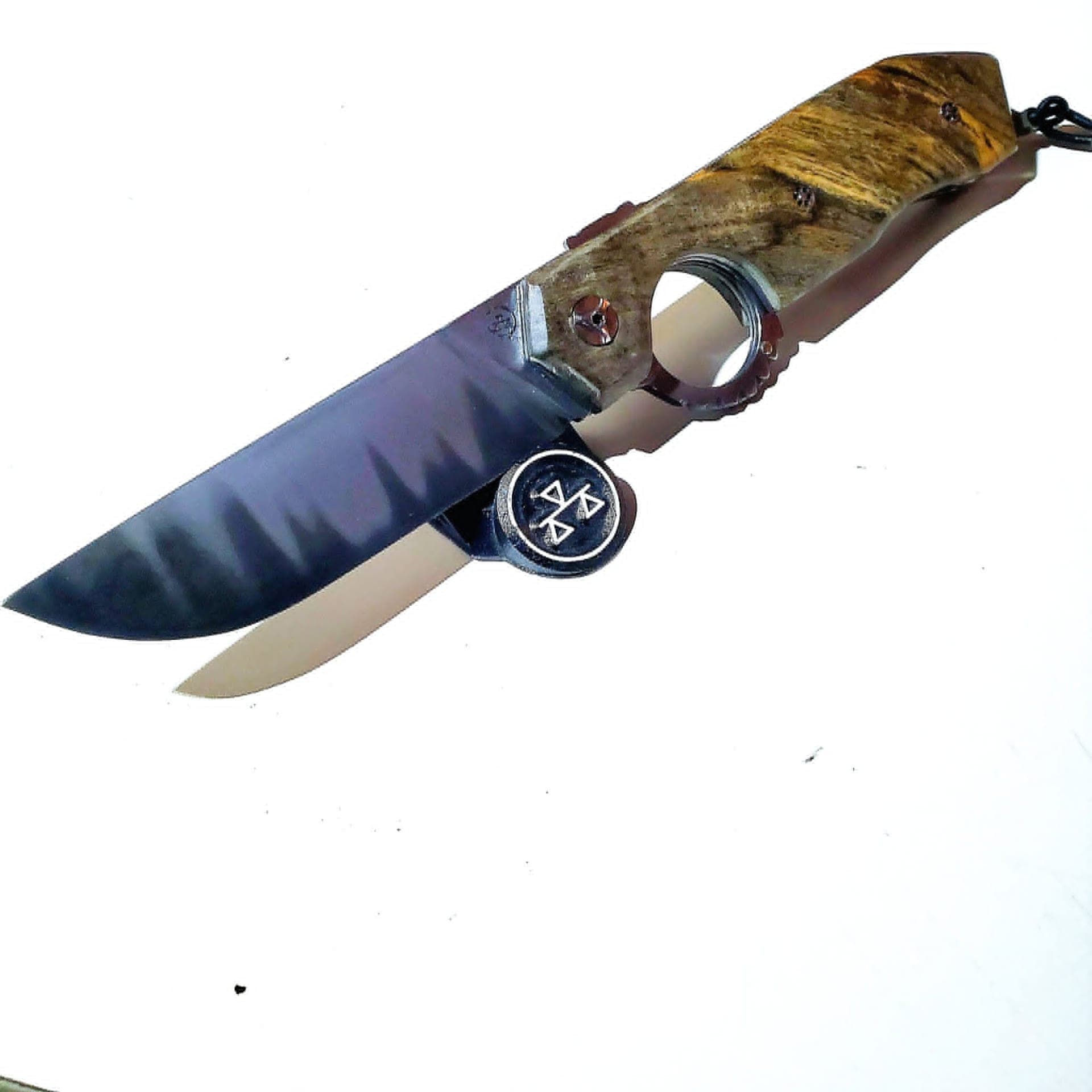
90MCV8, the workshop's carbon grade
90MCV8 is the French designation of a carbon steel the United States calls O2: the same metal under two standards. It is the carbon grade Le Résiliant works in Thiers, on the 2.0 and on the carbon version of the Shotokan. A fine edge that is easy to revive, a grey-blue patina with use, and closer care.
90MCV8 goes by two names depending on the continent: O2 in the United States, 90MCV8 in France, and it is the same metal. Cutlery lives with these double designations, much as the American D2 is called Z160 by the French standard. Behind the code, nothing exotic: a carbon steel, not stainless, that does not rely on chromium to defend itself against corrosion.
It is also the steel of hunting daggers, chosen for its resilience: it takes an impact without breaking, and it comes back to true very easily on a butcher's steel. In Thiers, the workshop hardens it between 790 and 830°C in its temperature controlled electric furnace, the range that suits the carbon steels in the collection.
In the collection, it equips the Résiliant 2.0 and the carbon version of the Shotokan. What it asks in return comes down to three habits, wiping after use, keeping it dry, oiling now and then, covered in the article on rust and patina.
Modern stainless no longer gives up on the edge
Chromium gives a steel its resistance to corrosion, but a chromium rich stainless has long sacrificed cutting performance. The N690 in the Mini Tanto and the 14C28N in the Tracker, two modern stainless grades designed for cutlery, reverse that old trade-off: both receive a cryogenic hardening carried out in industry, for an edge that holds better.
The old prejudice holds that a stainless can never cut as well as a carbon steel: it comes from older stainless grades, loaded with chromium to resist corrosion at the cost of cutting performance. Modern grades like N690 or 14C28N are designed differently, with a better balance of hardness and resistance, and refined specifically for cutlery rather than borrowed from other industrial uses.
The Mini Tanto, fitted with this N690 and a carbon fibre handle, is meant as the most carefree of the Résiliants: its grade resists wear and oxidation well, an advantage for humid use or for anyone who sometimes forgets to wipe the blade. The Tracker, in 14C28N, targets the same profile with a blade coating available on request, at the quote stage, a stainless grade built for a mid-range budget without giving up on cutting performance.
D2, or Z160: the semi-stainless steel of the series
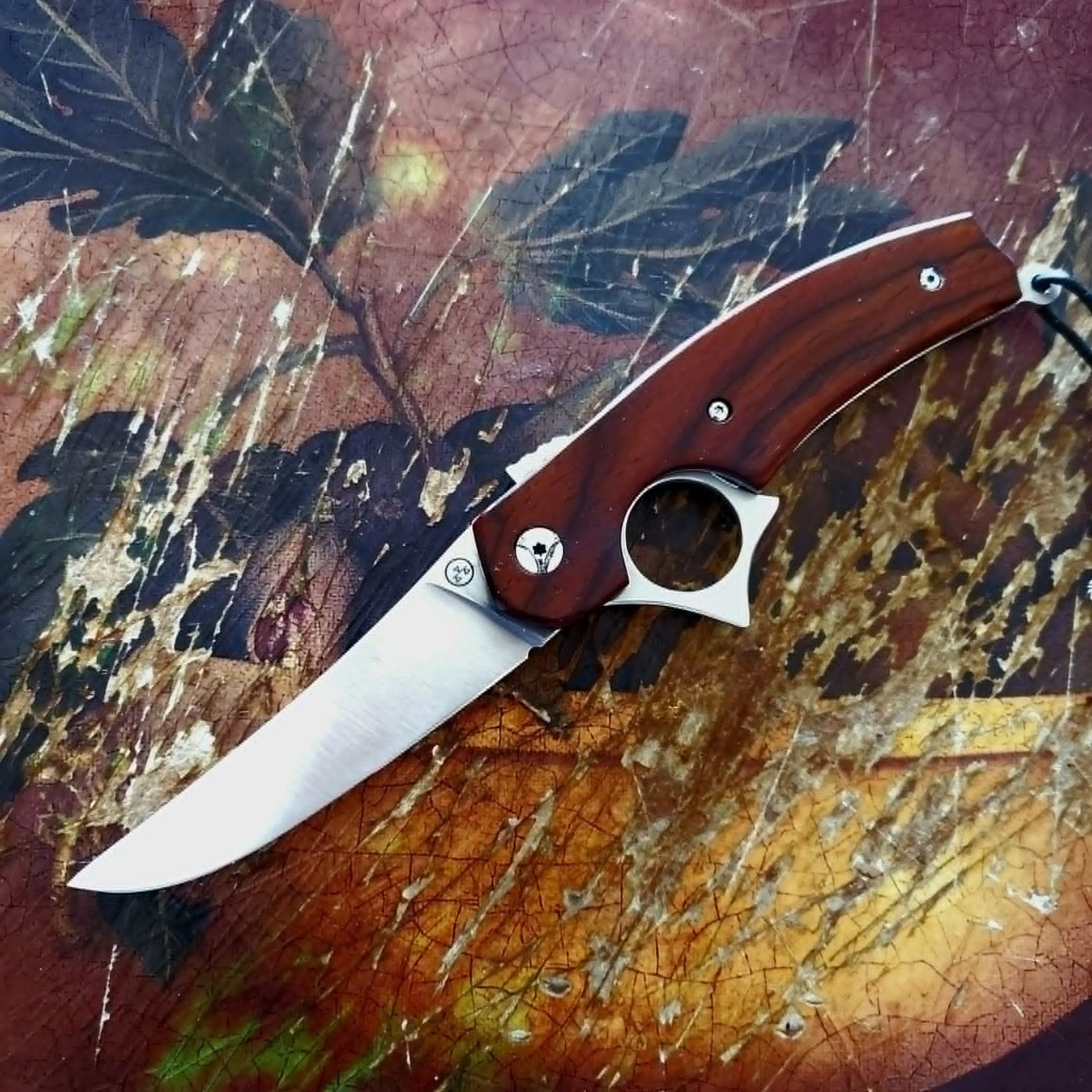
D2 and Z160 (Z160CDV12) name the same steel under two labels, D2 in the United States, Z160 in Europe: a tool steel rich in carbon and chromium, semi-stainless. It equips Le Résiliant Tanto and Le Mancharicou, and also comes on Le Shotokan: it tolerates daily use without offering the ease of a true stainless.
The workshop itself speaks of D2 Z160: the same tool steel, just two designations under different standards, American and European. Rich in carbon and chromium, it holds a demanding edge and resists abrasion well, which is why it equips the Résiliants built for job site or everyday use, starting with the Tanto, the original model in the collection.
Le Mancharicou takes it up in a more compact format, and Le Shotokan comes in a Z160 semi-stainless version alongside its carbon one. Semi-stainless does not mean stainless: D2 tolerates moisture better than a carbon steel, but a D2 blade left wet in its sheath still stays exposed to corrosion, and always benefits from being wiped before storage.
Heat treatment decides as much as the grade
A steel grade is only as good as the heat treatment it receives. At the workshop, the electric furnace heats carbon steels between 790 and 830°C and stainless steels a little above 1050°C, then, for the N690 and the 14C28N, a cryogenic cooling step at very low temperature, done in industry, further refines corrosion resistance and edge retention.
These orders of magnitude sit within what the CTIF documents: austenitisation of a steel begins at around 723°C, and hardening itself falls, depending on the grade, between 780 and 1250°C. The workshop's temperature controlled electric furnace makes it possible to hold these ranges precisely, and to tailor the treatment to each steel rather than applying one recipe to all.
The workshop does not work steels whose hardening calls for 1100 to 1200°C, those high tech American grades. The collection sticks to the five grades the furnace in Thiers can handle, from carbon to stainless, with the cryogenic step for the N690 and the 14C28N left to industry. It is a limit stated rather than hidden, and it says what matters: a steel gives nothing without the heat treatment that matches it.
The full story of the shaping, from cutting to grinding, is told in the Journal article on how a Résiliant is made, from steel plate to finished knife: what matters here is that hardening shapes the edge, and how long it lasts, just as much as the initial choice of grade.
Choosing your steel means choosing your use
For job site or demanding EDC use, D2 goes the distance. For the pleasure of a very lively edge and the look of a patina, carbon. For humidity or a forgotten wipe, a modern stainless like N690 or 14C28N. For display and collecting, damascus. The choice is always made at the quote stage, in Thiers.
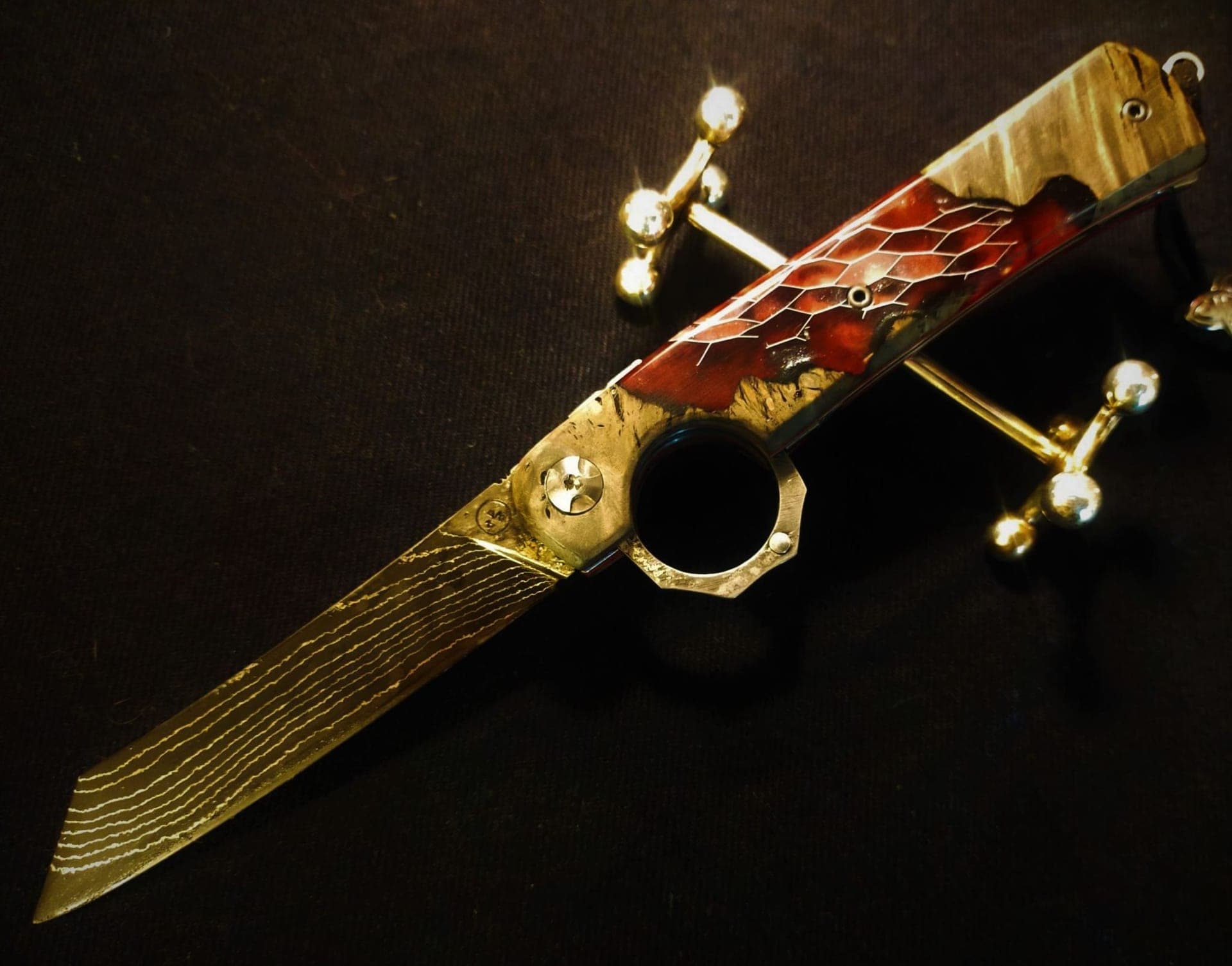
Damascus deserves a word of its own: it comes in both carbon and stainless. Carbon damascus, forged by a bladesmith through pattern welding, behaves at the care stage like any carbon steel, wiped and kept dry; it is the variant the workshop reserves for L'Archétype, for the damascus version of Le Shotokan and, on request, for Le Fhiers, and its patterns are covered in the article "Damascus steel: how the patterns of a blade are born". Stainless damascus, on the other hand, cannot be forged by an artisan bladesmith, only industry can produce it: the workshop buys it already shaped, for clients who ask for it at the quote stage.
Beyond the grade, the choice of a steel is always made directly with the cutler, at the quote stage: he is the one who knows how each grade actually behaves across the eight models in the collection, and who helps match a steel to a use rather than a trend. That choice, like the model or the handle material, sits at the heart of a craft practised in Thiers, where every blade is tempered, assembled and adjusted by hand.
- What is 90MCV8 steel?
- 90MCV8 is a carbon steel, not stainless, that the United States designates as O2: the same metal under two standards. It takes a very fine edge that is easy to revive, develops a grey-blue patina with use, and calls for being wiped, kept dry and oiled now and then. In Thiers, the workshop hardens it between 790 and 830°C and uses it on the Résiliant 2.0 and the carbon version of the Shotokan.
- Which steel should I choose for an everyday knife?
- For demanding daily use, job site, workshop, outdoors, D2 (Z160) is the most forgiving grade: rich in carbon and chromium, it holds a demanding edge and resists abrasion well. A modern stainless like N690 or 14C28N suits humid use or a more distracted routine better.
- Does a carbon steel always rust?
- A carbon steel is sensitive to corrosion by nature, but it does not rust automatically: wiped after use, kept dry and oiled now and then, it develops a patina instead, a blue grey veil that protects the surface rather than eating into it. Rust stays a care failure, not a fatality.
- Is D2 really a stainless steel?
- No: D2, also called Z160 in Europe, is a semi-stainless steel. Rich in carbon and chromium, it resists corrosion better than a plain carbon steel, without reaching the 10.5% chromium threshold that defines a true stainless. A D2 blade left wet still stays exposed to rust.
- Is a stainless steel harder to sharpen than a carbon steel?
- Generally, yes: a carbon steel like 90MCV8 comes back to sharp faster than a carbide rich stainless, which wears down the abrasive more. It is not a matter of quality but of steel structure; the choice comes down to how much maintenance you are willing to accept.
- Is damascus a carbon steel or a stainless steel?
- Damascus comes in both carbon and stainless. Carbon damascus, forged by a bladesmith through pattern welding, behaves like any carbon steel when it comes to care, sensitive to moisture, wiped and kept dry; it is the variant the workshop reserves for L'Archétype, the damascus version of Le Shotokan and, on request, Le Fhiers. Stainless damascus cannot be forged by an artisan bladesmith, only industry can produce it: the workshop buys it already shaped for clients who ask for it at the quote stage.
- Which steels does the Résiliant workshop work with?
- Five grades, across eight models: 90MCV8 carbon (Résiliant 2.0, Shotokan), D2 or Z160 semi-stainless (Tanto, Mancharicou, Shotokan), N690 (Mini Tanto), 14C28N (Tracker) and damascus (Archétype, Shotokan, Fhiers). The choice is always made at the quote stage, directly with the cutler, in Thiers.
Sources
- Wikipédia — Acier au carbone — Établit la définition de l'acier au carbone (0,05 à 2,1 % de carbone, très peu d'éléments d'alliage) et sa sensibilité à la corrosion.
- Wikipédia — Acier inoxydable — Donne le seuil qui fait qu'un acier est dit inoxydable (au moins 10,5 % de chrome) et le mécanisme de la couche passive qui protège la surface.
- CTIF — « Les mécanismes de la trempe des aciers » — Confirme les ordres de grandeur de la trempe (austénitisation dès environ 723 °C, trempe entre 780 et 1250 °C selon l'acier) dans lesquels s'inscrivent les pratiques du four de l'atelier.
- Knife Steel Nerds — Analyses métallurgiques publiées par un docteur en science des matériaux sur le compromis permanent entre dureté, ténacité, tenue de coupe et résistance à la corrosion d'un acier à couteau.