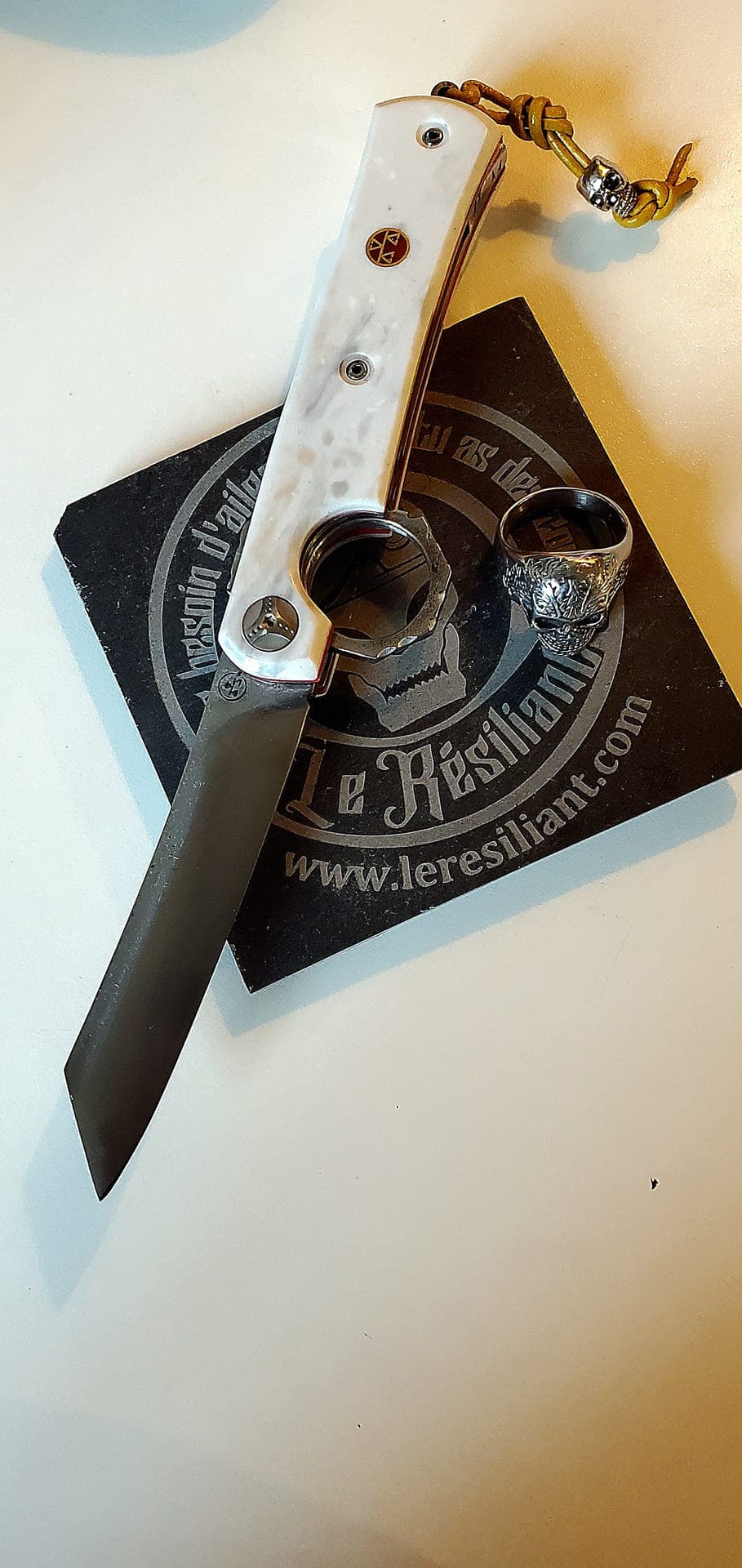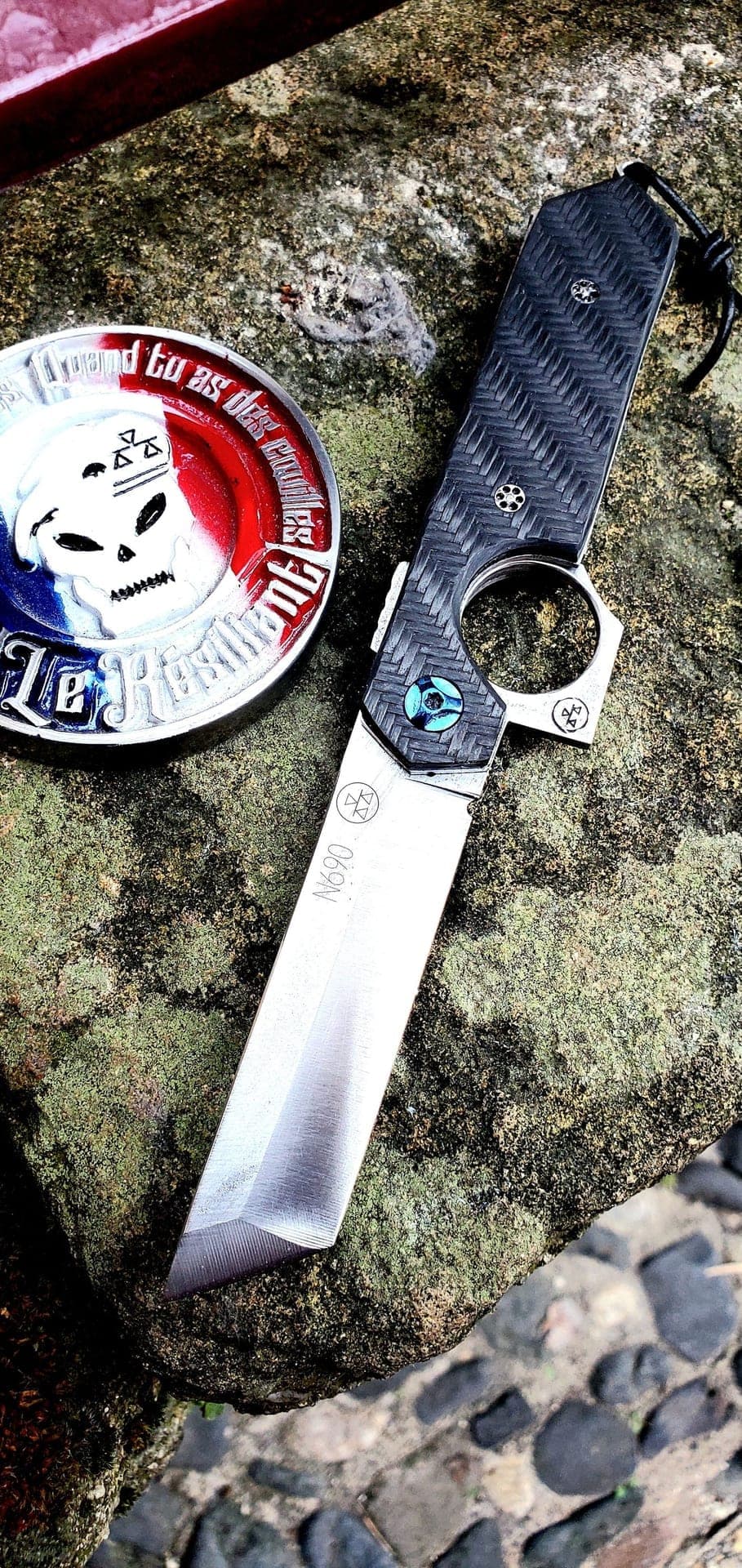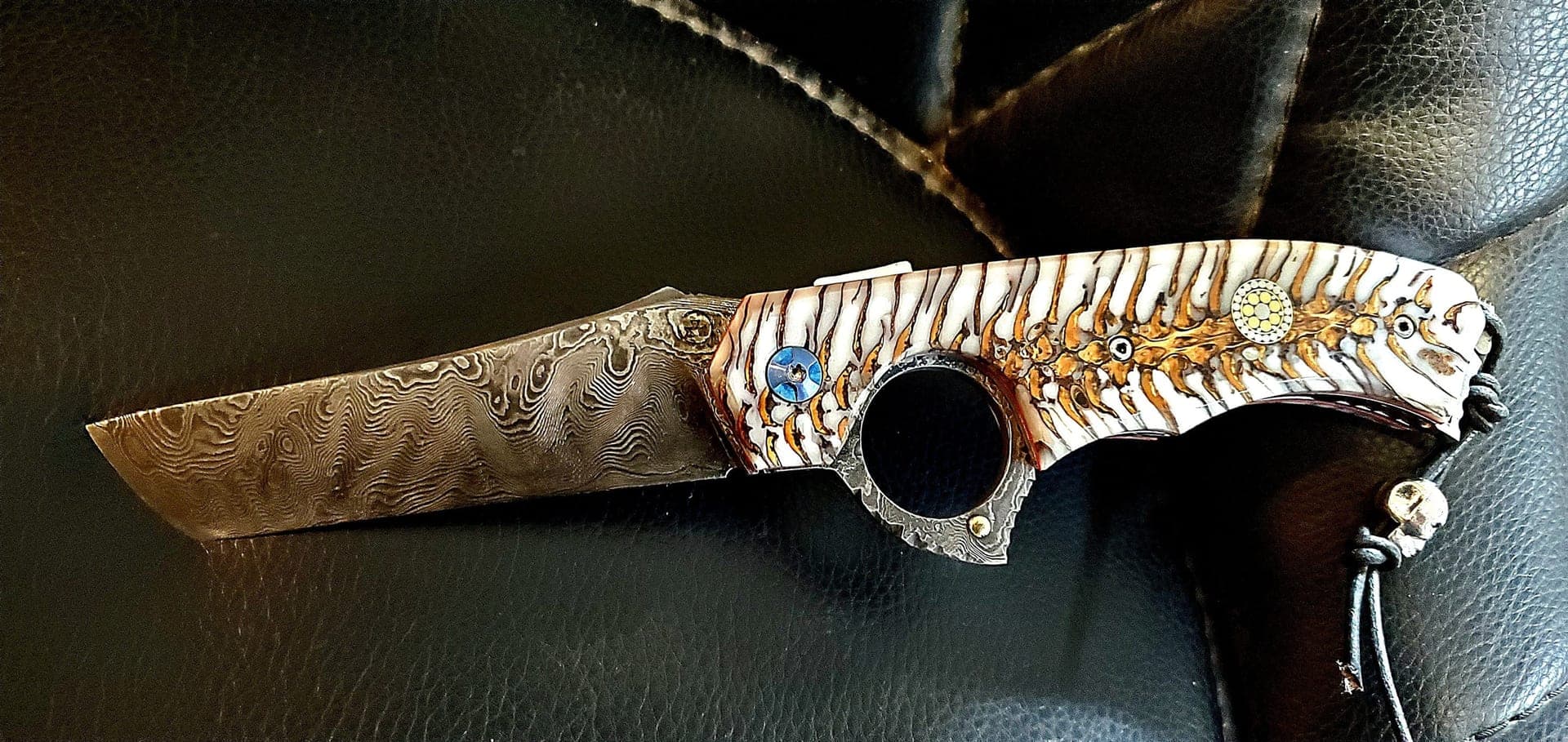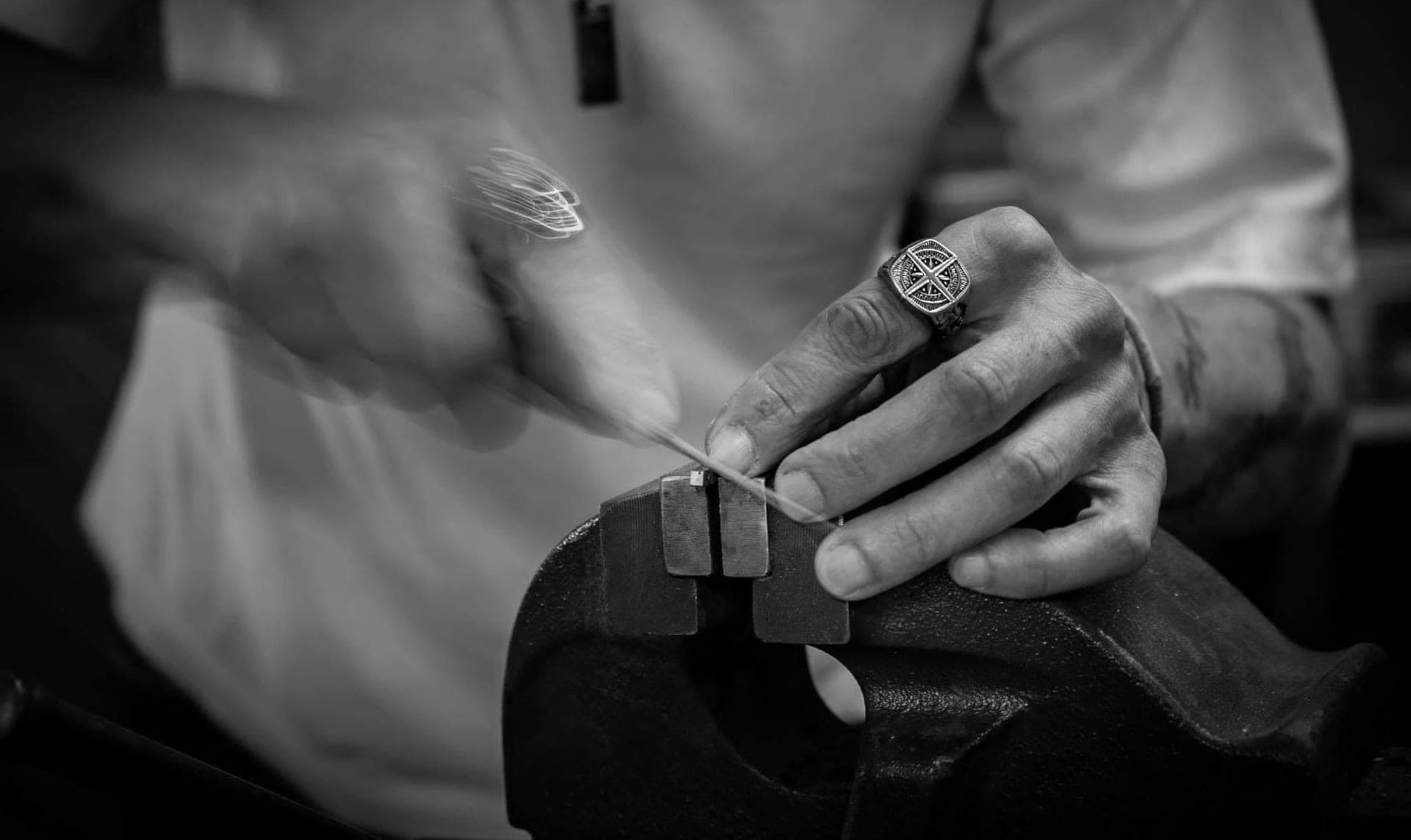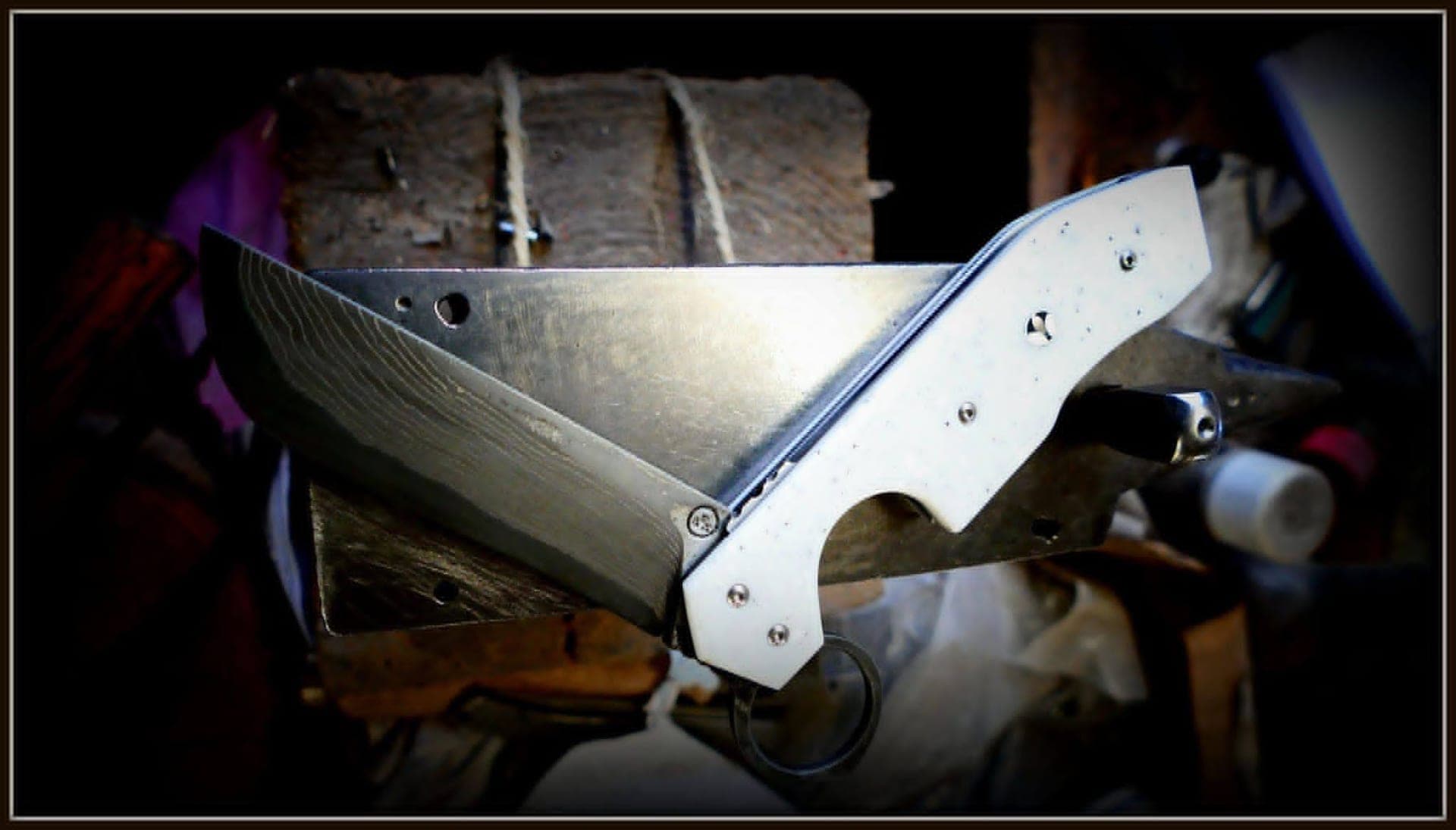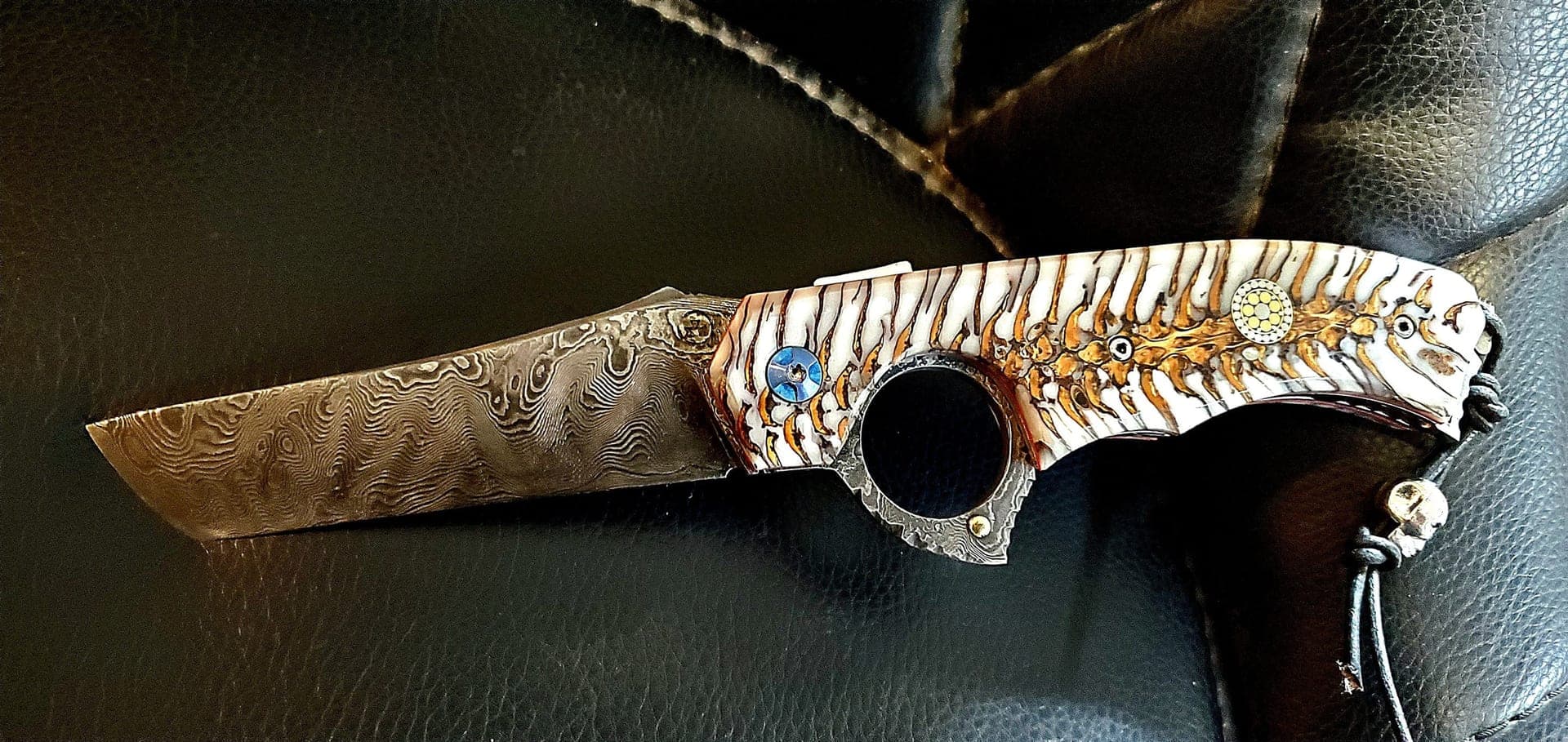
A Résiliant knife always starts from a plate, never from a raw ingot. Before it reaches a customer's hands, that plate of steel or damascus goes through several distinct steps: cutting, quenching, bevel grinding, polishing and assembly.
This article follows that path as it actually happens at the workshop in Thiers, without blurring what is done on site and what isn't.
It covers why the workshop doesn't forge and what its method is called, where the steel for each blade comes from, how the blade is cut by hand or in series, what quenching actually does, and what, across the whole process, never leaves the Thiers workbench.
The Workshop Doesn't Forge, a Deliberate Choice, Old in Thiers
No, the workshop doesn't forge its blades: it cuts them by removing material, what cutlery calls stock removal. A blacksmith shapes raw steel with a hammer; the cutler starts from a plate already milled to size and removes material from it. In Thiers, this specialization is documented as far back as the 15th century.
The distinction comes down to a simple fact: forging and cutlery call for different skills, tools and facilities. The cutlery trade of Thiers documents this division of labor from the 15th century onward, with roles already split between hammer-mill operators, blacksmiths, filers, drillers, grinders and polishers, organized into a piecework economy from the 17th century. Many workshops in the region still work this way, relying on steel and damascus already produced by specialists.
This system explains why a workshop in Thiers never needed to master every step of a knife at once. A single craftsman could spend an entire career on one operation, cutting, quenching or polishing, without ever touching the forge itself. It's this logic, more than modern machinery, that explains why a workshop like Le Résiliant's still keeps sourcing its steel or damascus from outside specialists, rather than producing it in-house, and keeps that supply separate from the shaping work carried out on site, by hand, plate after plate.
This method has a name: stock removal, shaping the blade by removing material. The principle is simple to describe, even if it takes a steady hand: start from a plate or bar of steel already milled to size, then remove material from it by scribing it with a scribe, cutting it with a pillar drill and an angle grinder, then grinding it, until the blade's outline appears. Where a blacksmith moves material, hammering it while hot to give it shape, a stock-removal cutler removes it, cold, until only the intended blade is left. Both methods coexist in cutlery today, and neither outweighs the other in quality: the choice between them is a matter of workshop organization, not of the finished blade's result.
The Confrérie Le Thiers, a professional institution of the Thiers cutlery district, confirms that this organization is still current: in its own presentation of cutlery trades, forging is still listed as a distinct trade, separate from cutting, polishing and handle-fitting. Saying this plainly is part of the workshop's approach: better to describe precisely what happens on site than to keep up a blacksmith image that doesn't match the trade actually practiced here.
Choosing stock removal also means depending on a supplier for the raw material: without a plate already milled to size, the method makes no sense. That's precisely where making a Résiliant knife begins, covered in the next section.
Every Knife Starts From a Steel or Damascus Plate, Never an Ingot
Every knife starts from a plate or bar of steel, or damascus, bought from specialized suppliers. This material arrives already shaped and ready to work: the workshop never starts from a raw ingot or a bar forged on site. The cutler's work begins on material that's already stabilized.
Carbon steel, stainless steel and damascus used at Le Résiliant all come from this kind of sourcing. The details of damascus patterns and how they're produced are covered in the dedicated article, « Acier damas : comment naissent les motifs d'une lame damassée »: here, only the plate origin matters for understanding what comes next.
This raw material already shapes part of the final result: a damascus blade like the one on L'Archétype, or a carbon steel blade like the Shotokan's, sets its own constraints for cutting and quenching, well before the blade takes its final form.
It's this material, already milled to size, that makes stock removal possible in the first place: without a ready-to-use plate or bar, there would be nothing to trace, cut or grind at the workshop. The plate origin, covered here, and the removal-based method, covered above, are therefore two sides of the same choice: not forging, and cutting instead.
The Tanto and the Mancharicou start from a D2 plate, the Shotokan from a Z160, 90MCV8 carbon, or damascus plate depending on the version chosen, the Fhiers from a plate whose steel is defined at the quote stage. Whatever the exact origin, none of these plates is forged on site: all of them arrive already milled to size, ready to be traced and cut at the workshop.
The Blade Is Hand-Cut, Except for the D2 or Z160 Series
Starting from the plate, the blade's shape is traced and then hand-cut at the workshop, using a scribe, a pillar drill and an angle grinder. One exception: the D2 series, also called Z160, are factory-cut to save time; every step after that stays in-house.
This hand-cutting, plate after plate, explains some of the small variations you can notice between two knives of the same model: each blade is genuinely cut on its own, one at a time, not machine-reproduced identically. For the Shotokan, available in carbon steel, Z160 or damascus, this step varies depending on the material chosen, between manual cutting at the workshop and an initial factory cut used on series priced more accessibly.
This cut is still only a silhouette at this stage. The bevels, the angled faces that run down toward the edge and give the blade its cutting profile, come later, after quenching. This workshop step has nothing to do with the sharpening each owner does at home afterwards, covered step by step in the article « Comment aiguiser un couteau : la méthode d'un coutelier ».
D2 and Z160 aren't two different steels: they're the same steel under two names. D2 is the American designation, the one most used across the Atlantic; Z160, short for Z160CDV12, is the French designation used in Europe. Le Résiliant Tanto, Le Mancharicou and the semi-stainless version of the Shotokan are therefore all cut from this same steel, each under whichever name applies to it.
Quenching: Electric Furnace, 790-830°C for Carbon, About 1050°C for Stainless
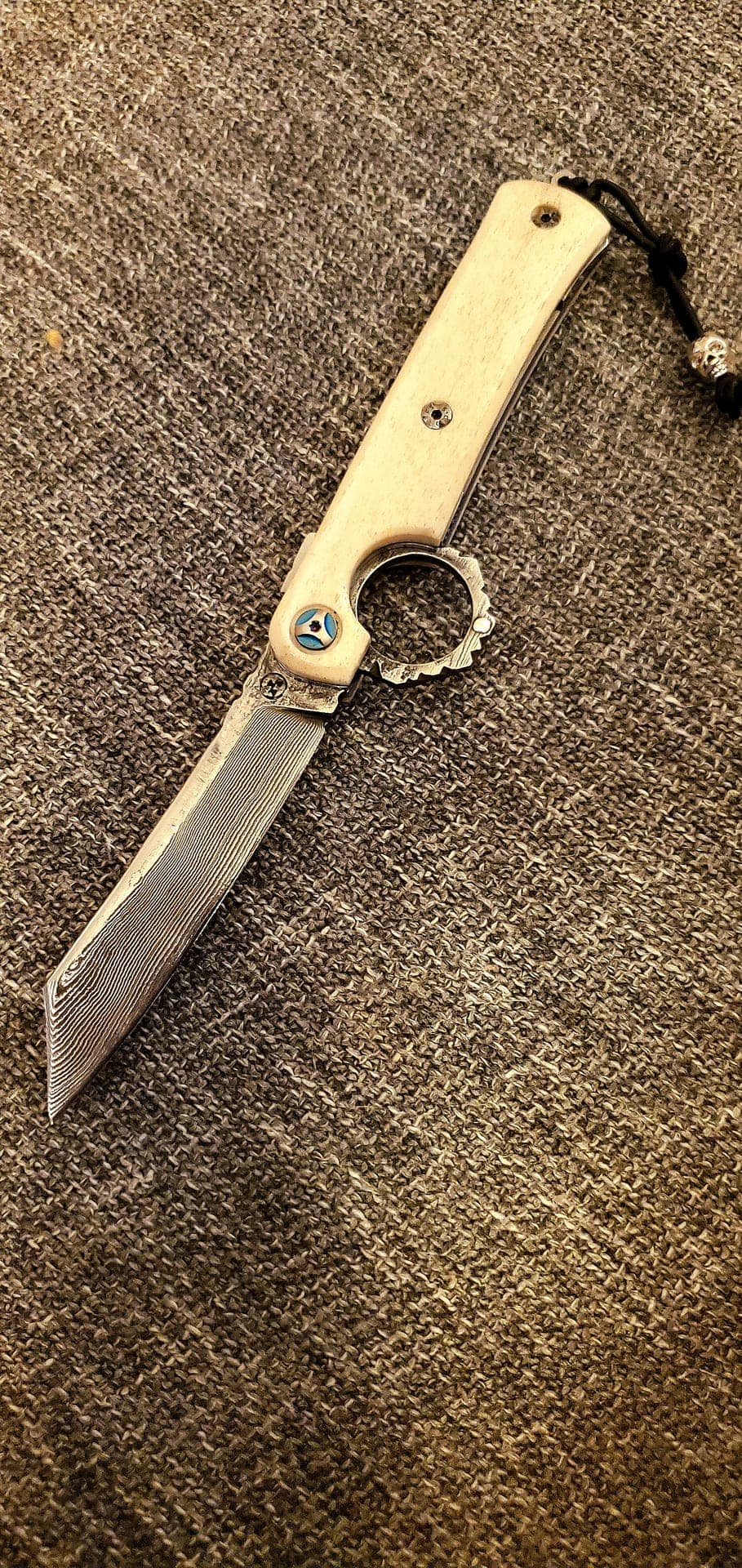
Quenching is a heat treatment that hardens steel: heated then rapidly cooled, it changes structure and gains hardness. At the workshop, an electric furnace controlled up to 1200°C quenches carbon steel between 790°C and 830°C, stainless steel around 1050°C, according to figures specific to the workshop and its furnace.
These temperature ranges are observations specific to Le Résiliant's workshop, given for its own steels and furnace; they may differ from one workshop to another depending on equipment and steel grades used. As for the general principle of quenching, heating to a critical temperature called austenitizing followed by rapid cooling, the CTIF (Centre Technique des Industries de la Fonderie, a French industrial technical body) notes that austenitizing starts around 723°C and that quenching temperature ranges from 780°C to 1250°C depending on the steel, which confirms the order of magnitude of the practices observed at the workshop, without replacing them.
The Mini Tanto, in N690 steel, and the Tracker, in 14C28N steel, both get a cryogenic quench, each in its own grade. That quench is carried out in industry: the workshop can't do it itself, since it calls for industrial facilities, large forced-air cold chambers that bring the blade down to a very low temperature, very fast, on top of the standard heat treatment. It's one of the reasons behind the partly outsourced production of these two models, covered in the next step.
Assembly: the One Step Never Outsourced
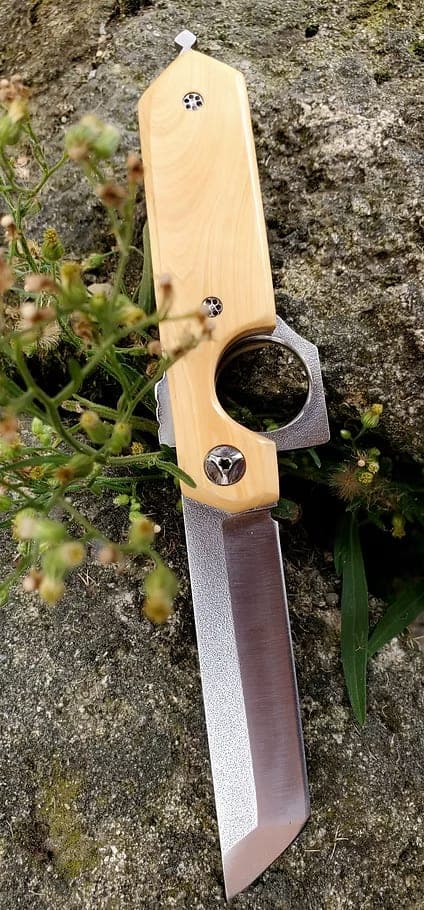
On six of the eight models, blade polishing as well as assembly, fitting the blade to the handle and the final adjustments, are done at the workshop in Thiers. On the Mini Tanto and the Tracker, polishing, drilling and the fitting of the parts are handled outside: assembly alone comes back to the bench.
Once quenched, the blade gets its bevels ground, then comes polishing, before assembly. The Mini Tanto and the Tracker embrace a semi-industrial process: cutting, heat treatment, bevel grinding and handle-shaping are handled by different outside facilities, each chosen for a specific operation, and to that list must be added polishing, drilling and the fitting of the parts, entrusted to a craftsman nearby. On these two models, it is assembly that comes back to the workshop: the cutler assembles these knives himself, onto a handle whose material is covered in a dedicated article, « Le manche d'un couteau : quels bois, quelles matières ? ».
On the six other models, none of this leaves the workshop: polishing, assembly and adjustments all stay at the bench. This is the stage where the knife takes its final shape and balance in hand, whether it's a damascus blade like L'Archétype or a semi-industrial model like the Mini Tanto or the Tracker.
- Is the Résiliant forged in Thiers?
- No. The workshop doesn't forge: it buys steel and damascus already in plates or bars, then cuts, treats and assembles every blade on site, in Thiers. This specialization of trades is documented in Thiers as far back as the 15th century.
- What is stock removal in knifemaking?
- Stock removal, the process of shaping a blade by removing material, means cutting the blade from a plate or bar of steel already milled to size, by scribing, cutting and grinding it, instead of shaping it with a hammer the way a blacksmith does. It's the method used at the Résiliant workshop.
- What is quenching and why does it matter?
- Quenching is a heat treatment that hardens steel by heating it and then cooling it rapidly. It determines the blade's hardness, edge retention and toughness.
- Why are the Mini Tanto and the Tracker partly made outside the workshop?
- The Mini Tanto and the Tracker embrace a semi-industrial process: cutting, heat treatment, bevel grinding and handle-shaping are handled by outside facilities, along with the cryogenic quench of their blades, which the workshop can't carry out itself, and along with polishing, drilling and the fitting of their parts. Assembly alone still happens at the workshop, in Thiers.
- Where does the workshop's damascus steel come from?
- Damascus isn't made at the workshop: it's bought already in plates or bars from specialized suppliers. The blades are then traced and hand-cut at Thiers, just like carbon or stainless steel. Pattern details are covered in the article « Acier damas : comment naissent les motifs d'une lame damassée ».
- What's the treatment difference between carbon steel and stainless steel?
- At the workshop, carbon steel is quenched between 790°C and 830°C, stainless steel around 1050°C. The Mini Tanto (N690 steel) and the Tracker (14C28N steel) also get a cryogenic quench carried out in industry, since the workshop doesn't have the facilities that treatment requires.
Sources
- CTIF — Centre Technique des Industries de la Fonderie, « Les mécanismes de la trempe des aciers » — Confirme l'ordre de grandeur des pratiques de trempe de l'atelier (austénitisation dès environ 723°C, trempe entre 780°C et 1250°C selon l'acier), sans s'y substituer.
- Coutellerie de Thiers — Wikipédia — Établit que la spécialisation des métiers coutelliers (martinaires, forgerons, limeurs, perceurs, émouleurs, polisseurs) est documentée dès le XVe siècle à Thiers, organisée en économie de la pièce dès le XVIIe siècle.
- Confrérie LE THIERS® — « Métiers de la coutellerie » — Institution professionnelle du bassin thiernois : liste aujourd'hui encore le forgeage comme un métier distinct de la découpe, du polissage et du façonnage du manche.
- Knife making — Wikipédia (EN) — Recense les procédés de fabrication d'un couteau et cite le stock removal, la mise en forme de la lame par enlèvement de matière, comme une alternative documentée au forgeage.