Every so often a customer comes back to the workshop with a knife that « no longer cuts ». Almost every time, the blade is fine: it is the edge, that last tenth of a millimetre, that has rolled over or rounded off with use. And almost every time, ten minutes on a stone bring it back to life.
Sharpening is not an art reserved for professionals. It is a simple skill, provided you understand what happens at the very edge of the steel and follow the few rules every cutler applies without thinking.
Here is the method as we practise it and teach it at the workshop: what to do, in what order, and above all what never to do.
Why a knife stops cutting
A cutting edge is a steel apex only a few microns thick. With use, that apex first rolls to one side, then rounds off through wear. The blade feels dull when, most of the time, straightening or reforming that edge is all it takes to restore the original bite.
Under a microscope, a knife edge is a V whose tip measures a few microns. That fineness is what cuts, and it is fragile: every pass on a cutting board, every contact with a bone or a cardboard staple bends or crushes it a little.
The edge starts by rolling over: the cut becomes uneven and the blade slides across a tomato instead of biting in. At that stage there is no need to remove metal at all; the apex only needs straightening. Keep forcing, and the edge eventually wears round: then the V must be reformed by abrading material from both sides.
And the edge's worst enemy is neither bone nor cardboard: it is the dinner plate. Ceramic is harder than the edge, and every stroke that taps or drags across the glaze while pressing down to cut a steak dulls it a little more. The habit to build: cut food across the plate, without crushing the edge against the ceramic.
Telling those two states apart is already half the method: you do not attack a merely tired edge with a coarse stone.
Honing and sharpening: two different acts
Honing straightens a rolled edge without removing metal: a few strokes on a butcher's steel are enough. Sharpening reforms the bevel by abrading steel on a stone. Hone often, sharpen rarely: that is the secret of blades that last.
The vocabulary matters, because it dictates how often you do each thing. Honing is routine care: ten seconds on a steel before or after use, and the edge stays straight for weeks. It is the butcher's gesture between two cuts.
That is exactly the advice handed over with every knife that leaves the workshop. The knife is delivered razor sharp; from then on, all the upkeep is done on a butcher's steel, one with medium ridges, and above all not a diamond steel: diamond removes too much material and turns routine care into wear. Handled well, that simple steel carries an edge a very, very long way.
Sharpening removes material. Every session on the stone consumes a little of the blade: indispensable once the edge has truly suffered, but pointless, even harmful, when it has merely rolled. The stone also takes practice: as long as the edge is maintained on the steel, it can wait for years.
One last cutler's trick, for camping or a holiday table: an upturned ceramic bowl makes an emergency hone. The unglazed ring under the bowl is just abrasive enough to straighten an edge, the same ceramic that ruins an edge in the plate revives it when you are the one guiding the stroke.
The stone method: constant angle, steady strokes
Set the stone on a stable base, present the blade at 15 to 20 degrees per side, and keep that angle identical on every stroke, heel to tip, alternating faces. Consistency of angle matters far more than pressure, which should stay light.
Everything starts with stability: a stone that moves makes a steady angle impossible. Wedge it on a damp cloth or a dedicated holder, at a comfortable height. If it is a water stone, soak it as long as the maker recommends; if it is an oil stone, a few drops are enough.
The angle is the heart of the craft. Fifteen to twenty degrees per side suits a pocket or kitchen knife: less and the edge grows fragile, more and the cut turns dull. To find and hold that angle, a workshop trick: blacken the bevel with a marker, make two strokes, and look where the ink has gone. Ink left at the very edge means raise the spine slightly; ink left on the shoulder means lower it.
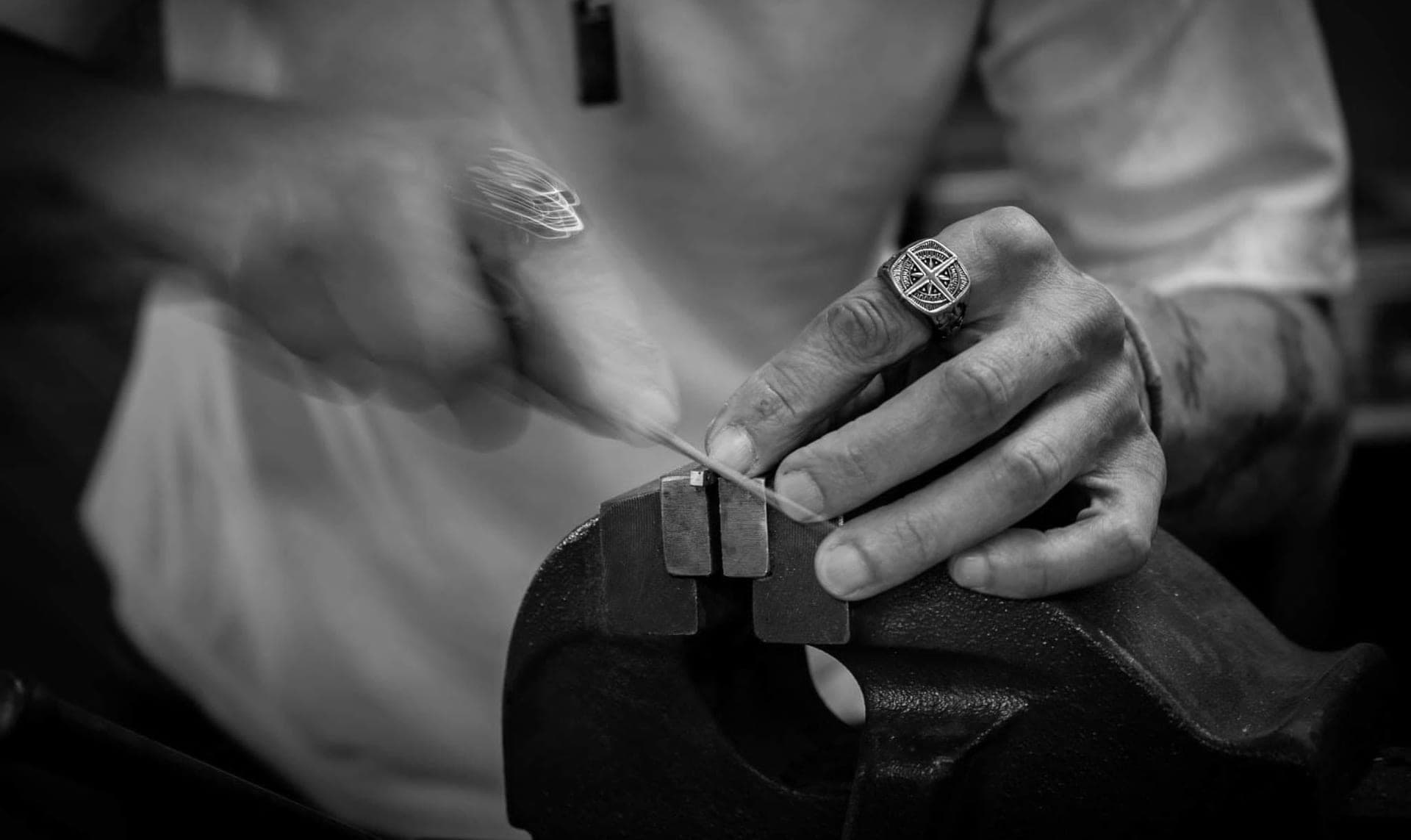
Then work in regular strokes from heel to tip, as if slicing a thin layer off the stone. Alternate faces in small groups of strokes, keeping the pressure light: the abrasive does the work, not the arm. On a badly worn blade, start at medium grit (400 to 800) before finishing fine (1000 to 3000).
The burr: the sign you are almost there
The burr is a fine ridge of pushed-over metal that forms along the whole edge when the two faces of the bevel finally meet. You feel it by brushing your thumb across, never along, the edge. Its presence proves the sharpening is complete; all that remains is to remove it.
The burr is the best friend of anyone learning to sharpen, because it is an objective signal. As long as it has not appeared, the two planes of the bevel have not yet met and you must carry on. When you feel it catch the pad of your thumb along the full length, on one side then the other after flipping the blade, the stone's work is done.
It must then be removed, because a burr left in place tears off in use and leaves a chipped edge. A few very light alternating strokes on the fine stone weaken it, then leather finishes the job: a dozen passes on a strop, blade drawn backwards, edge trailing never leading, and the apex comes out clean, aligned and polished.
The final test does not lie: a sheet of paper held in the air should slice silently, without snagging. If the blade tears in places, some burr or a missed spot remains.
The mistakes that ruin a blade
The three most destructive mistakes are the power grinder or bench wheel overheating the steel and destroying its temper, the angle changing on every stroke and rounding the bevel, and excess pressure that hollows the stone and fatigues the edge. None is easily repaired.
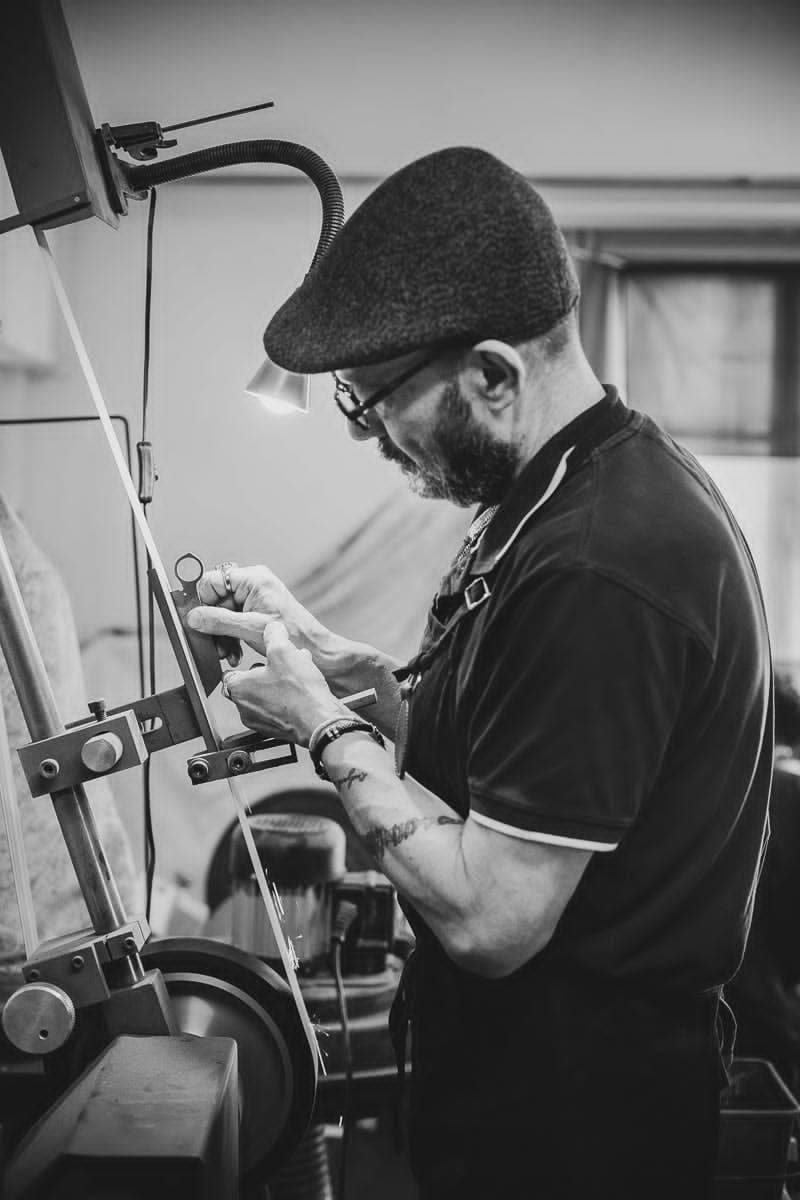
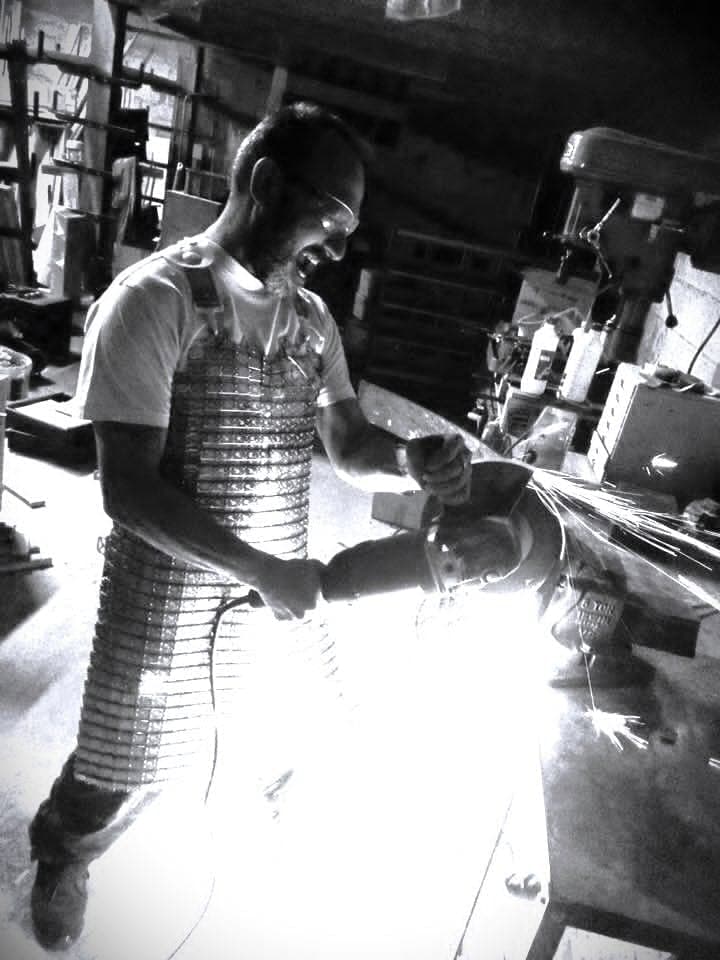
The worst is heat. A bench grinder climbs past the steel's tempering temperature in seconds: the edge turns blue, the heat treatment is locally destroyed, and that zone will never hold an edge again. At the workshop, material-removal machines are used with precise know-how, suitable belts and constant cooling; at home, they have no business near a knife.
Next comes the inconsistent angle. A hand that rocks on every stroke produces a convex, mushy bevel that never seems to get sharp despite hours on the stone. Ten slow, identical strokes beat fifty fast, different ones.
Add to that the hollowed stone that is never flattened and imposes its curve on the blade, the burr ripped off in a hurry that leaves a saw-toothed edge, and the forgotten drying: a carbon steel blade goes back in the drawer wiped and lightly oiled, or rust moves in at the first sign of damp.
- Never a power grinder or bench wheel: heat destroys the edge's temper.
- Do not press the edge into the plate while cutting: ceramic dulls a knife faster than use.
- One angle, held from heel to tip, on every stroke.
- Light pressure: the abrasive does the work, not the arm.
- Remove the burr on leather, never by test-cutting « to see ».
- Wipe and oil a carbon blade before putting it away.
- How often should a knife be sharpened?
- As rarely as possible. Regular honing on a butcher's steel with medium ridges (not diamond, which removes too much material), a few seconds before or after use, keeps the edge straight for weeks. The stone, which removes metal, only comes in once the edge has truly suffered.
- What sharpening angle for a pocket knife?
- Between 15 and 20 degrees per side, an inclusive angle of 30 to 40 degrees. Below that the edge becomes fragile against hard materials; above it the cut loses its finesse. What matters most is not the exact value but keeping it constant on every stroke.
- Water stone or oil stone: which to choose?
- Both sharpen very well. A water stone cuts fast and wears faster; an oil stone is slower but more durable. To start out, a combination 1000/3000 grit water stone covers most needs of a pocket or kitchen knife.
- Can a damascus blade be sharpened like any other?
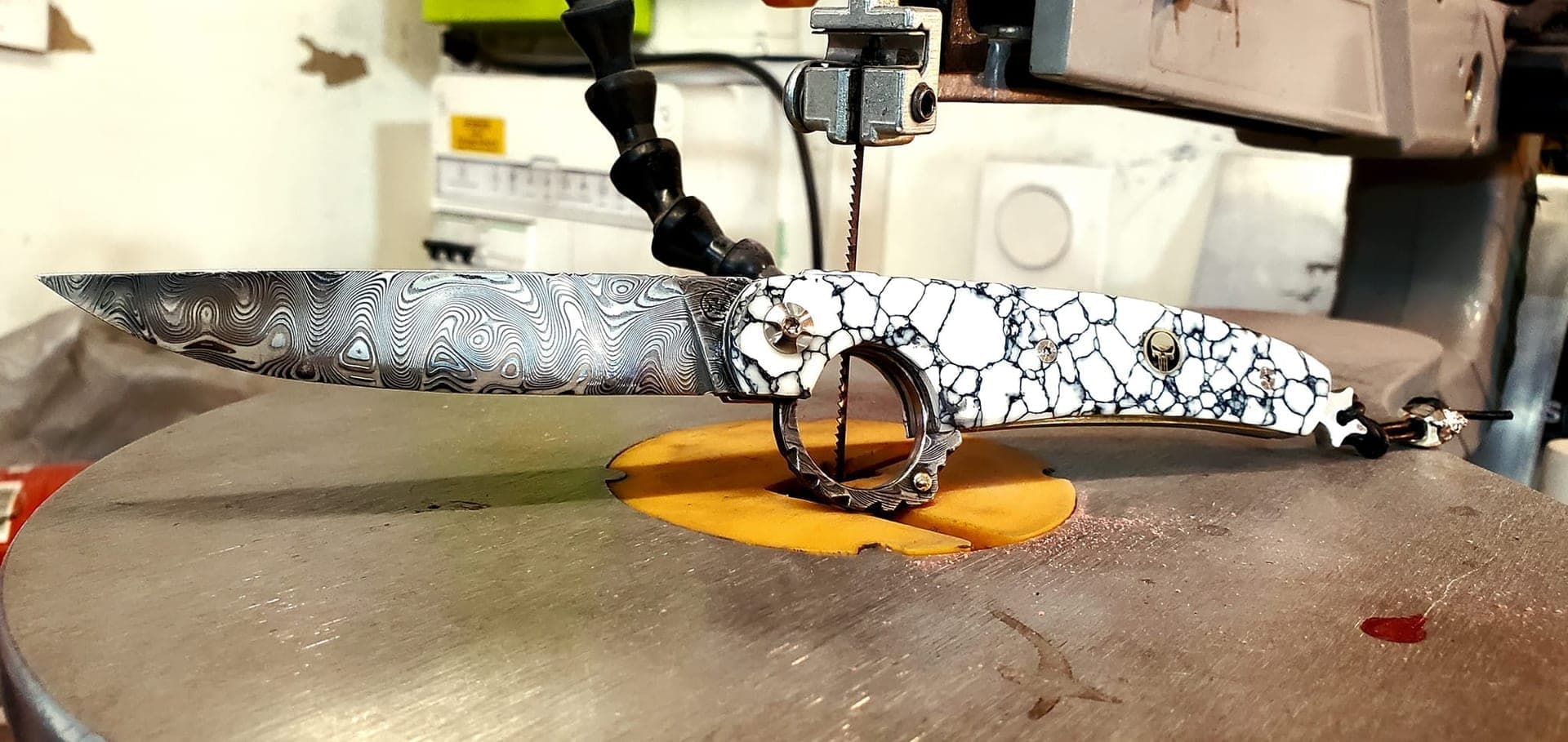
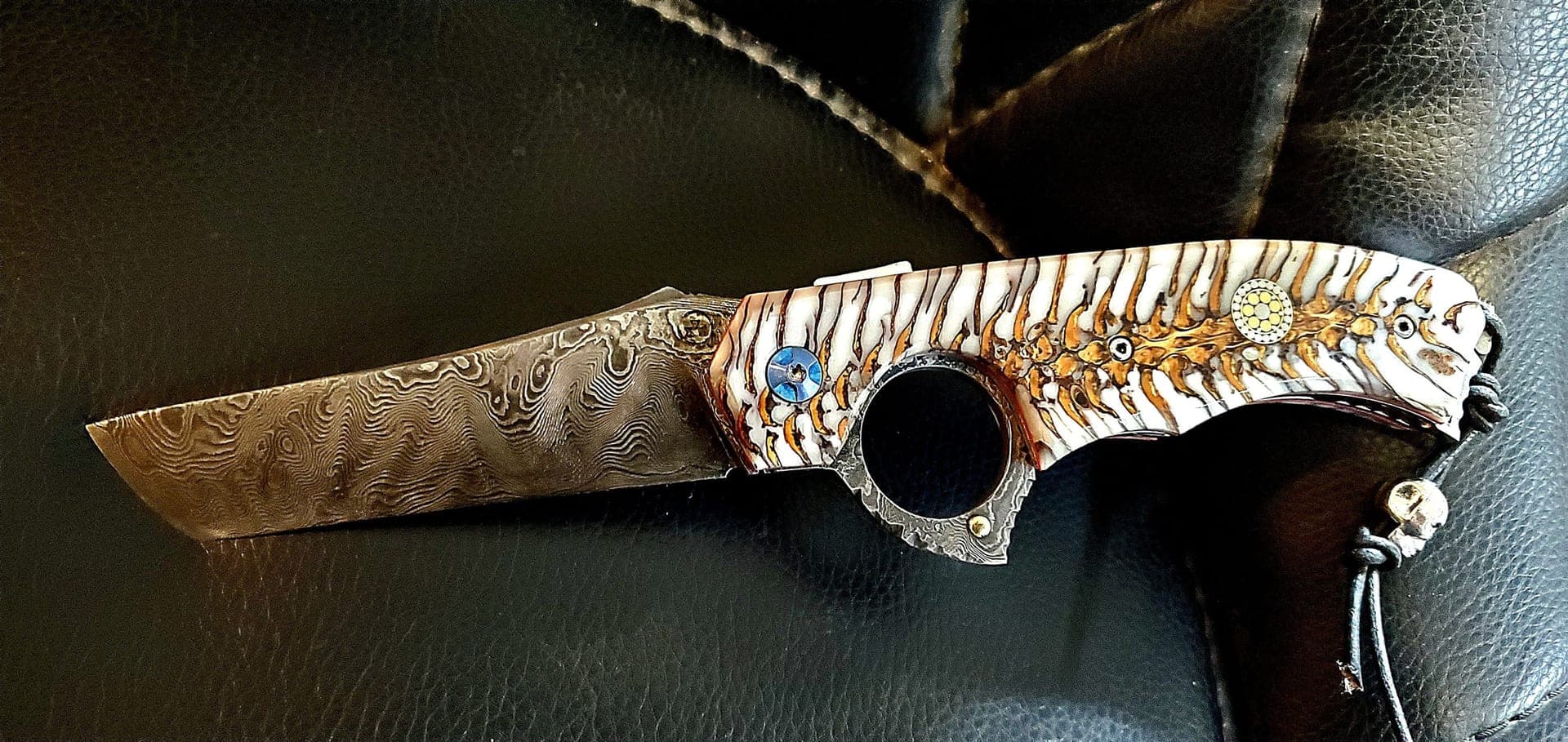
- Yes. A damascus blade sharpens exactly like a homogeneous one: stone, constant angle, burr, leather. The only precaution is to avoid very coarse abrasives that needlessly scratch the flats and their pattern. The acid etch that reveals the damascus does not concern the cutting bevel.
- Does a reverse-opening knife need different care?
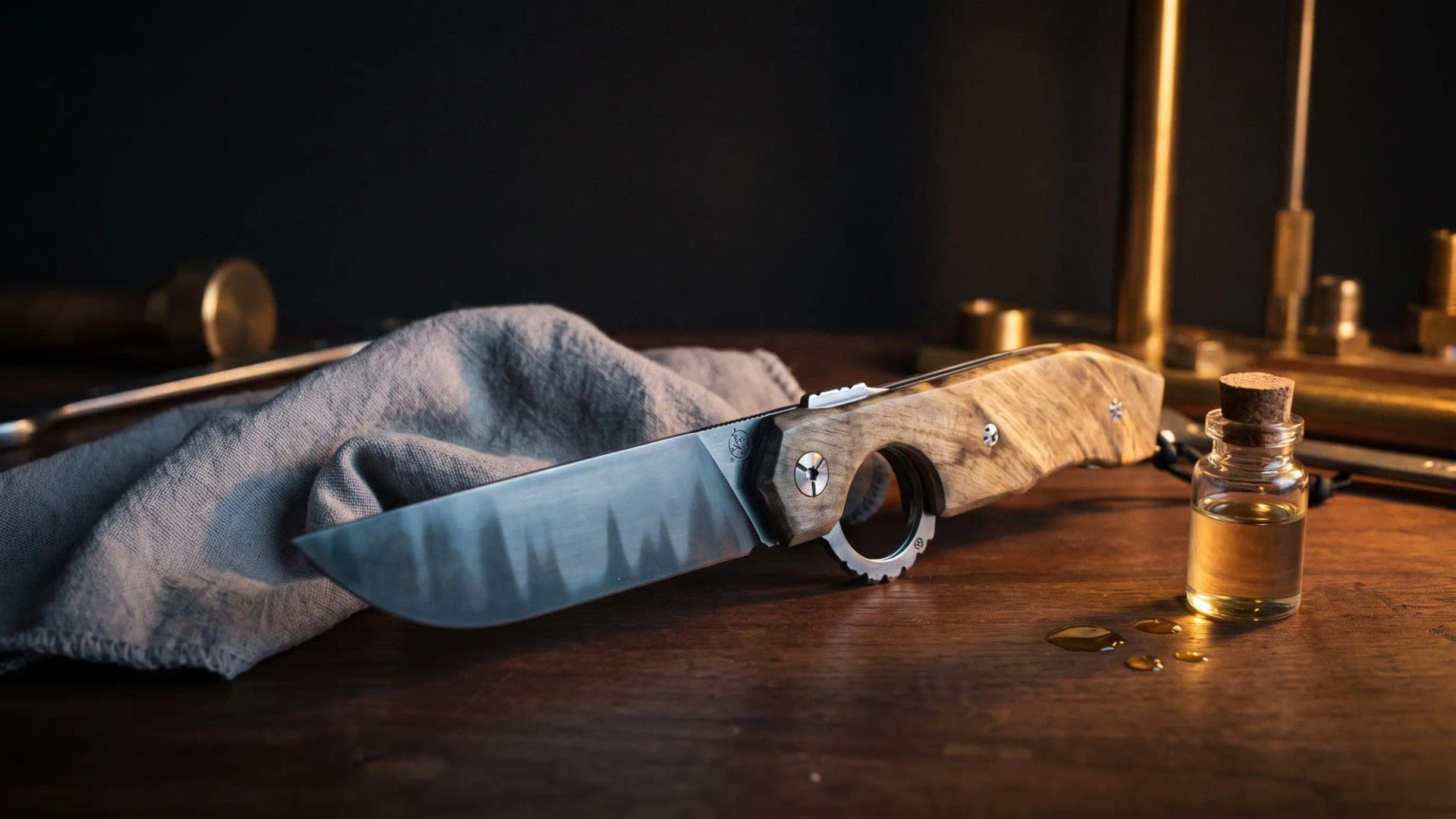
- Not for the edge: it hones and sharpens like any folding knife. The mechanism simply needs to be kept clean and dry. If in doubt about a part, better to stop by the workshop than to take it apart yourself.
Sources
- Aiguisage — Wikipédia — Principes généraux de l'aiguisage : abrasion, angle de taillant, granulométrie des pierres.
- Morfil — Wikipédia — Le bourrelet de métal repoussé qui se forme au fil de la lame pendant l'affûtage.
- Science of Sharp — Micrographies au microscope électronique de tranchants, de morfil et d'affilage sur cuir.
- Knife Steel Nerds — dossiers affûtage — Études techniques sur la géométrie du taillant, les angles et la tenue de coupe.