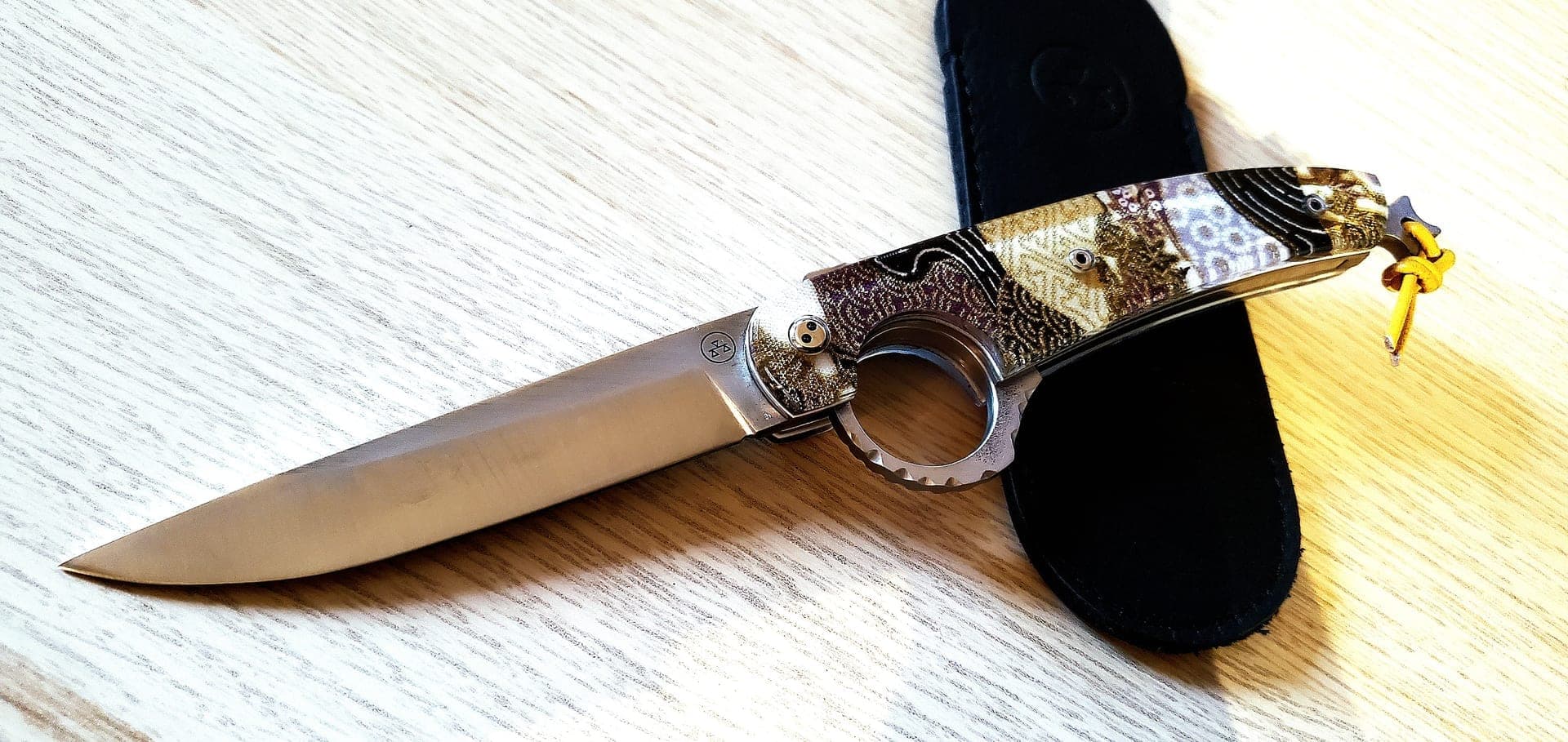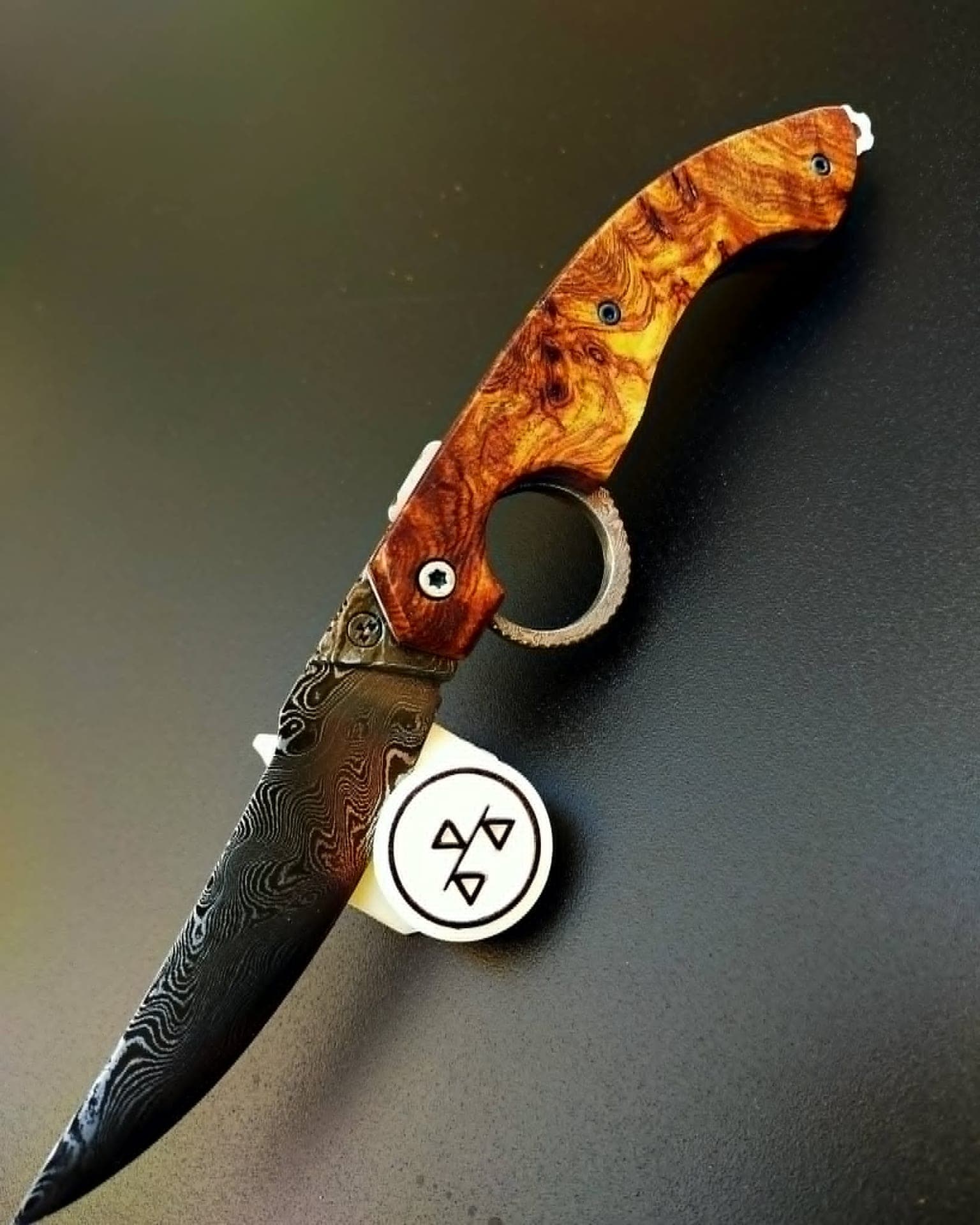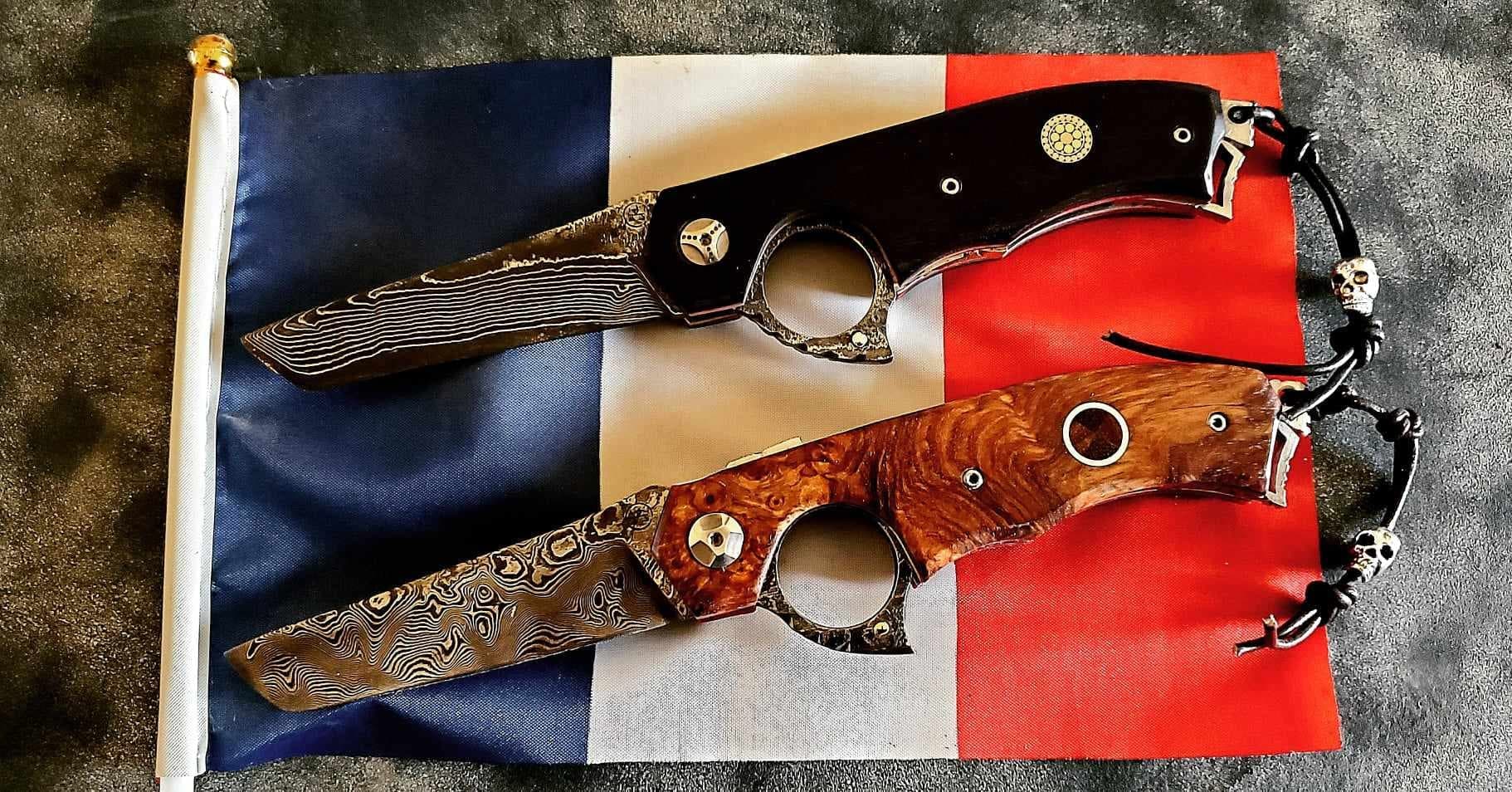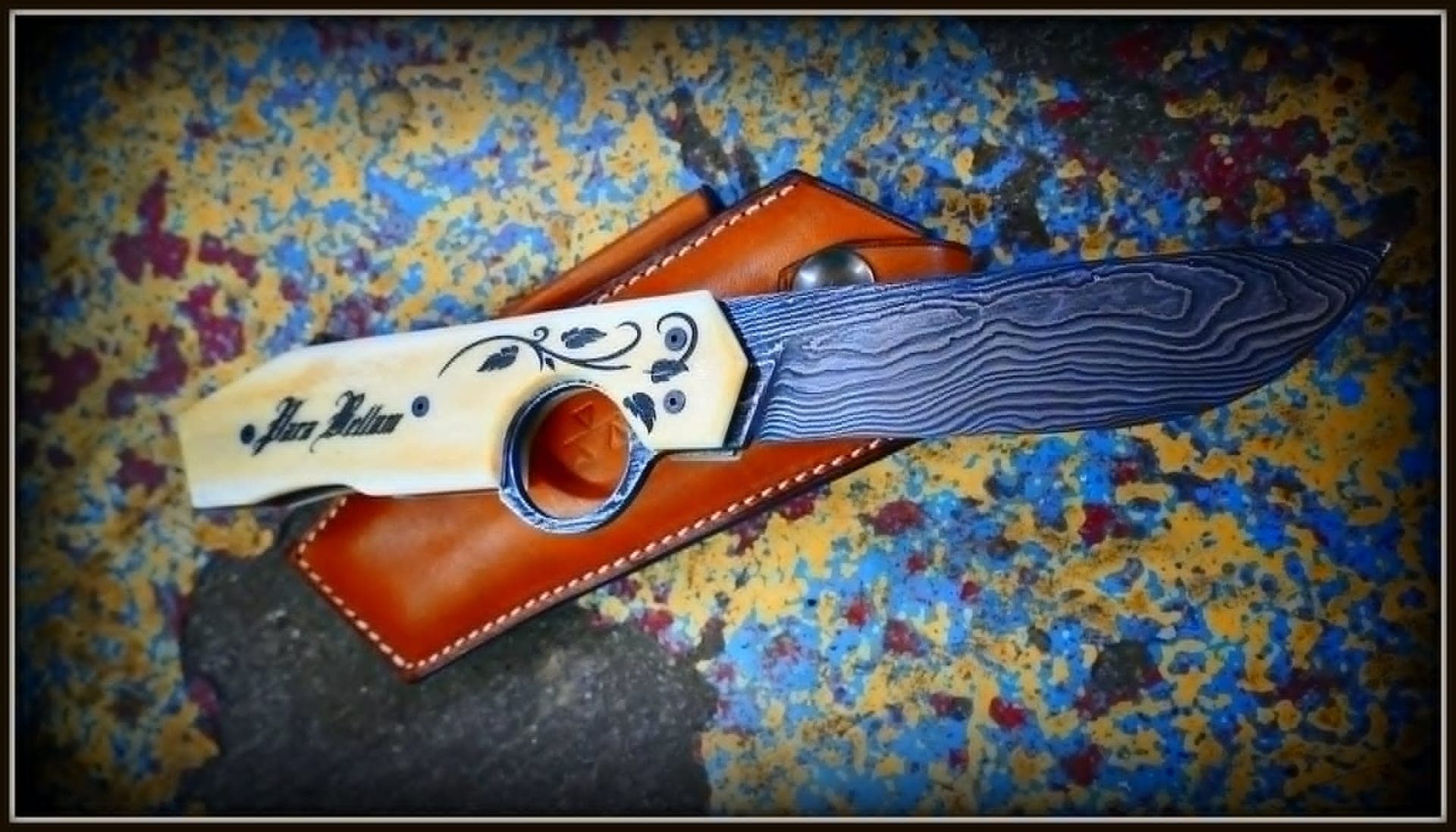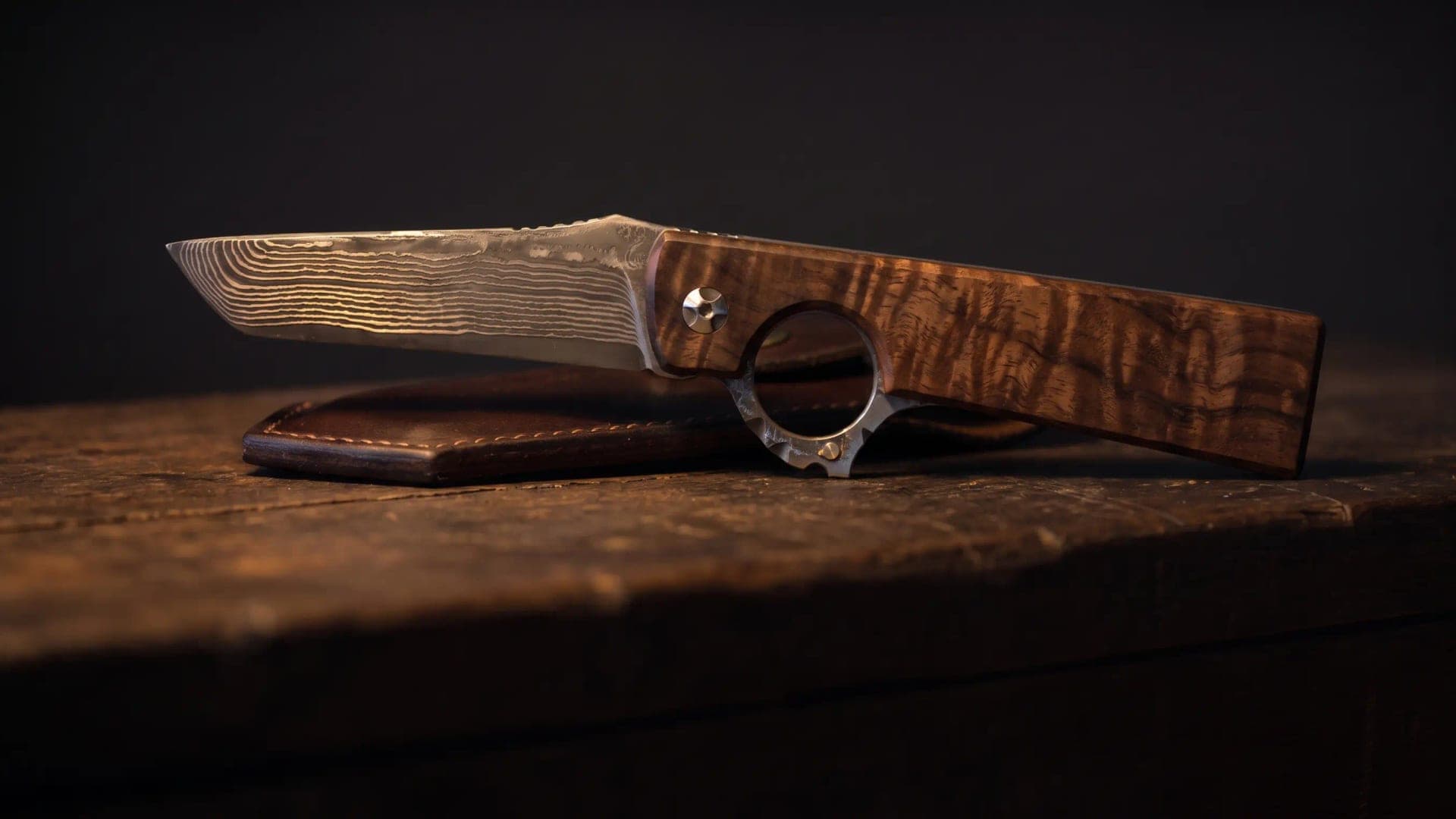
Typing "personalised knife" into a search engine often conjures up the same picture: a screen where you sketch the shape of a blade yourself, the length of a handle, the angle of a guard, the way you might configure a pair of trainers. At a cutler's workshop in Thiers, personalisation does not start from a blank drawing. It starts from a frame already set, worked out by the workshop itself, model after model.
At Le Résiliant, a cutler's workshop in Thiers, personalisation touches the steel, the handle material, the engraving and even the colour of the sheath. It never touches the knife's template: its proportions, its safety, the balance of its mechanism remain the workshop's decision alone, the only judge of what fits a hand and what does not.
Here, then, is what this bespoke work really allows: the choices that belong to the client, the ones that are never up for discussion, engraving and its limits, what the workshop accepts or turns down when a request steps outside the ordinary, and how all of it gets ordered, in Thiers, with no online shop.
Personalising a knife is not the same as drawing it
At a cutler's workshop, personalising a knife does not mean inventing its shape. The client chooses inside a frame set by the workshop: a model, a steel, a handle material. The drawing, the proportions and the balance of the mechanism remain the cutler's decision, the only one responsible for what the hand will hold.
The phrase "personalised knife" often suggests a configurator: choose the length, the angle, the shape of the tip, as if for a mass-produced object customised after the fact. In a craft workshop, the logic runs the other way. A cutler does not start from a blank page with every order: he starts from models that already exist, thought through, tuned, tested, and it is inside that base that bespoke work operates.
At Le Résiliant, the Thiers workshop behind the reverse-opening knife, the collection counts eight models, each with its own template. Personalising, here, means choosing among what exists and adapting it to yourself, not drawing a piece that has never been built. That distinction changes everything the workshop can promise a client, and it is exactly what an article on bespoke work should say honestly.
No judgement is intended on other ways of working: a digital configurator answers a real demand, that of a unique object drawn from scratch. A cutlery workshop answers a different demand, that of an object that has already proven itself, but in which much remains to decide: the steel, the handle material, the engraving, and even the colour of the sheath.
This honesty is not a reservation offered reluctantly. It is, on the contrary, what allows the workshop to keep its promises: a knife sold to order, with no fixed catalogue of possible configurations, but with a technical frame that had already proven itself before it welcomed its first personalised order.
The four choices that make a knife unique
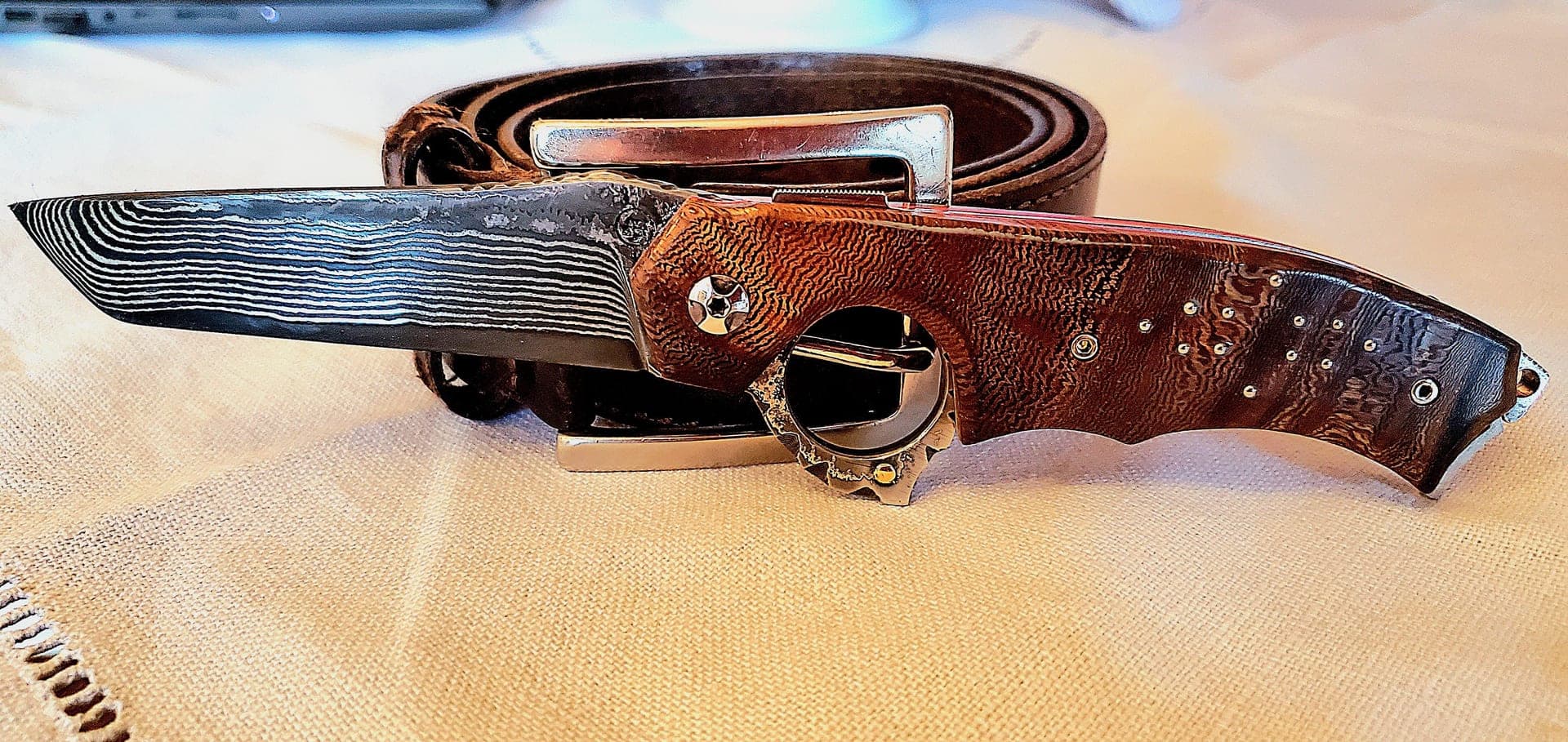
A Résiliant client decides on four things: the model, from among the eight in the collection, the steel, carbon, semi-stainless or damascus depending on the model, the handle material, and the colour of the leather sheath, chosen when the order is placed. These four decisions are enough to make two knives of the same model different.
The first choice is the model. Eight silhouettes make up the collection, from the Résiliant Tanto, the original model, to L'Archétype, reserved for collectors. The second choice concerns the steel: some models impose a fixed grade, others, such as Le Fhiers, let the client decide between carbon, semi-stainless or damascus. Le Fhiers is, in fact, presented by the workshop as the most personalisable model in the collection.
The third choice concerns the handle material: precious wood, carbon fibre or another material depending on the model, each with its own character and constraints. The subject deserves an article of its own, already written elsewhere in this Journal: the reader is pointed there rather than repeating it here, so as not to weigh down this page with what belongs next to it.
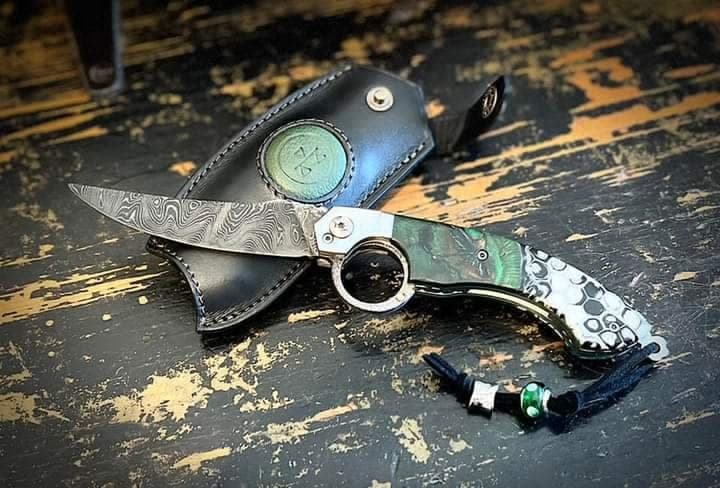
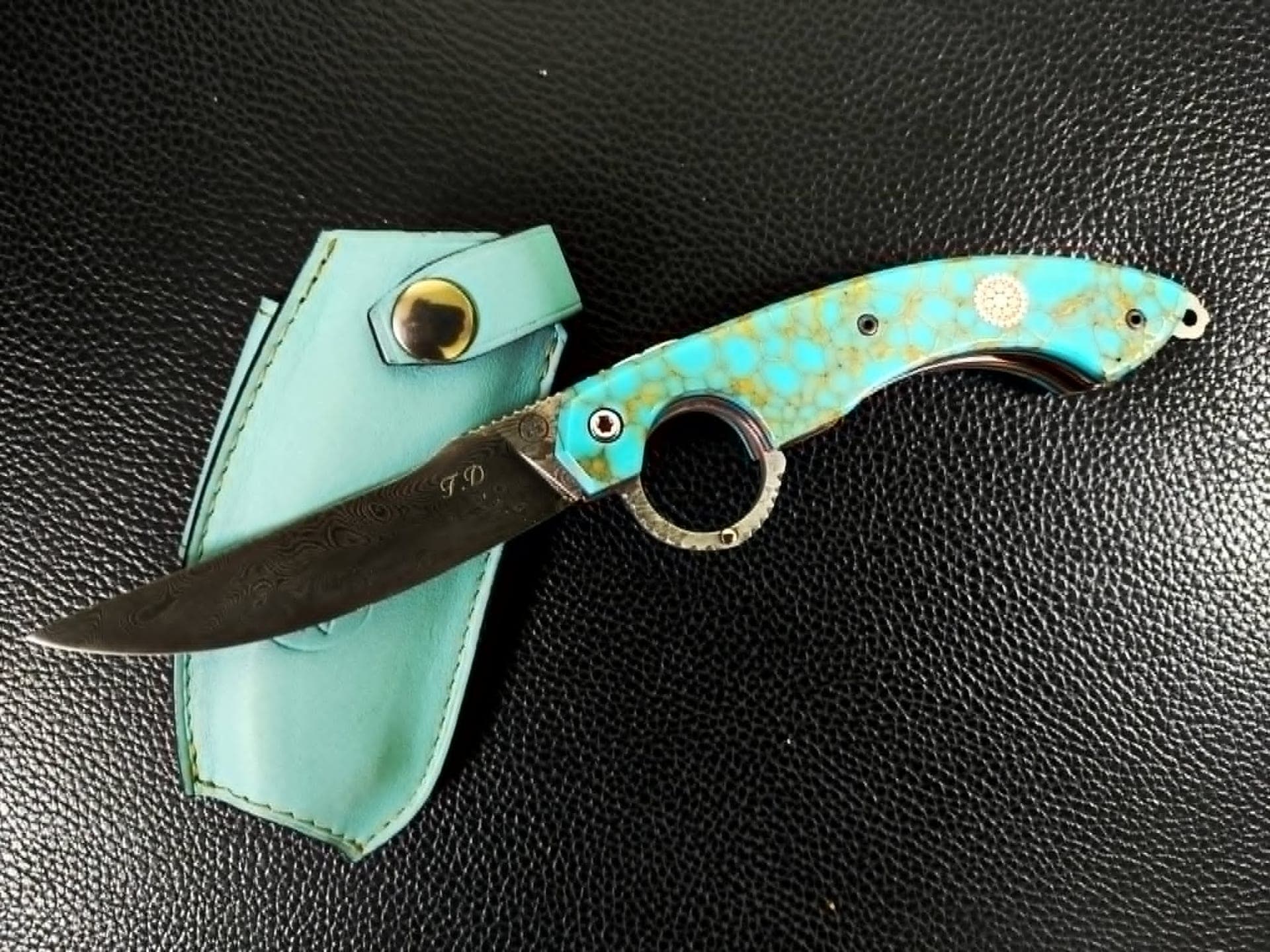
One fourth axis remains, less well known: the leather sheath, hand-stitched in Thiers by the VD Cuir workshop, a partner of the cutler's for seven years. It is chosen when the order is placed, like the rest, in plain leather or with a stud matched to the handle. Four decisions, in the end, are enough to make a knife built on the same template unique:
- The model, from among the eight in the collection.
- The steel or the damascus, depending on what the model allows.
- The handle material, chosen at the quote stage.
- The leather of the sheath, hand-stitched in Thiers, in plain version or with a stud matched to the handle.
The template itself is never up for negotiation
A model's template represents weeks, sometimes months, of tuning: proportions open and closed, the safety of the lock, the thickness of the liners and of the blade. The workshop bends this rule for no one. It is the trade-off for everything else: a stable frame, already proven on each model, is what makes bespoke work reliable rather than a gamble.
The cutler sums up the rule in one sentence, quoted here exactly as said: "I can give a client the knife's measurements, he cannot give me his own." Nothing is left to chance in a template: every model was worked out long before its first sale, and every knife is then set in a vice, piece by piece, so that the blade opens, locks and folds back without play.
L'Archétype, the collection's top-of-the-range model, shows what that work represents: five years of assembly, tuning and adjustment before it reached its current form. That kind of investment is not redone with every order. It is the price of a reverse-opening mechanism that has to stay safe, whatever steel or handle material is chosen around it.
How this reverse-opening mechanism works, unique to Thiers cutlery, is covered in a separate article on this Journal: here, it is enough to know that no personalisation ever touches its setting.
Engraving, from a first name to a design sent as a PDF
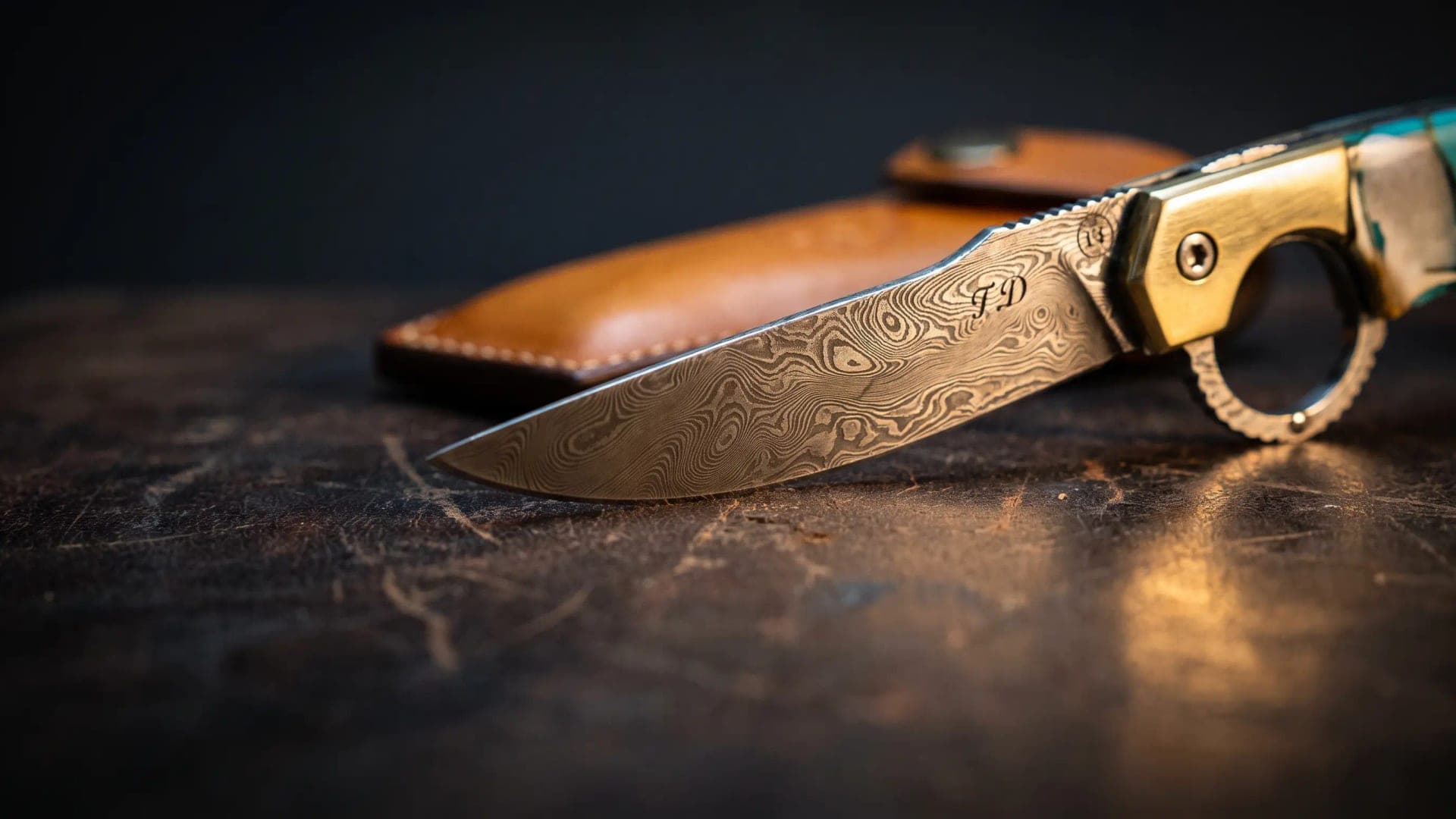
Engraving accepts initials, names, dates, phrases, and even a drawing sent by the client as a PDF file. It is a paid option, priced at the quote stage, decided at the same time as the model and the handle material. On damascus models, a small silver fish is already inlaid at no extra cost.
Almost anything can be engraved on a blade: a first name, a date, a whole sentence, interlaced initials. The only condition, for a more elaborate design than text, is to send a PDF file to the workshop. The cutler sums up his method in one sentence: "I take care of the rest."
Engraving is decided at the time of order, along with the choice of model and handle material: it is a paid option, whose amount is priced at the quote stage, not before. Engraving naturally meets the question of gifting, covered in the article devoted to giving a knife as a gift: there is no need to revisit it here.
Engraving should not be confused with another mark found on damascus models: a small silver fish, inlaid on every piece, the workshop's signature. On Le Mancharicou, compact, slim and unusual, this fish comes as standard on every damascus version, at no extra cost: it is not a requested engraving, it is a maker's mark.
None of this concerns the price of the engraving itself, which is not published and is only revealed at the quote stage, along with the rest of the order.
What the workshop accepts, and what it refuses
The workshop looks at unusual requests case by case, up to inlaying a personal object into the resin of a handle. It refuses, however, without exception, ivory, any material linked to poaching or protected species, and certain materials simply unsuited to the screwed construction of a Résiliant.
One recent request shows just how far that willingness goes: a motorcyclist once brought in a piece of rock picked up on a beach in Ireland, with the idea of having it inlaid into the resin handle of one of his models, in pink resin, on a wood with a pink tint. The request was accepted and remains, to this day, under study.
The cutler sums up his position in one sentence, which holds for every request that steps outside the ordinary: "I love a challenge: ideas can always be put to me, and then I say yes or no." Looking into a request does not mean accepting it automatically: it is a case-by-case judgement, depending on what the proposed material can or cannot take.
Some materials, by contrast, are refused outright: ivory, categorically, along with anything linked to poaching or protected species, tortoiseshell, snake or crocodile skins. The article devoted to handle materials sets out these refusals and their reasons, technical as much as ethical.
Another choice made only on request: the stabilisation of a wood, entrusted to an outside professional rather than carried out at the workshop.
In Thiers, a personalised knife is ordered on a quote
Every knife from the workshop is ordered on a quote, with no online shop and no stock on hand. The client chooses the model, the steel and the handle material, the lead time is given with the quote, and the leather sheath, hand-stitched in Thiers, is chosen with the order, like the rest, in plain leather or with a stud matched to the handle.
There is no online shop at Le Résiliant, no stock to draw from: every piece starts from a contact form, where the model can already be pre-selected, before being built in Thiers according to the choices made. The lead time itself is not announced in advance: it is given with the quote, and nowhere else.
The assembly method also plays a part in that confidence: the scales are screwed onto stainless steel liners, never glued. Glue, at this workshop, is reserved for fixed-blade knives, to seal their handles.
A personalised piece carries no right of withdrawal of the kind granted for distance purchases: French consumer law excludes from that right goods made to the consumer's own specifications, which is the case for a knife built to order. In Thiers, the sheath is chosen at the same time, in plain leather or with a stud matched to the handle, hand-stitched by the VD Cuir workshop in the town centre, a partner of the workshop's for seven years.
- Can a first name or a date be engraved on a knife's blade?
- Yes. Engraving accepts initials, a first name, a date or a whole sentence, and even a drawing sent as a PDF file. It is a paid option, whose price is revealed at the quote stage, decided at the same time as the model and the handle material.
- Can a knife be ordered fully custom-made, to a client's own dimensions?
- No. Each model's template is fixed by the workshop, which has spent weeks and months tuning it: proportions, safety, the thickness of the blade and of the liners. The client chooses the model, the steel and the handle material, never the knife's own measurements.
- Is engraving included in the price of the knife?
- No, it is a paid option, separate from the price of the knife itself. Its amount is not published: it is priced at the quote stage, depending on the text or the design requested, just like the steel or the handle material chosen by the client.
- Can you choose the handle material of your knife?
- Yes, it is one of the main choices left to the client, along with the model and the steel. Precious wood, carbon fibre or another material depending on the model: the subject is covered in detail in the Journal article devoted to knife handles.
- How long does it take to receive a personalised knife?
- No standard lead time is published by the workshop. The real timescale for an order is given at the quote stage, never before: a date that holds is worth more than an estimate ventured at random on a piece assembled by hand and personalised.
- Can a personal object be inlaid into the handle?
- The workshop looks at this kind of request case by case: a motorcyclist, for instance, asked for a fragment of rock picked up in Ireland to be inlaid into the resin handle of one of his models. The request was accepted and remains under study. Nothing is promised in advance.
Sources
- Légifrance, article L221-28 du code de la consommation — Établit l'exclusion du droit de rétractation pour les biens confectionnés selon les spécifications du consommateur ou nettement personnalisés.
- service-public.gouv.fr, « Achat à distance : droit de rétractation du consommateur » — Rappelle le délai de quatorze jours pour se rétracter d'un achat à distance, et ses exceptions, dont les biens personnalisés.
- Wikipédia, « Gravure » — Établit la définition de la gravure comme incision d'un motif dans une surface dure.
- Wikipédia, « Coutellerie de Thiers » — Sept siècles de coutellerie dans le bassin thiernois, qui produit aujourd'hui la majorité des couteaux fabriqués en France.