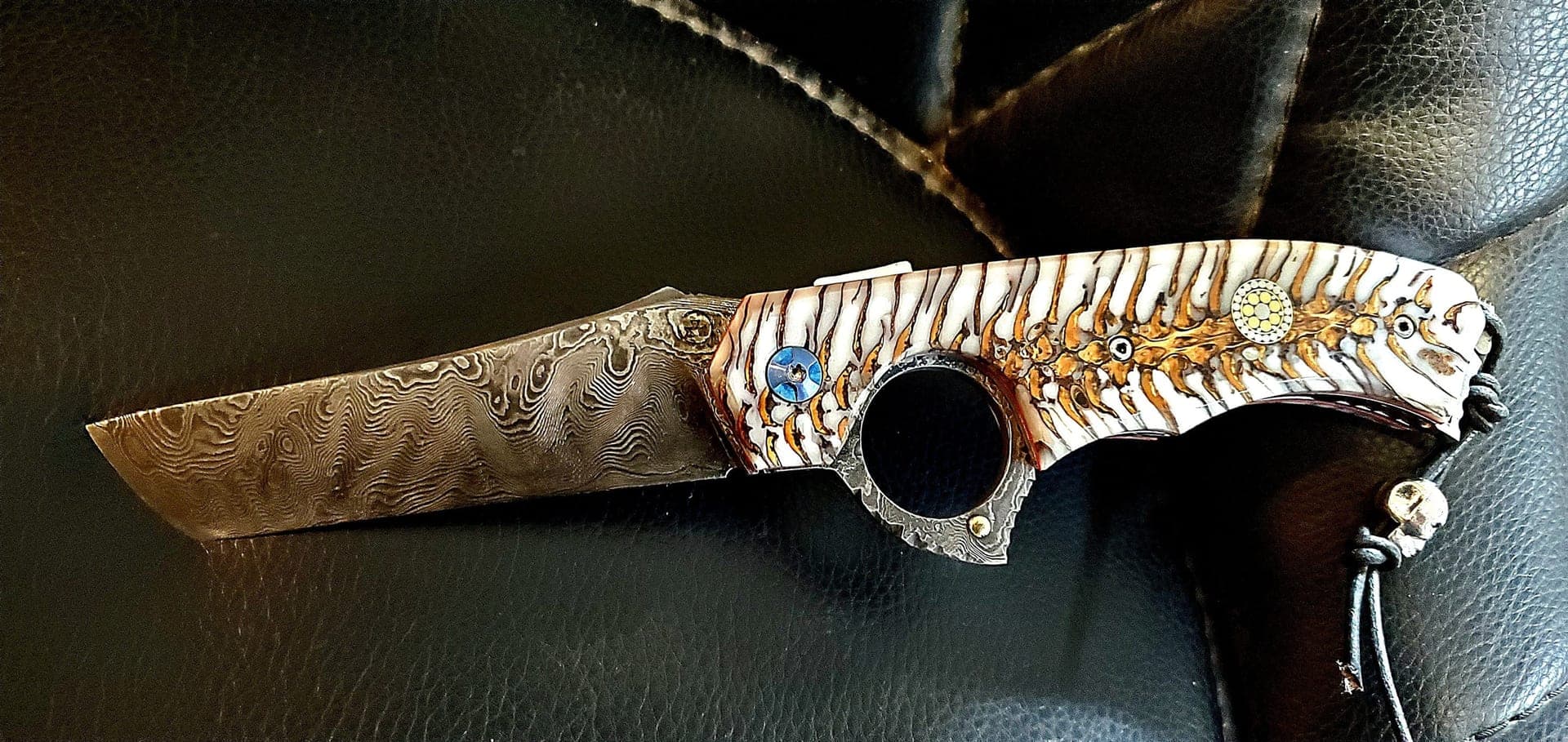
You choose a knife for its blade. You buy it for the steel, the pattern, the edge retention. Then you pick it up, and something else decides: the material settling into your palm, its density, its coolness, the way it grips or slides under your fingers.
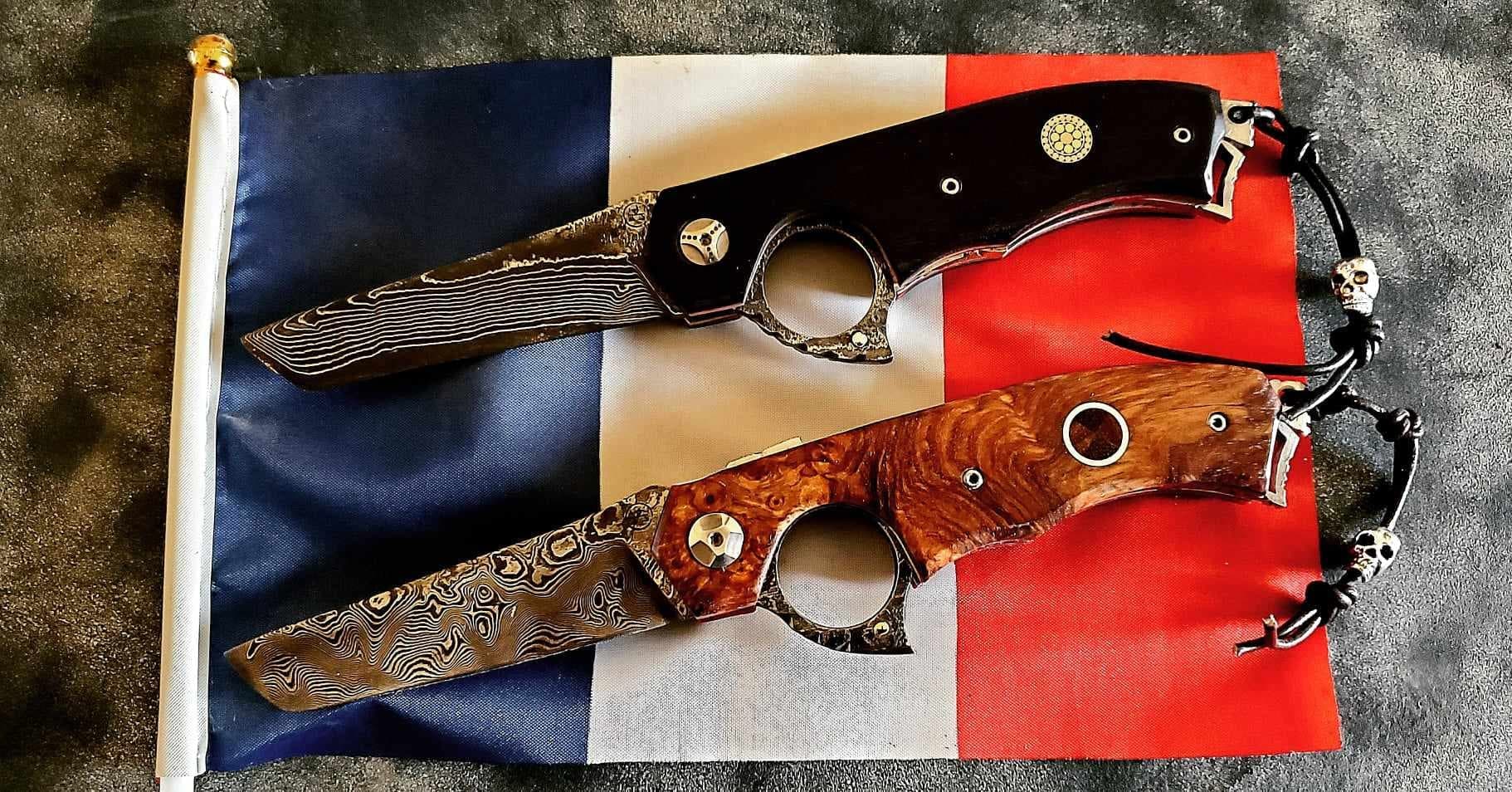
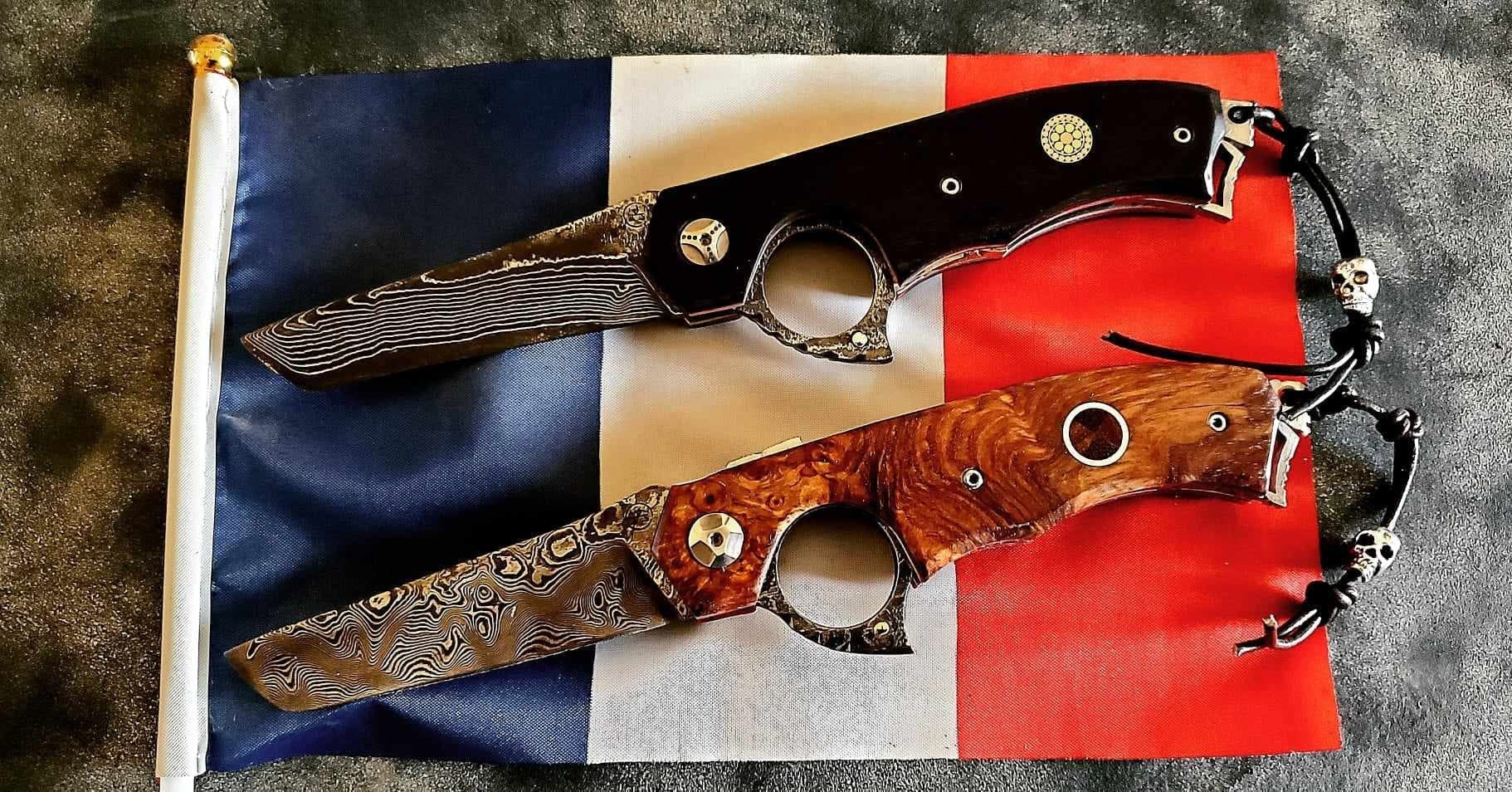
The handle is the only part of a knife your hand never leaves. It is also what changes most from one piece to the next: on two Archétype knives assembled at the same bench, the blade tells the same damascus story, the handle never does. One is dark and restrained, inlaid with a rosette; the other unfolds a light grain that exists only once.
Here is what is at stake in this half of the knife that nobody talks about: where the patterns come from, what a handle material really has to deliver, what happens when it is not wood at all, and how to care for yours.
The handle, the other half of the knife
The handle is the only part of a knife in permanent contact with the hand. It governs grip, balance and comfort while cutting far more than the blade does. It is also what makes every artisan piece unique: two knives in the same steel will never share the same handle.
A blade is judged on things you can measure: steel grade, hardness, grind angle, edge retention. A handle is judged in use, and use does not reduce to numbers. The hand has to settle in without thinking, the knife must not turn under load, and the material must still feel right after an hour of work, or after a winter spent in a pocket.
The handle also carries the mechanism. On a Résiliant, the reverse-opening ring emerges at the junction of blade and handle: the scales have to house the locking liner, take the pivot, and let the finger find the ring without hesitation. The material is therefore not a covering added at the end, it is part of the fitting.
And then there is what technical sheets never mention: the handle is what you look at. The blade folds away, the handle stays visible. It is what you show at the table, what ages in front of its owner, what makes you recognise your knife among ten others of the same model.
Burl and grain: where the patterns come from
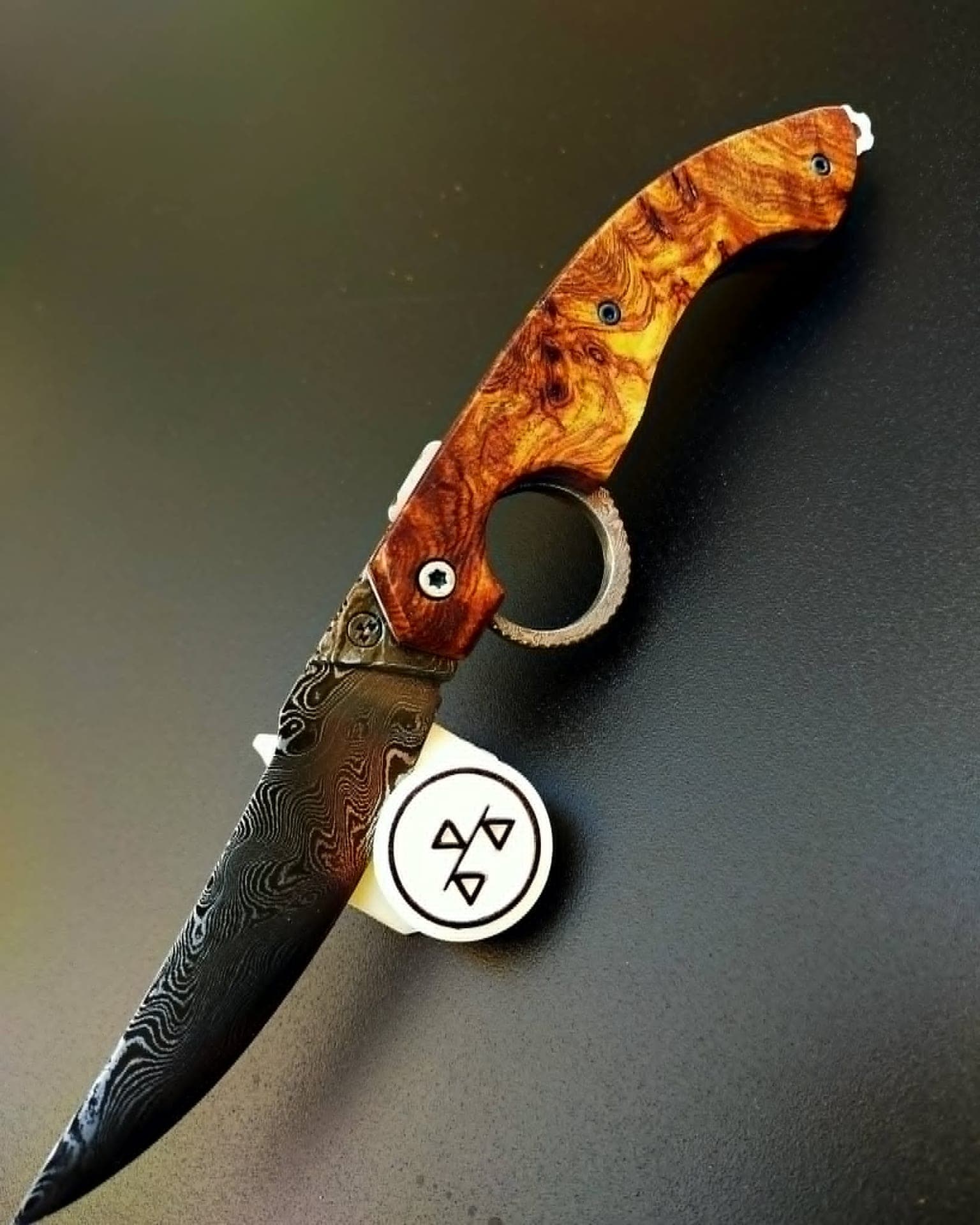
A burl is a growth on a tree caused by a wound, an insect bite or a fungal attack: cambium cells proliferate locally and produce wood with interlaced fibres. That disorder is what creates the eyes, swirls and depth prized on a knife handle.
Ordinary wood grows straight: its fibres follow the axis of the trunk, and a board cut from it shows parallel, regular, quiet grain. A burl does the exact opposite. It is reaction tissue, a local proliferation of cambium cells triggered by an aggression: a wound, an insect, a parasitic fungus.
The result is wood whose fibres run in every direction. Where a plain board shows lines, a burl shows eyes, tight knots and swirls that shift as the light moves. That is why cabinetmakers and small-goods craftsmen have always sought it out, and why a cutler saves it for the pieces meant to be noticed.
One direct consequence: a burl handle cannot be reproduced. The pattern belongs to one piece of wood and no other. Two knives from the same bench, in the same steel and with the same mechanism, will carry two different drawings. That is the cost of the material, and also the whole point of it.
What a handle material really has to deliver
A good handle material is dense, stable over time and indifferent to humidity. It must hold a screw without splitting, keep its dimensions as the air changes, avoid turning slippery in a damp hand, and survive daily carry without marking at the first knock.
Density comes first. Wood that is too soft crushes around the screws, marks at the slightest knock and eventually develops play. Handle materials are therefore chosen among the densest, the ones still hard under a fingernail years after assembly.
Stability comes next, and that is what really sorts them. Wood moves: it swells in damp air and shrinks as it dries. On a handle screwed between two steel liners, that movement is paid for in cracks or play. Hence the common cutlery practice of stabilised materials, impregnated with resin and then cured, which no longer move once fitted.
At the workshop, not every wood is stabilised, and that is a deliberate choice. Stabilisation is done on request, entrusted to a professional. A wood fitted in its natural state is glued onto spacers with epoxy resin, the same resin used to fill the hollows of a burl or to work the handle. And at buffing, the compound passed over the wheels leaves a grease that feeds and protects the wood left raw.
The rest is judged in the hand. Four points come up again and again at the workshop:
- Grip: a material polished too smooth turns slippery as soon as the hand is damp, one left too matt soils quickly. No varnish in cutlery: the shine comes from polishing, with the workshop's cotton buffing wheels and felts.
- Warmth to the touch: wood and horn stay mild, metal and stone stay cold. A detail, until the day you draw the knife in winter.
- Screw retention: a handle is taken apart to be serviced. On a Résiliant, the scales are screwed onto the stainless liners, never glued: the knife remains fully serviceable, and glue is kept for fixed-blade handles, where it seals against moisture.
- Ageing: a material that patinates well gains with time, one that dulls badly leaves you with a tired knife after two years.
When the handle is not wood
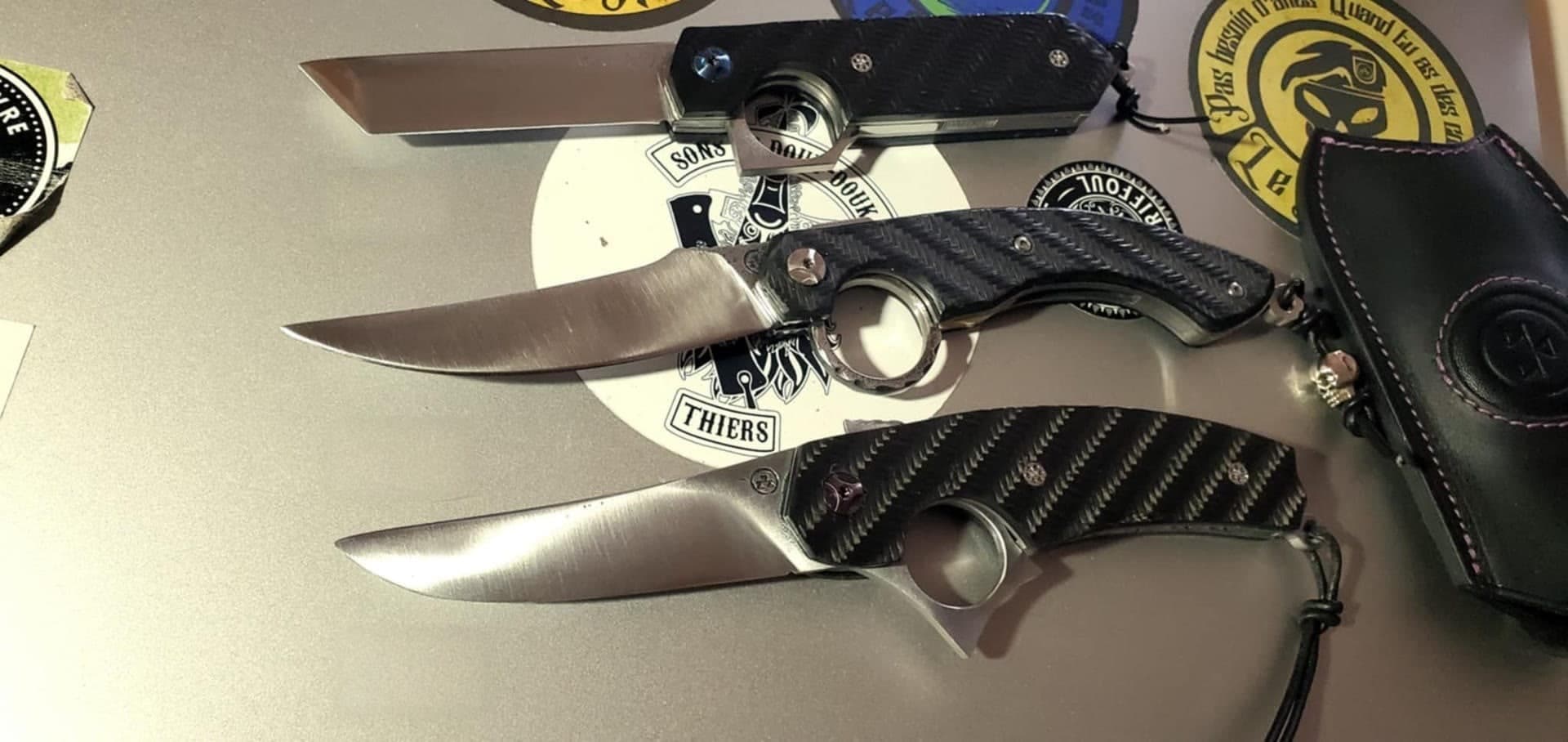
Wood is only one option among several. Carbon fibre, woven into sheets and then set in a matrix, offers high rigidity at a density of around 1.7. Then come aluminium honeycomb set in resin and reconstituted turquoise, each with its own character and constraints.
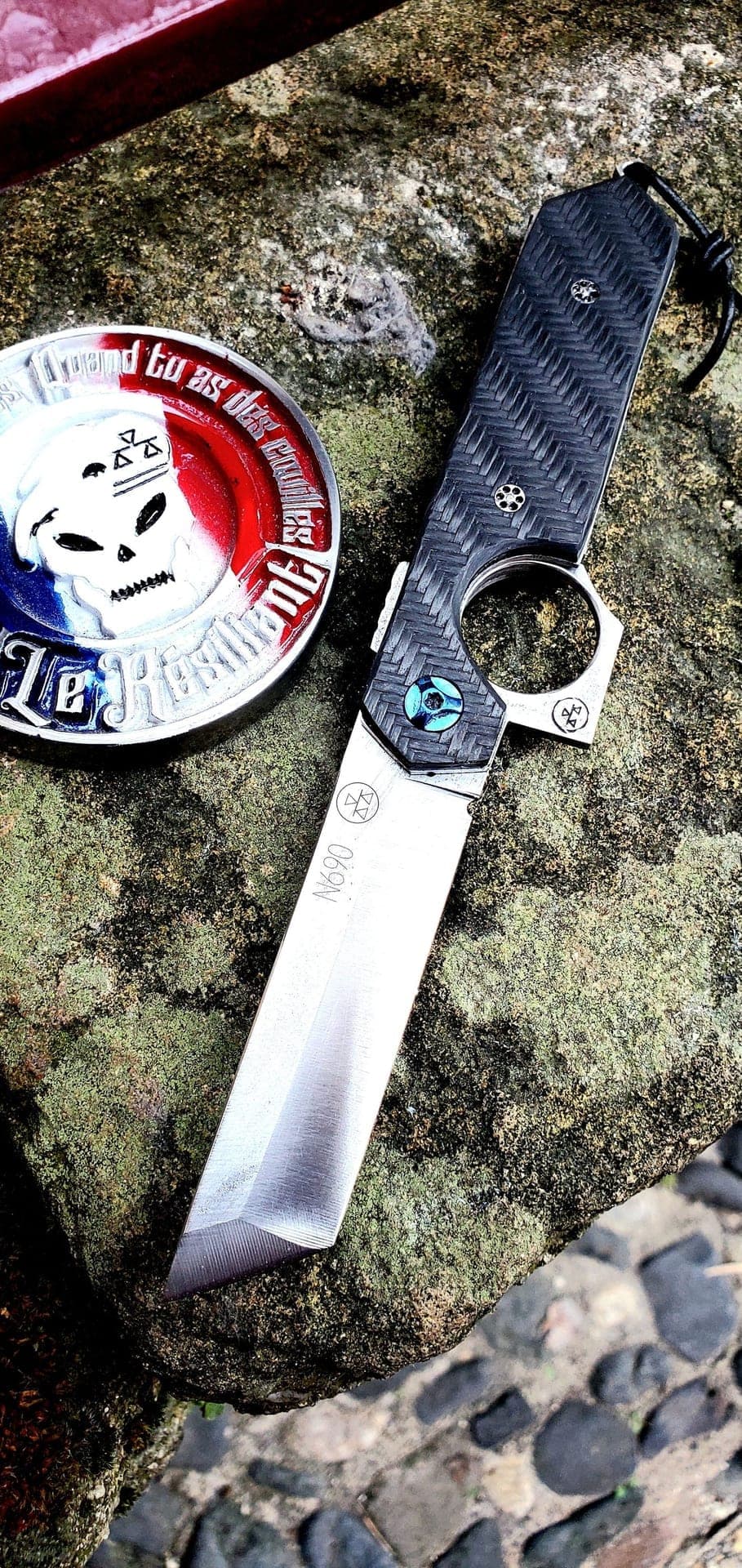
Carbon fibre is the rational choice. Made of more than 90% carbon by mass, produced as woven sheets into which a matrix is then infiltrated, it combines great rigidity with low density. On a handle, that means a light piece, immune to humidity, requiring strictly no maintenance. It is the material of the Mini Tanto, the most carefree of the Résiliants, the one you take everywhere without a second thought.
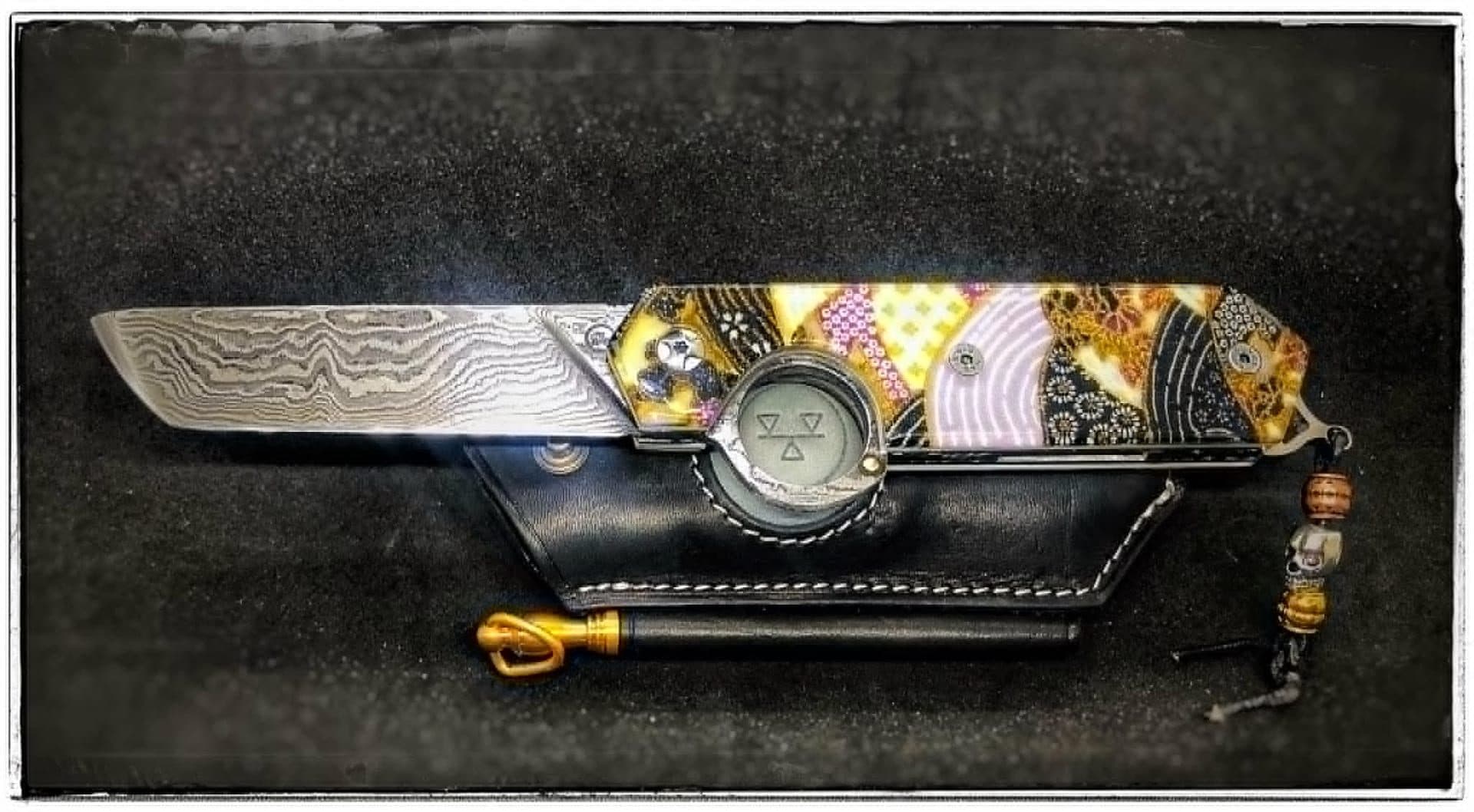
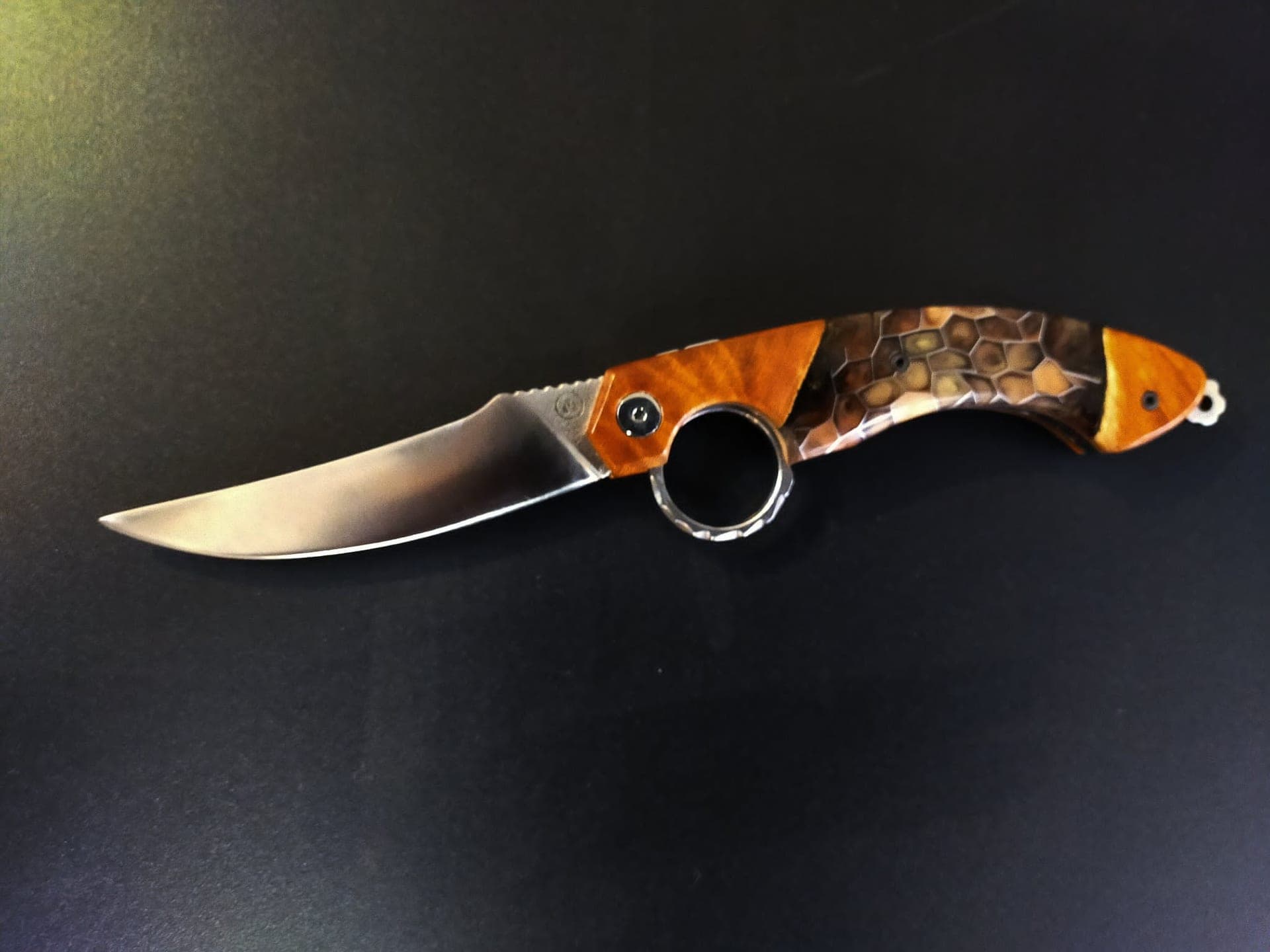
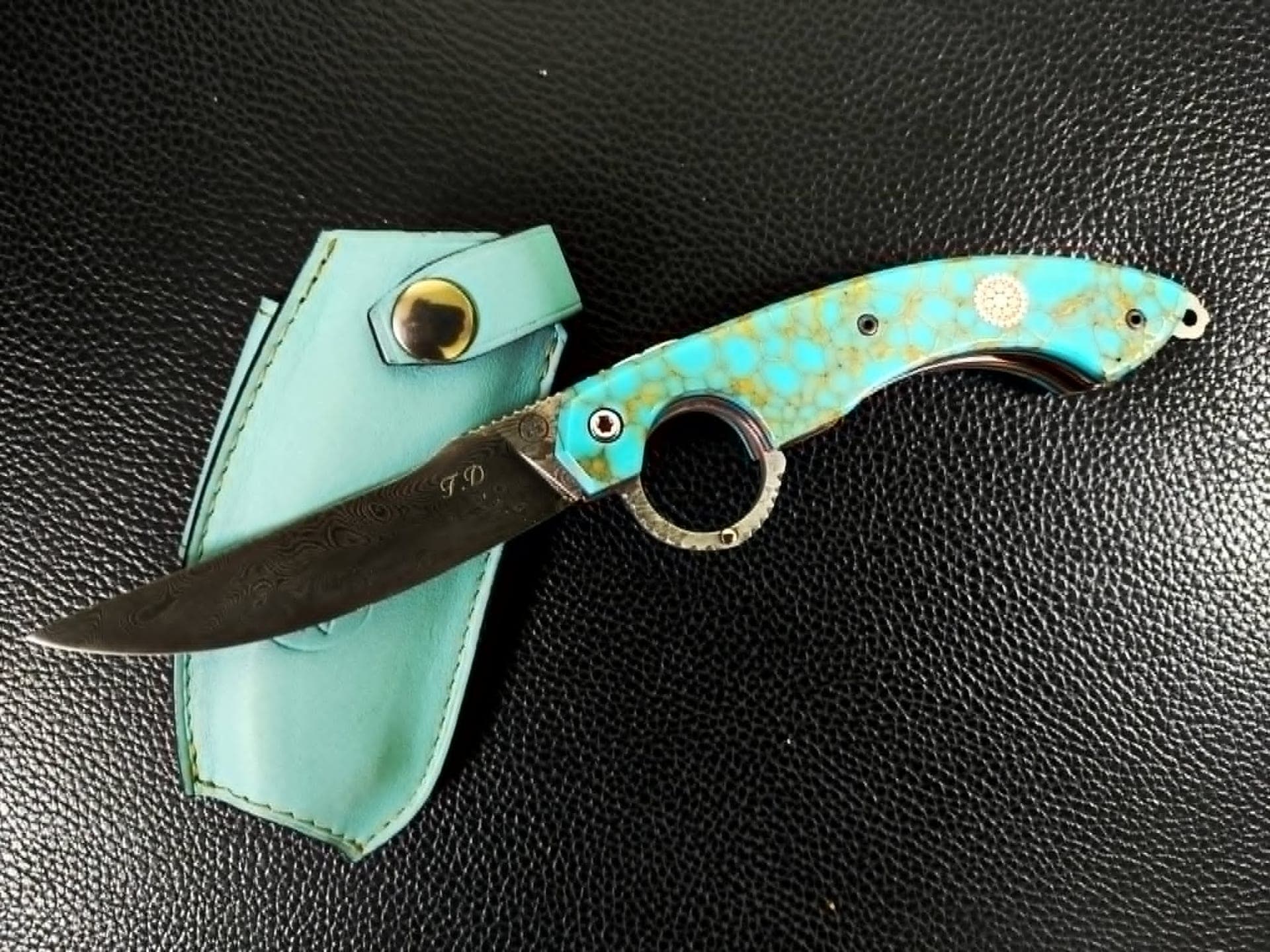
At the other end are the materials chosen for what they say. Honeycomb, first: aluminium cells flooded with resin in the mould. Cast with wood on either side, it produces what the workshop calls a hybrid handle, the one on the Mancharicou pictured above. And reconstituted turquoise: the stone is ground to powder and then bound with resin, which draws those golden veins that tip the knife firmly towards jewellery.
Neither family is superior: they answer different questions. Carbon fibre answers "I carry it every day and forget about it". Burl and turquoise answer "I want a piece that exists only once". With one workshop caveat on the latter: beautiful but fragile, reconstituted turquoise is kept for collection and display pieces, not for the knife that works every day.
The materials the workshop refuses, and why
The workshop categorically refuses ivory, strictly banned and against its ethics, and any material linked to poaching or protected species: tortoiseshell, snake or crocodile skins. It also sets aside warthog tusk, legal but brittle, expensive and unsuited to a knife built to be taken apart.
There are materials a cutler learns to say no to. The first is ivory, and the refusal is twofold. Legal, first: trading it is strictly forbidden. Ethical, second, and that is the reason the workshop holds to most. Yet the requests exist, and they are regular: people who own ivory, know they are breaking the law, and would like to see it mounted on an objet d'art. The answer is always the same: no.
The refusal extends to everything that comes from poaching and protected species: tortoiseshell, snake skins, crocodile skins. A handle is kept for decades; it has no business carrying that kind of story.
Last case, more unexpected: warthog tusk, which nothing forbids. The workshop leaves it aside for purely technical reasons: impossible to draw a proper flat from it, and the material is brittle, fragile, expensive and hard to work. It is simply not suited to a Résiliant.
At Le Résiliant, the material is chosen at the quote stage
No Résiliant is mass-produced: every piece is assembled to order in Thiers, and the handle material is decided directly with the cutler when the quote is drawn up. Woods from Burkina Faso lead the way, shea, ebony, padauk, selected roots, alongside amboyna burl and pink ivory wood.
That is the practical consequence of a workshop that builds to order: there is no fixed catalogue of handles, there is a conversation. The species, now that they can be named, come largely from Burkina Faso: shea, ebony, padauk, the roots of certain trees. To these are added amboyna burl and pink ivory, a rare wood that shares nothing with ivory but its name: it really is pink. Le Mancharicou, the smallest and most dressed-up of the collection, carries these precious woods; its damascus versions also receive a small inlaid silver fish, the workshop's signature, at no extra cost.
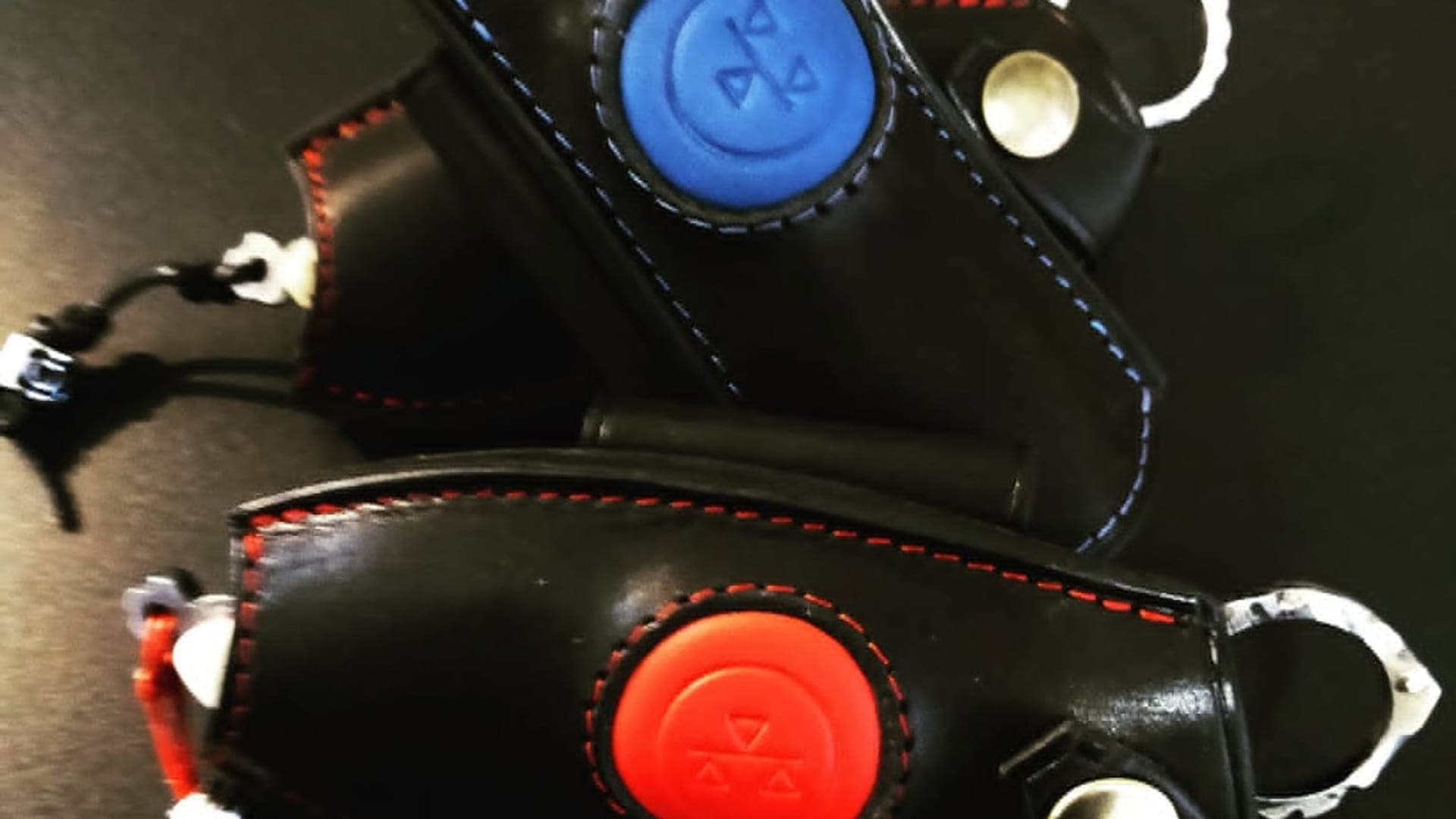
Bespoke work does not stop at the handle. A made-to-measure hand-stitched leather sheath can be added as an option, in plain leather or with a tab matching the handle; a blade can be engraved with its owner's initials. The knife then stops being a model and becomes someone's, which is precisely why a seven-square-metre workshop in Thiers exists rather than an assembly line.
A word on lead times, since the question always lands at this point in the conversation: a piece built to order depends on the workshop's order book and on the options chosen, and the timescale is given with the quote, never before.
Caring for a handle, without overdoing it
A wooden handle asks for little: keep it dry, away from heat sources and direct sunlight, and store it in its leather sheath rather than at the back of a drawer. No dishwasher, no soaking. Carbon fibre and composite handles ask for nothing at all.
The two enemies of a wooden handle are water and dry heat. Water makes it swell and then crack as it dries; heat, a radiator or a car parcel shelf in summer, works the material until the scales lift. Wiping after use and storing it dry is enough to avoid both.
The vegetable-tanned leather sheath is more than a carrying accessory: it is also the best place to let the piece rest between uses. It protects against knocks, keeps the knife away from light and prevents the rubbing that dulls a careful finish.
For the rest, restraint is the rule. A stabilised handle does not need oiling, and furniture wood care products have no place on a piece of cutlery. If a scale develops play after years of carry, it is refitted at the workshop, on the original piece: that is the advantage of a knife built by hand rather than assembled in series.
- Which wood should you choose for a knife handle?
- A dense, stable wood, meaning one that no longer moves with humidity. At the workshop, the species range from ebony to shea, by way of padauk, amboyna burl and pink ivory. Stabilisation, entrusted to a professional, is done on request; the final choice depends above all on the intended use.
- What is a wood burl?
- A growth on a tree formed in reaction to a wound, an insect bite or a fungal attack: cambium cells proliferate locally and produce wood with interlaced fibres. That disorder is what creates the eyes and swirls visible on a handle.
- Is a carbon fibre handle stronger than a wooden one?
- It is above all more rigid, lighter and completely immune to humidity, which makes it ideal for a knife carried every day with no maintenance. A dense, stabilised wood also holds up very well; it brings, on the other hand, a unique pattern that carbon does not have.
- How do you care for a wooden knife handle?
- Keep it dry and away from heat sources or direct sunlight, and store the knife in its leather sheath. No dishwasher, no soaking, no furniture wood care products. A stabilised handle does not need oiling.
- Can you choose the handle material of your Résiliant?
- Yes. Every Résiliant is assembled to order in the Thiers workshop: the handle material, the finish and the leather sheath are decided directly with the cutler when the quote is drawn up. Le Mancharicou in particular is offered in precious wood from Burkina Faso, with a small silver fish inlaid on damascus versions.
- Which materials will a cutler refuse to mount?
- At the workshop, ivory is categorically refused: trading it is banned, and the refusal is also a matter of ethics. The same rule applies to any material linked to poaching or protected species, tortoiseshell and snake or crocodile skins. Warthog tusk, though legal, is set aside as brittle, expensive and unsuitable.
Sources
- Broussin (loupe de bois) — Wikipédia — Formation de la loupe : prolifération locale des cellules du cambium en réaction à une blessure, une piqûre d'insecte ou une attaque de champignon, donnant un bois à fibres enchevêtrées prisé en ébénisterie.
- Fibre de carbone — Wikipédia — Composition (plus de 90 % de carbone en masse), densité de l'ordre de 1,7 et mise en œuvre en composite : nappes tissées dans lesquelles une matrice est ensuite infiltrée.
- Coutellerie de Thiers — Wikipédia — Sept siècles de coutellerie dans le bassin thiernois, où le montage et l'ajustage du manche restent un métier à part entière.