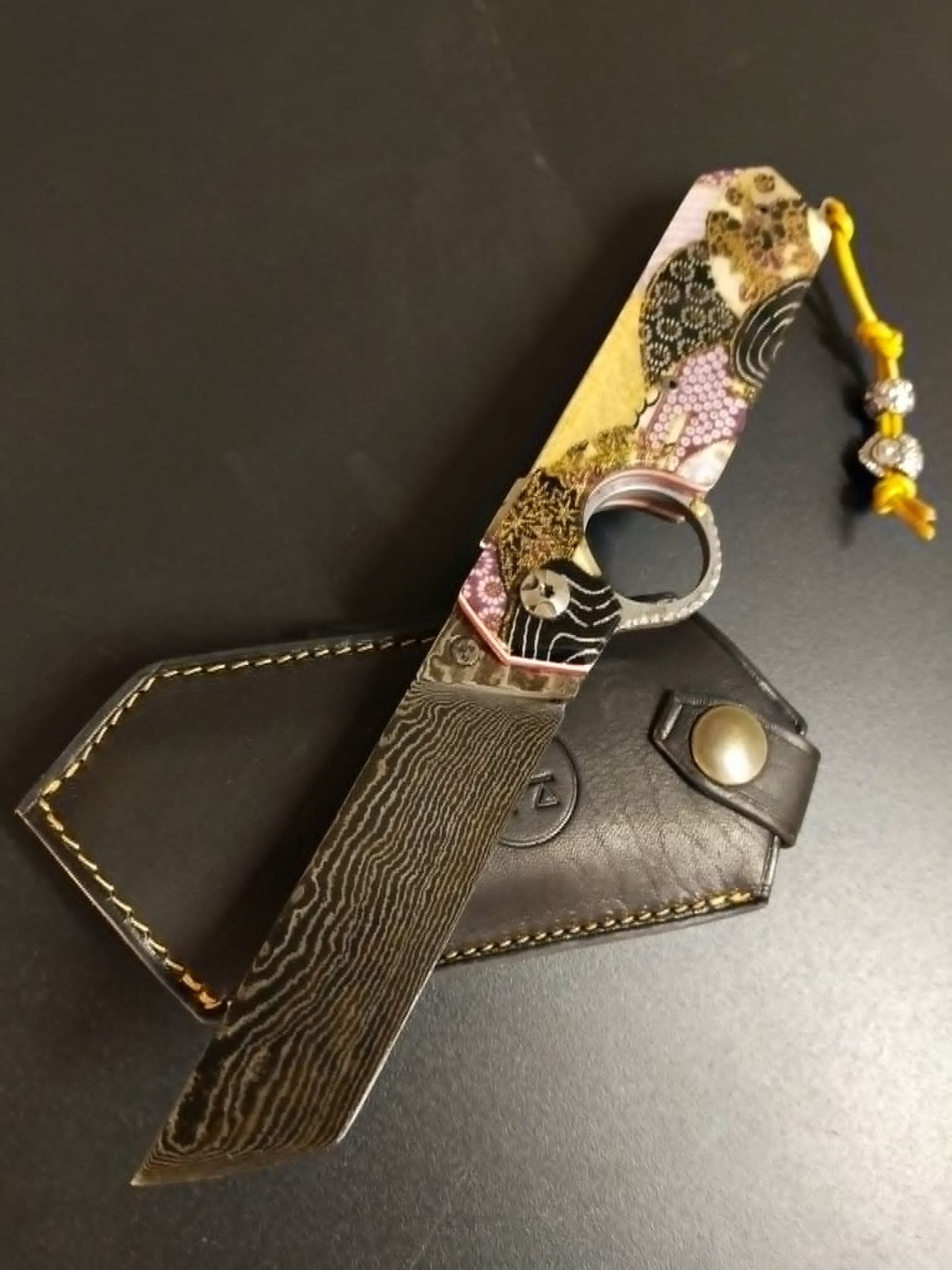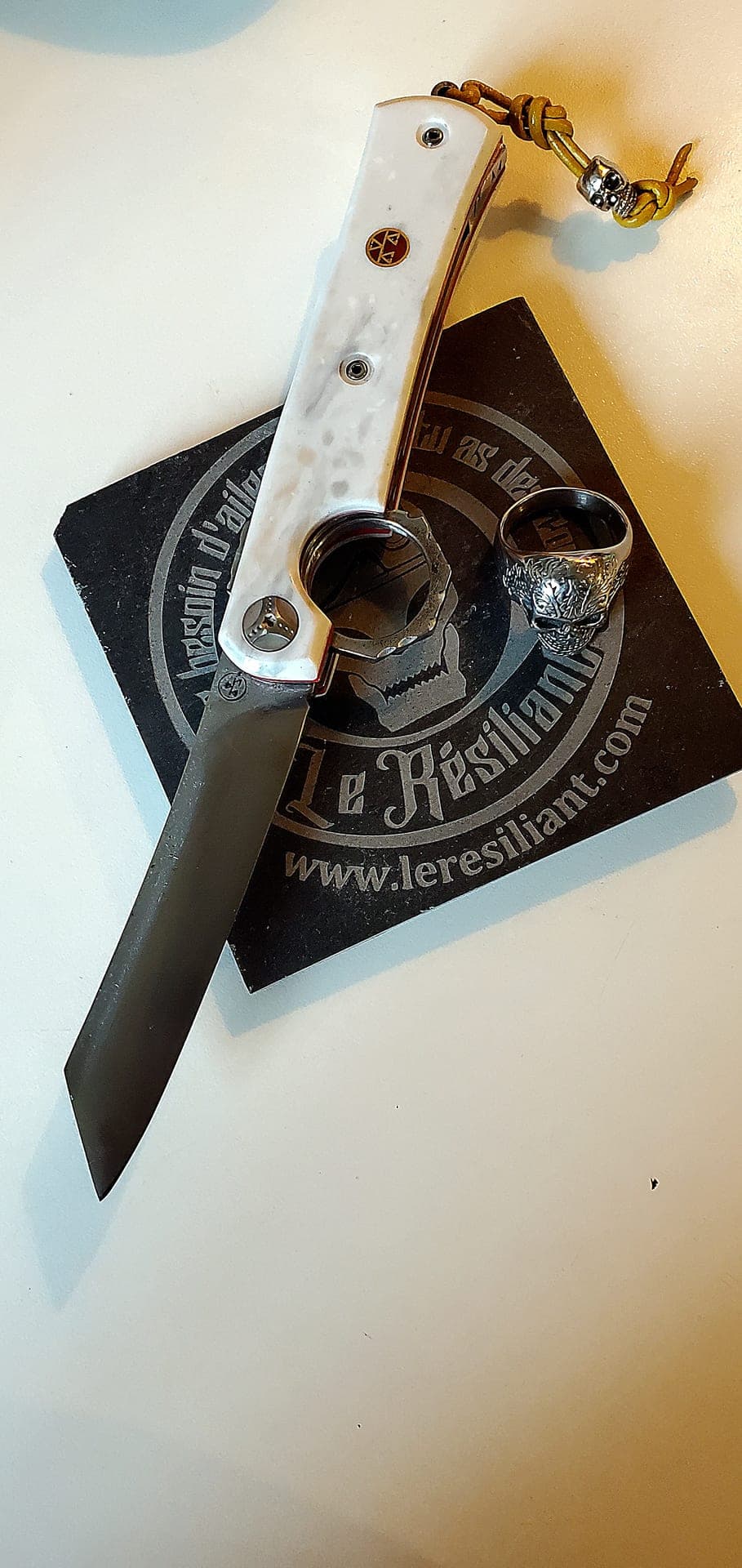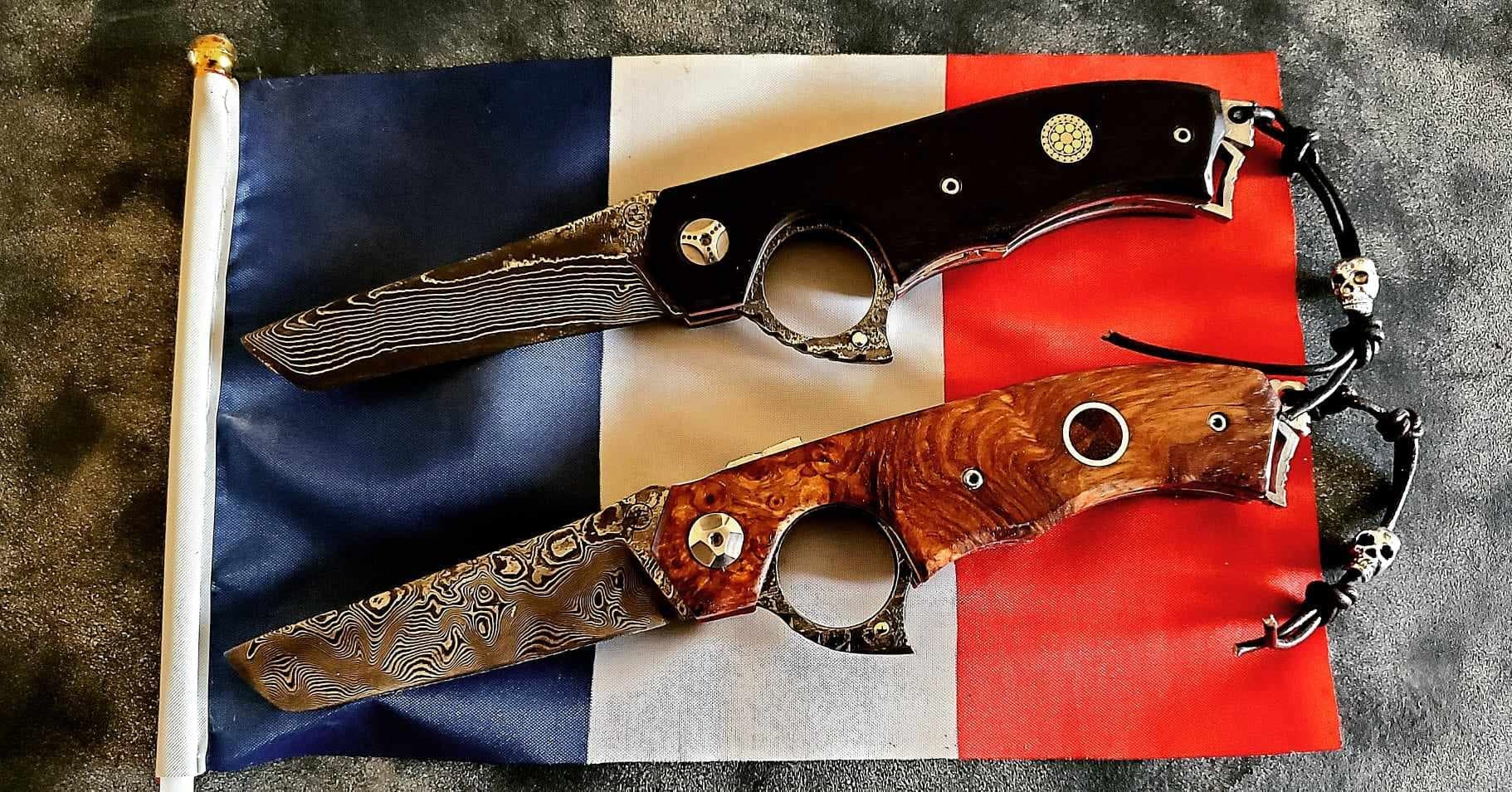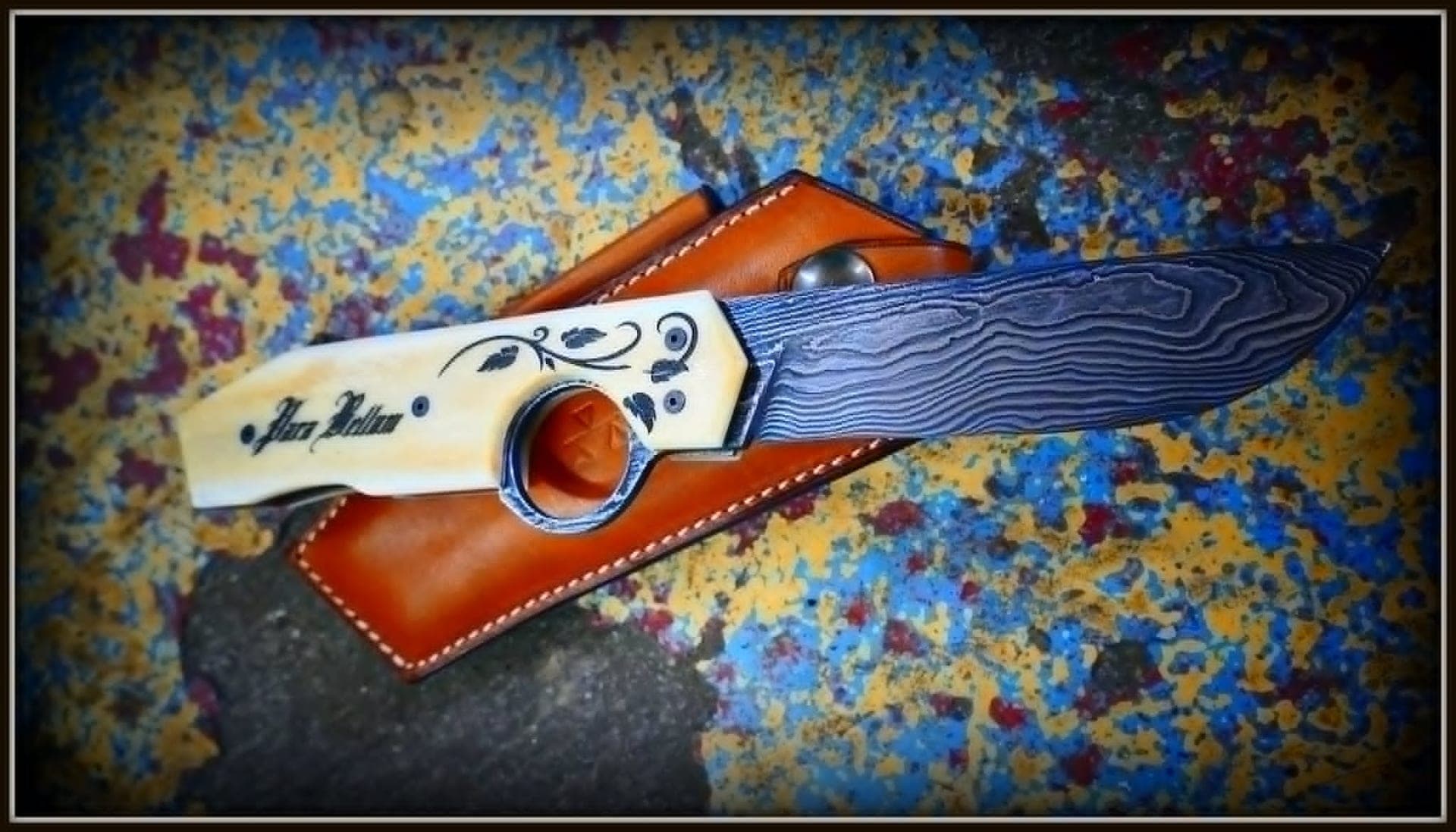
Choosing a knife for someone else is not the same as choosing one for yourself. You do not know how they will use it, or whether they will use it at all. You only know what you want to say by handing it over, and the object has to say it for you, for years.
At Le Résiliant's workshop in Thiers, the question comes up constantly: around a third of all orders are placed to be given as gifts. The workshop sees that moment of hesitation all year round, and with it the few pieces of information the person hesitating is almost always missing.
Here are five pieces from the collection, what each one fits, what sets them apart from a catalogue knife, and why this selection stops at five when the collection holds eight. The rest, the steel, the handle, the sheath, is decided when the order is placed.
A third of the workshop's knives are given away
Around a third of the workshop's orders, between 30 and 35%, are knives meant to be given as gifts. The occasions the cutler mentions are a birthday, or a wife buying a knife for her husband. The rest of the orders come from people treating themselves.
That figure changes the way a knife is ordered. A knife for yourself is discussed directly: you know what you want, you say it. A knife for someone else rests on an intuition, the intuition of the person giving it, and that intuition needs a few facts to hold up.
One custom almost always finds its way into the conversation: a knife is not given without a coin coming back to the person who gave it. The cutler never slips that coin into the sheath, it belongs to whoever is giving, and the meaning of the gesture is told elsewhere.
There is a more concrete reason to take that third seriously. The cutler regularly comes across strangers in supermarkets and service stations around Thiers wearing a Résiliant on their belt. He does not always know the face, but he recognises the knife, and he goes over to talk to them.
A knife that is given ends up belonging to a hand, and that hand is what to keep in mind when choosing. Not the recipient's assumed taste for fine objects: what they do with their days.
What you are really giving when you give a workshop knife
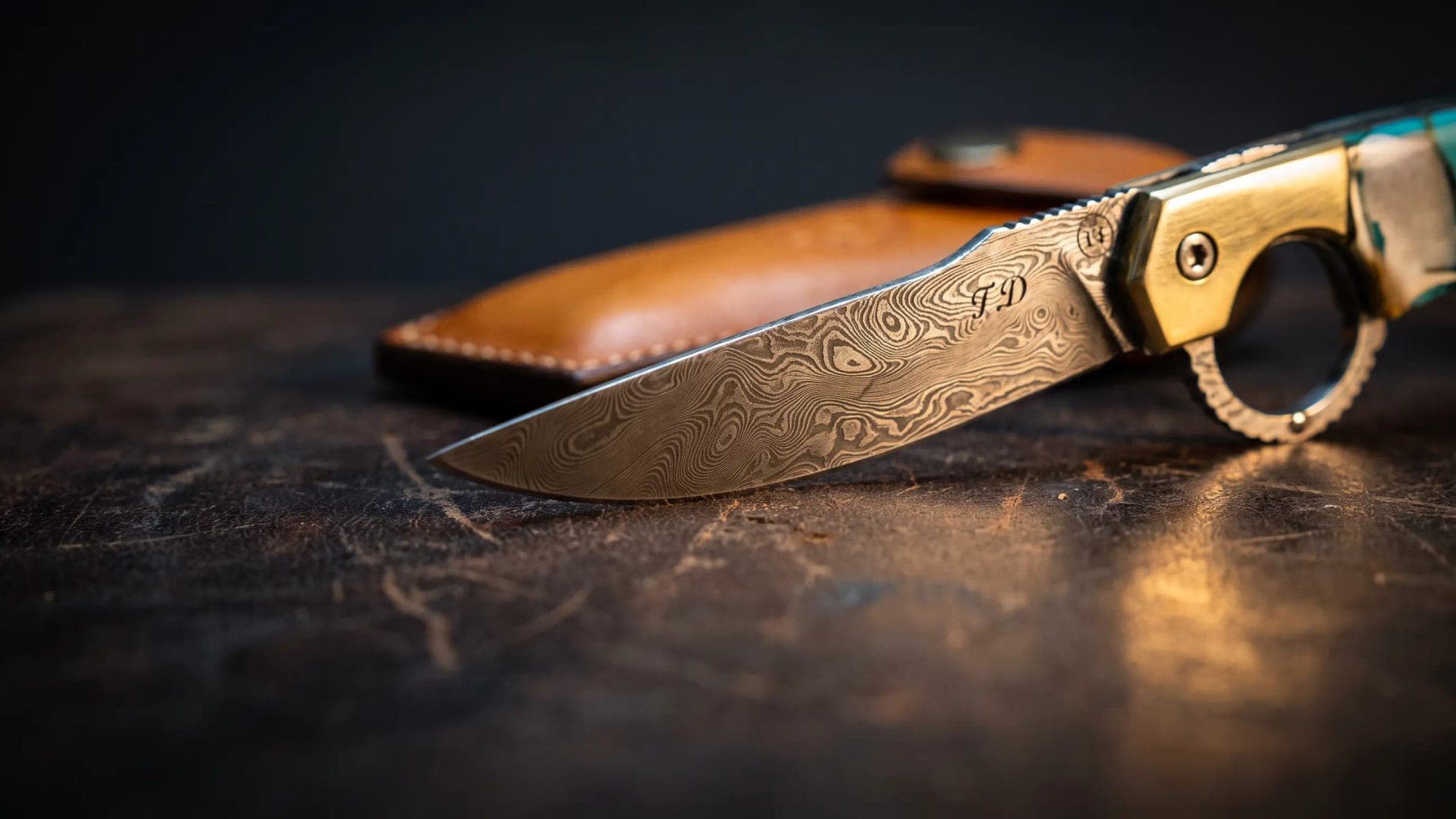
A damascus blade is cut by hand from the plate; a production blade is cut in a factory, then treated at the workshop. Hardening is done on site, in an electric furnace. Polishing and assembly happen at the bench, adjustment in the vice, piece by piece. All eight models share the same reverse-opening mechanism.
A catalogue knife is a finished product before it has an owner. A workshop piece is not: it is assembled for an order. Blades here are not born under a hammer, they are cut, hardened, polished and assembled, a method cutlery calls stock removal, making a blade by taking material away.
The handle follows the same logic. The scales are screwed onto stainless steel liners, never glued: glue is kept for fixed blades, where it seals the handle. On a Résiliant folder, the screws hold everything, and nothing else does.
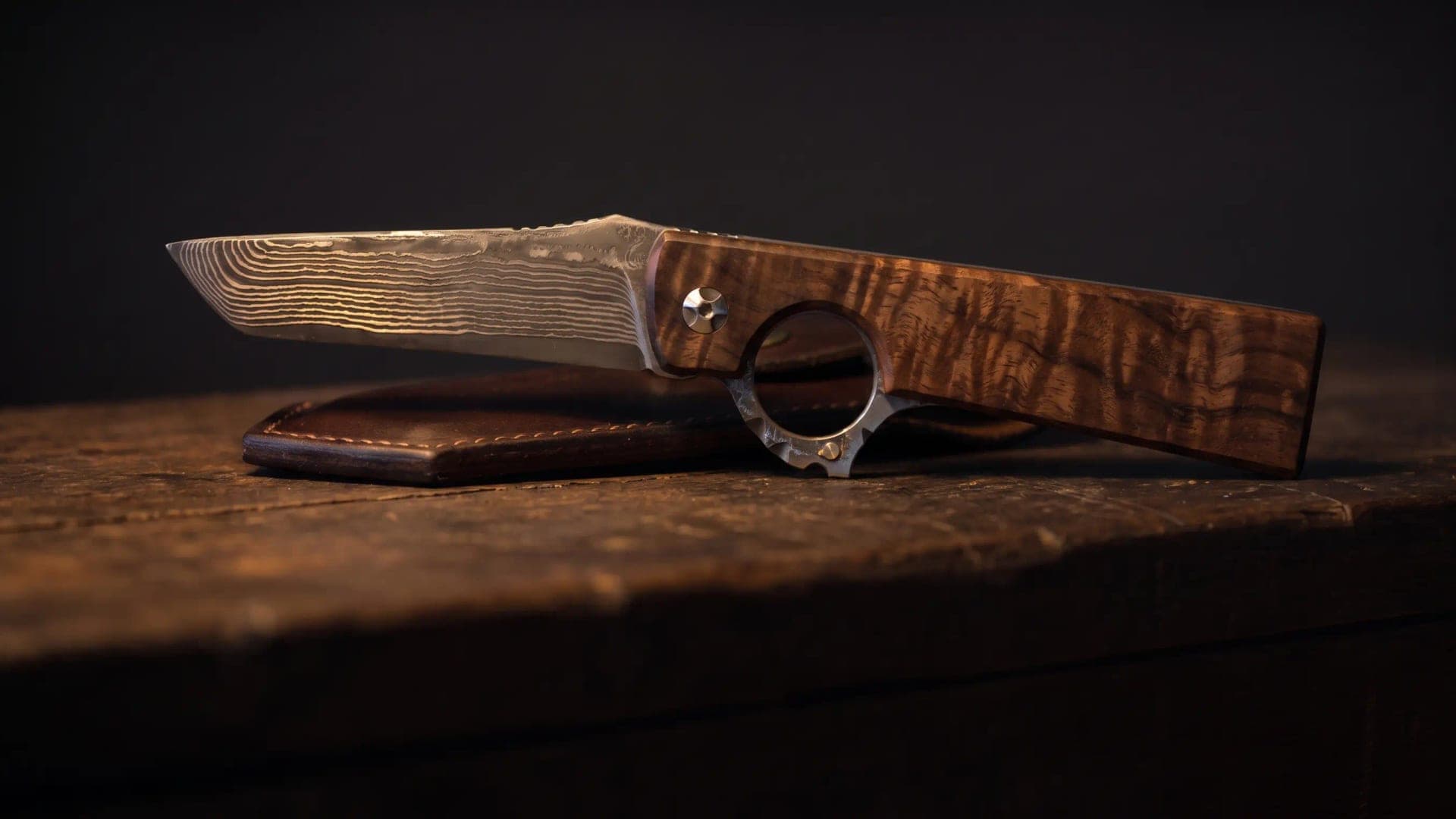
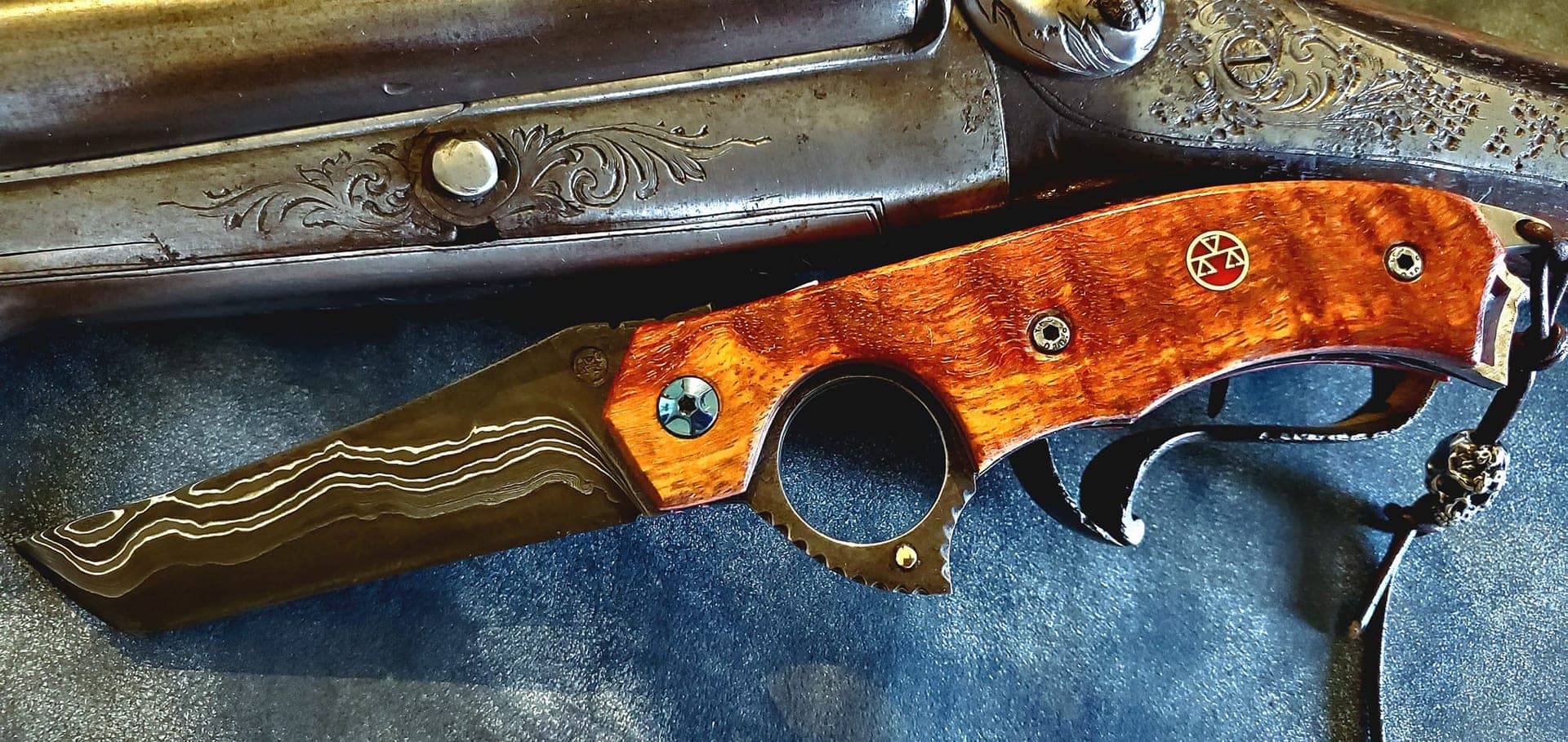
The mechanism is the same across all eight models. The blade comes out of the top of the handle, cutting edge first, driven by a ring fixed to its heel into which the index finger slips; the lock is a reversed liner lock, whose liner works at the top of the handle. Opening is entirely manual, with no spring: the reverse-opening knife was born in this workshop.
Whoever receives it is not receiving one model among others, but a piece adjusted for itself, in the vice. Two knives of the same model never look quite alike: the wood has its own figure, the adjustment has its own hand. That is what makes the object hard to replace.
Five Résiliants, five ways to give
Le Résiliant Tanto suits someone who works with their hands. Le Résiliant 2.0 suits someone who likes objects that take on a patina. Le Shotokan suits a recipient whose tastes you do not know. Le Mancharicou suits someone who already has everything. L'Archétype suits what you give only once.
Le Résiliant Tanto is the original model, the one through which reverse opening was born. Its blade is D2, a tool steel rich in carbon and chromium, semi-stainless. It is a working tool, carried on the belt, on building sites and in the workshop. You give it to someone who uses their hands every day.
Le Résiliant 2.0 is made from 90MCV8, a carbon steel that takes on a grey-blue patina. Its grind is finer than the Tanto's, it is meant for a bite to eat, and it sharpens easily. That patina is not rust, and the difference between the two is worth explaining to whoever receives it. This is the knife for someone who likes objects that carry the marks of time.
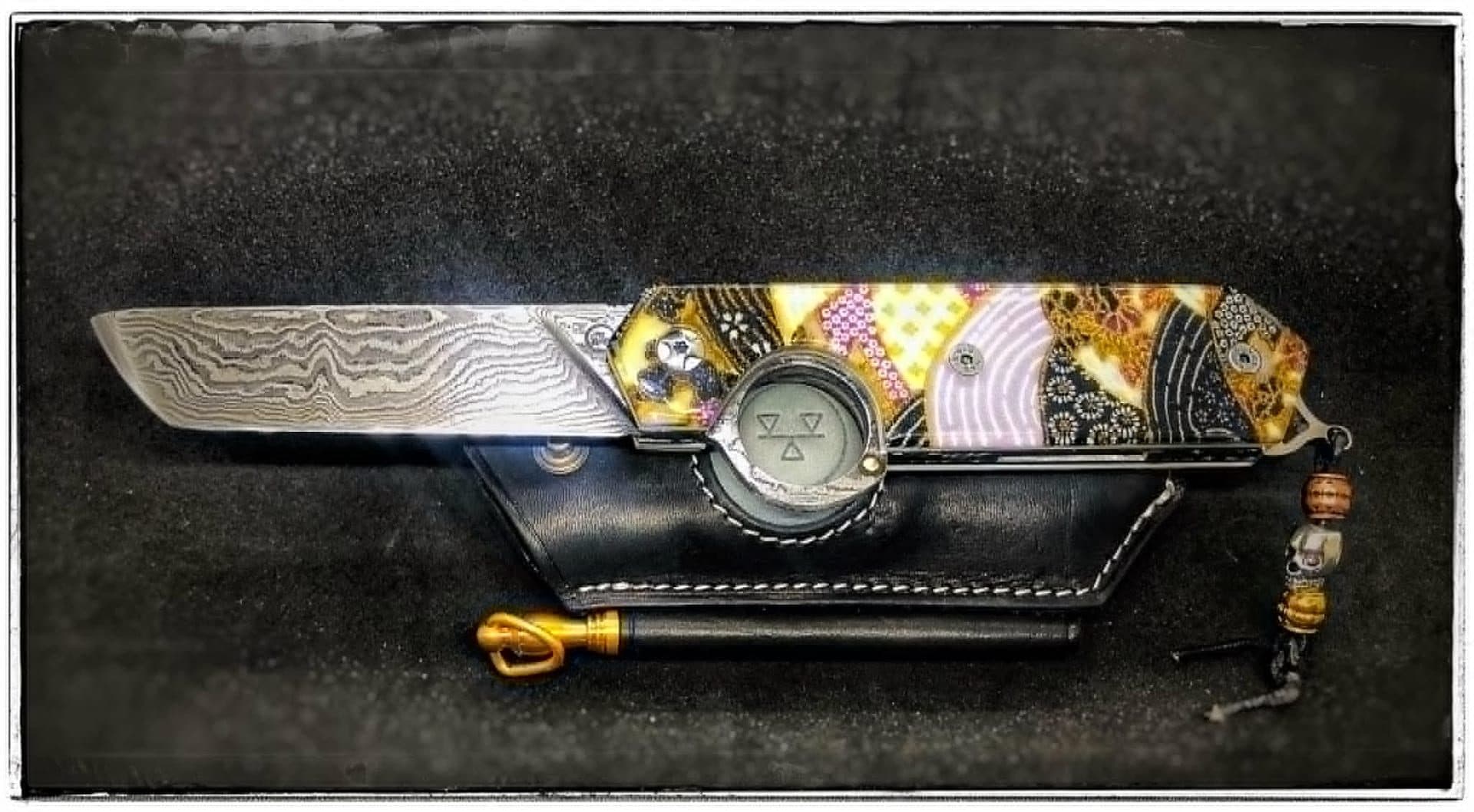
Le Shotokan is the most versatile model of the collection, and the one with the most variants: 90MCV8 carbon, Z160 semi-stainless or damascus. Its silhouette owes its inspiration to the Higonokami, a Japanese folding knife from the end of the nineteenth century. It is the model to keep in mind when you do not know the person's tastes, because you can still decide after asking them the question.
Le Mancharicou is compact, slim, with an unusual silhouette. It is carried discreetly in its sheath and drawn at the table. Its handle is cut from precious woods: shea, ebony, padauk, selected roots, pink ivory which is a wood despite its name. On damascus versions, a small silver fish is inlaid, the workshop's signature, at no extra cost. This is the knife for someone who already has everything.
L'Archétype is the outcome of five years of assembly, adjustment and fitting. It exists only in damascus. It is a collector's piece, one of those that gets passed on rather than replaced. You do not give it to help out someone who has lost their knife: you give it once.
- Le Résiliant Tanto: semi-stainless D2 steel, a working tool carried on the belt. For someone who uses their hands.
- Le Résiliant 2.0: 90MCV8 carbon steel that takes a patina, a fine grind, easy to sharpen. For someone who likes objects that age.
- Le Shotokan: carbon, Z160 semi-stainless or damascus, the most versatile of the eight. For someone whose tastes you do not know.
- Le Mancharicou: compact, precious woods, a silver fish inlaid on damascus versions. For someone who already has everything.
- L'Archétype: damascus only, five years of development. For what you give only once.
Why this selection stops at five
The collection has eight models. On six of them, the workshop does everything itself. Le Mini Tanto and Le Tracker involve steps entrusted to outside workshops, cutting, heat treatment, grinds and handles, with polishing and assembly staying in house. This selection keeps only pieces made entirely on site.
The two models left out come from a deliberate experiment in semi-industrial production: cutting, heat treatment, grinds and handle shaping are entrusted to outside workshops, while polishing and assembly stay at the bench. This is neither a flaw nor a reproach.
But the promise of this selection is precise: five pieces born in Thiers, from the first line drawn on the plate to the last turn of a screw. Thiers today produces most of the knives made in France, so naming the town says nothing until you say who did what. It is a fact the workshop owns, and one the person ordering has a right to know before choosing.
Le Fhiers, the sixth model made entirely in house, is missing from the list for the opposite reason. Its steel is chosen on request: carbon, semi-stainless or damascus. It is the most customisable of the eight, so it is the one you choose with the recipient rather than for them.
All eight can be seen side by side in the collection, with their steel and their range. Five belong in this selection; the other three are chosen differently.
What is decided with the recipient, and what is decided without them
The model, the steel and the handle material are chosen when the order is placed. Engraving is a paid option, priced in the quote. The leather sheath is an option too, in plain leather or with a colour insert matched to the handle. The knife's template remains the workshop's decision.
Three choices belong to whoever places the order: the model among the eight, the steel or damascus, the handle material. The template itself is not negotiable: each model took a long development, proportions open and closed, safety, liner and blade thicknesses. That is the exact limit of what bespoke work from an artisan allows.
Engraving falls within the same frame: initials, a name, a date, a sentence, or a drawing sent as a PDF. It is a paid option, priced in the quote.
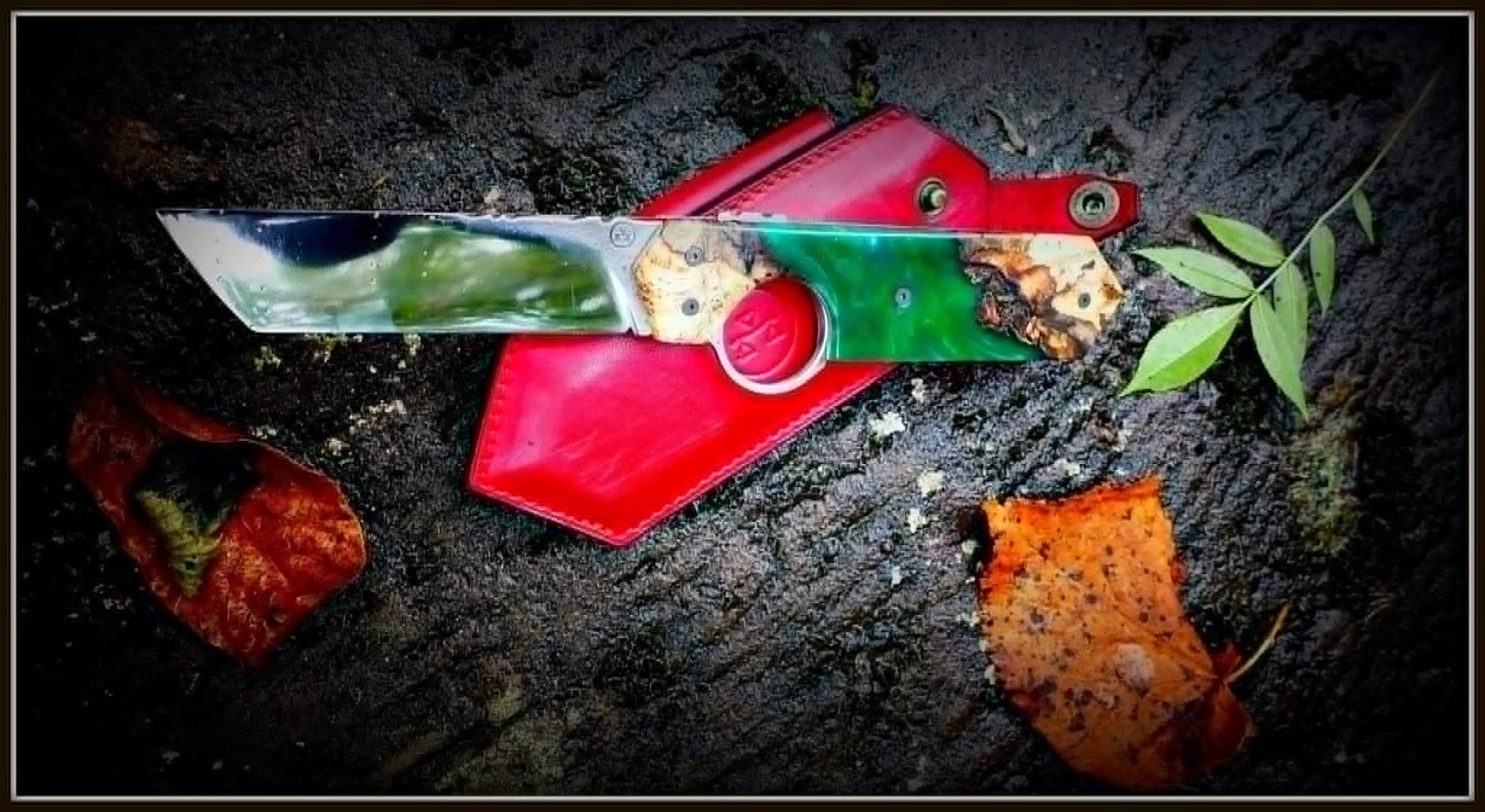
The sheath is chosen when the order is placed, at the same time as everything else. It is hand-stitched in Thiers by the VD Cuir leather workshop, a partner of the workshop for seven years, in vegetable-tanned leather. Two forms exist, plain leather and leather with a colour insert matched to the handle, with matching stitching and the logo. Colours are chosen at the order, and the sheath remains an option.
That leaves the real question for whoever is giving: decide alone, or give the choice. Both happen. A versatile model leaves little risk to someone deciding alone; an order placed together moves the gift towards the moment it is placed.
A knife meant as a gift is ordered through a quote
There is no online shop and no stock: every piece starts from the contact form, where the model can be preselected. The lead time is given in the quote. A personalised piece carries no right of withdrawal under distance selling rules, since it is made to the customer's own specifications.
An order starts with a message. The contact form lets you preselect the model, and that is where the steel, the handle, the sheath and any engraving are settled. Every page in the collection shows its starting price; the exact amount is set in the quote, and the lead time is given along with it.
A piece made to the specifications of the person buying it carries no right of withdrawal under distance selling rules: the French consumer code excludes it expressly. That follows from bespoke work, not from a clause written by the workshop.
The workshop ships abroad: Belgium, Switzerland and the United States have been among its customers since its first orders. It can also be visited, by appointment, at 15 rue Alexandre Dumas in Thiers.
One point matters precisely because this is a gift. Any knife that has left the workshop can be sent back for its edge to be re-established, free of charge: only shipping remains down to its owner. Please get in touch before sending anything.
The criterion is where the knife came from, not who owns it. A knife received as a gift is treated like any other, and whoever received it has nothing to justify. That is what separates an object you give from an object you simply buy: this one has an address to come back to.
- Which knife should you give as a gift?
- Five Résiliant models cover most cases: Le Résiliant Tanto for someone who works with their hands, Le Résiliant 2.0 for a carbon steel enthusiast, Le Shotokan when you do not know the recipient's tastes, Le Mancharicou for someone who already has everything, L'Archétype for a piece that gets passed on.
- Can you give a handmade knife without knowing the person's tastes?
- Yes. A versatile model such as Le Shotokan, available in carbon, semi-stainless or damascus, leaves little room for error. The other option is to place the order together: the steel and the handle material are then chosen in the quote.
- Can a knife received as a gift be re-sharpened by the workshop?
- Yes. Any knife that has left the workshop can be sent back for its edge to be re-established, free of charge: only shipping remains down to its owner. Please get in touch before sending anything. The criterion is where the knife came from, not who owns it.
- How much does an artisan knife to give as a gift cost?
- Every page in the collection shows its starting price. The exact amount is set in the quote: it depends on the model, on the steel or damascus chosen, on the handle material, and on options such as engraving or the leather sheath.
- Should the sheath be chosen at the same time as the knife?
- Yes, the sheath is chosen when the order is placed. It is an option, in plain leather or with a colour insert matched to the handle. It is hand-stitched in Thiers by the VD Cuir leather workshop, in vegetable-tanned leather, and its colours are chosen in the quote.
Sources
- Éloïse Mozzani, Le Livre des superstitions, Robert Laffont, Bouquins — Ouvrage de référence sur les croyances françaises : offrir un couteau, comme tout objet tranchant ou pointu, coupe l'amitié ou l'amour à moins qu'une pièce de monnaie ne soit rendue en échange. C'est la source de la coutume rappelée en première section.
- Légifrance, article L221-28 du code de la consommation — Texte officiel excluant du droit de rétractation des achats à distance les biens confectionnés selon les spécifications du consommateur ou nettement personnalisés, ce qui est le cas d'un couteau commandé à l'atelier.
- Wikipédia, « Coutellerie de Thiers » — Sept siècles de coutellerie dans le bassin thiernois, qui produit aujourd'hui la majorité des couteaux fabriqués en France.
- Ville de Thiers, « Thiers, capitale de la coutellerie » — Source institutionnelle sur le poids de la filière coutelière thiernoise et sur la place de la ville dans la fabrication française de couteaux.