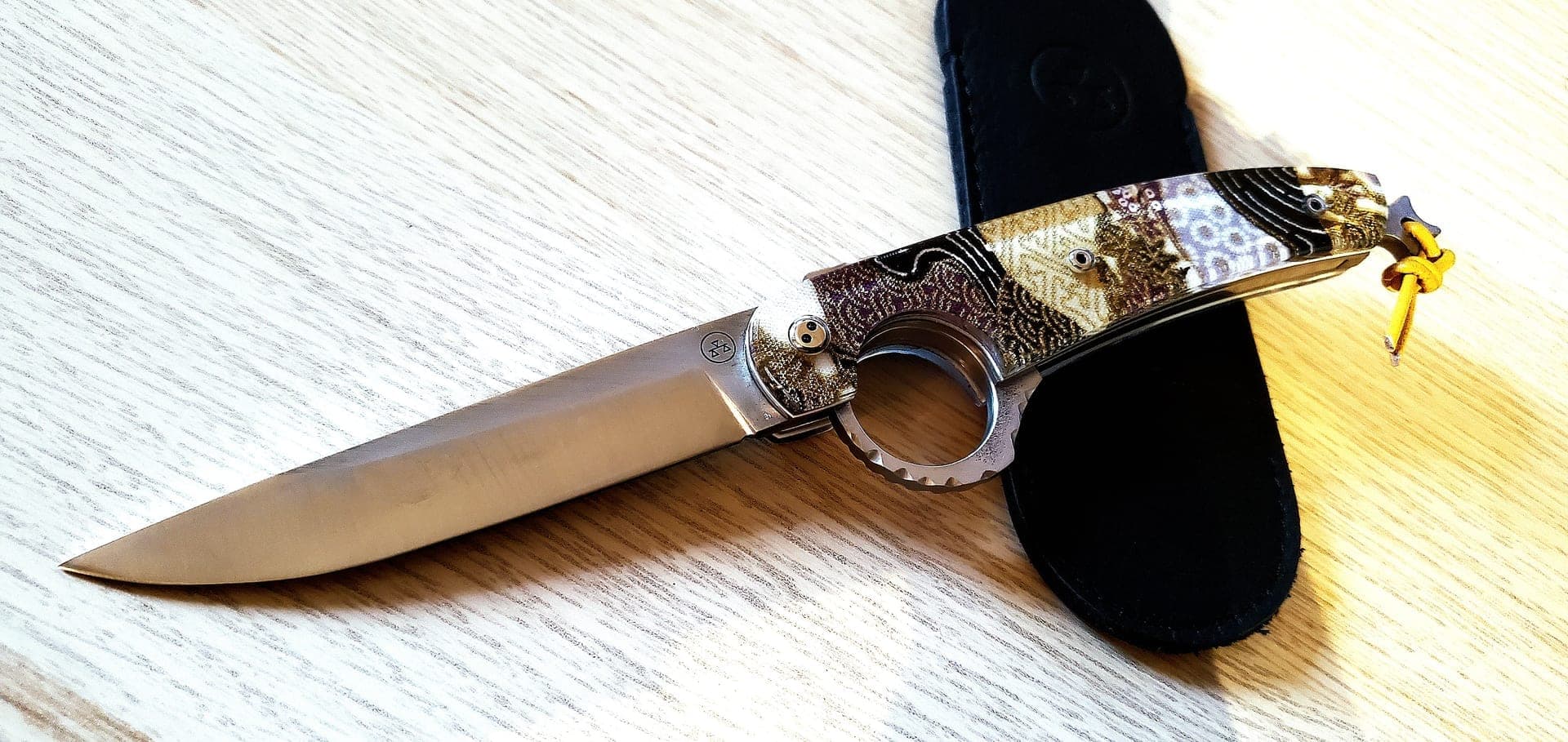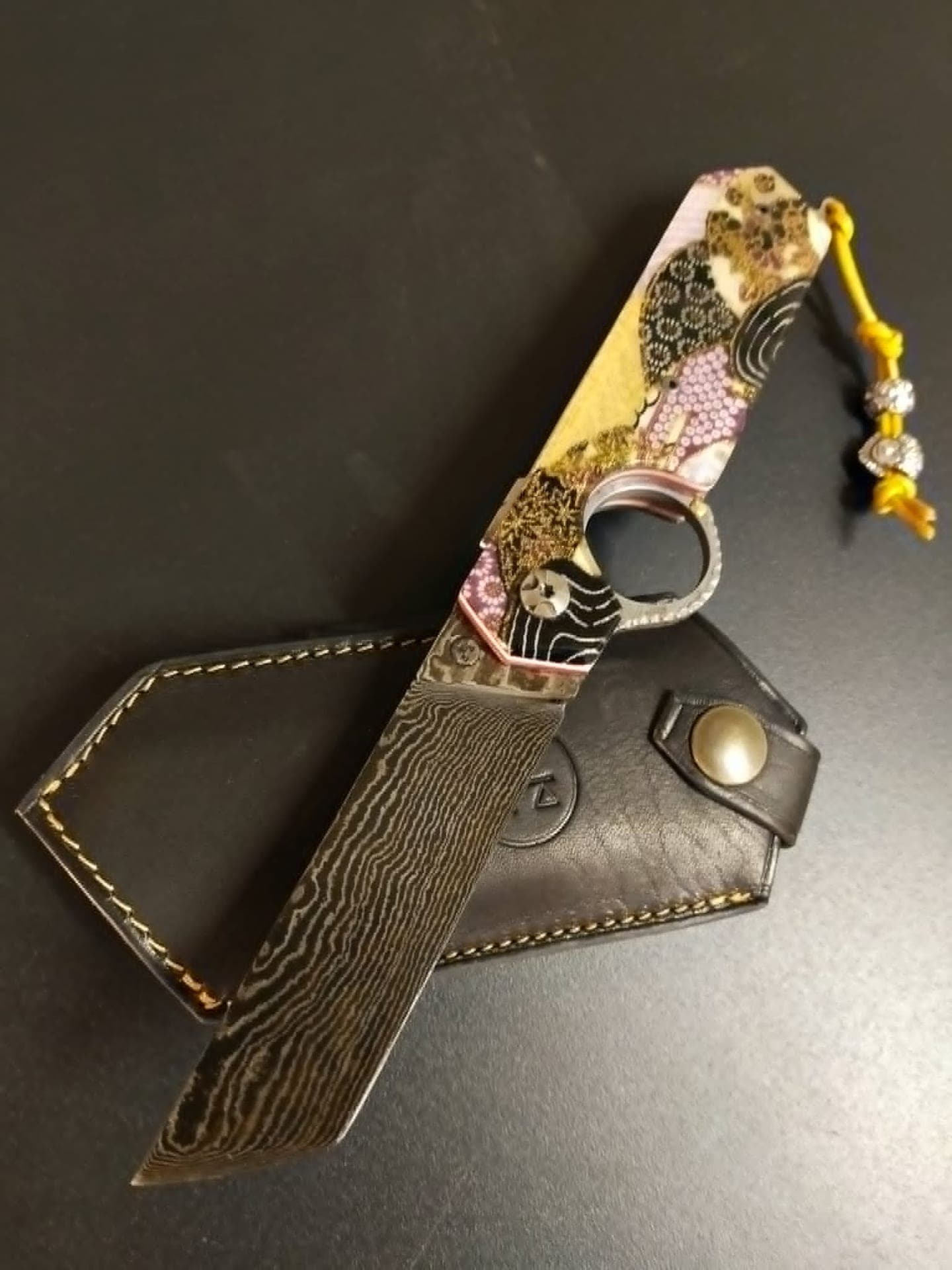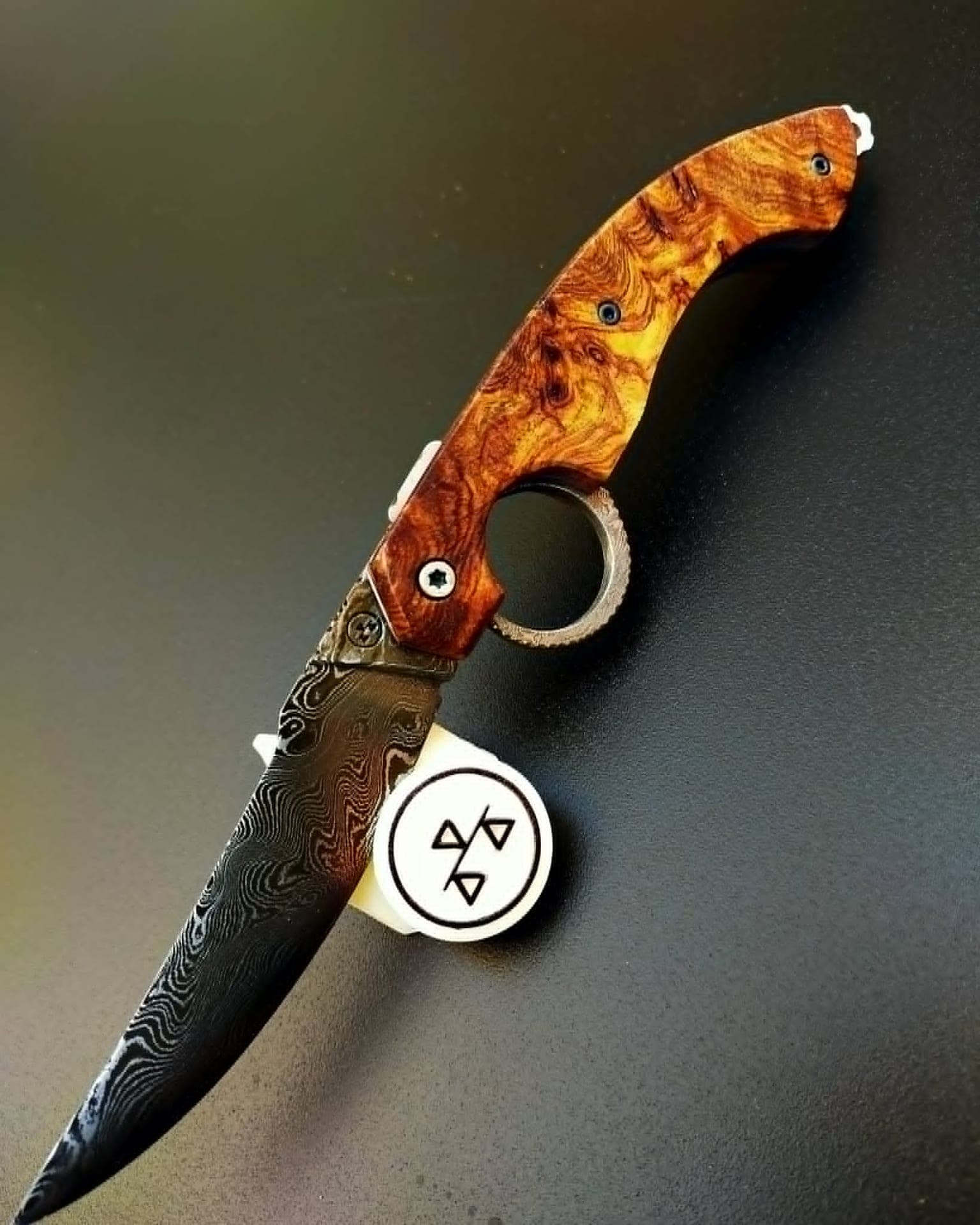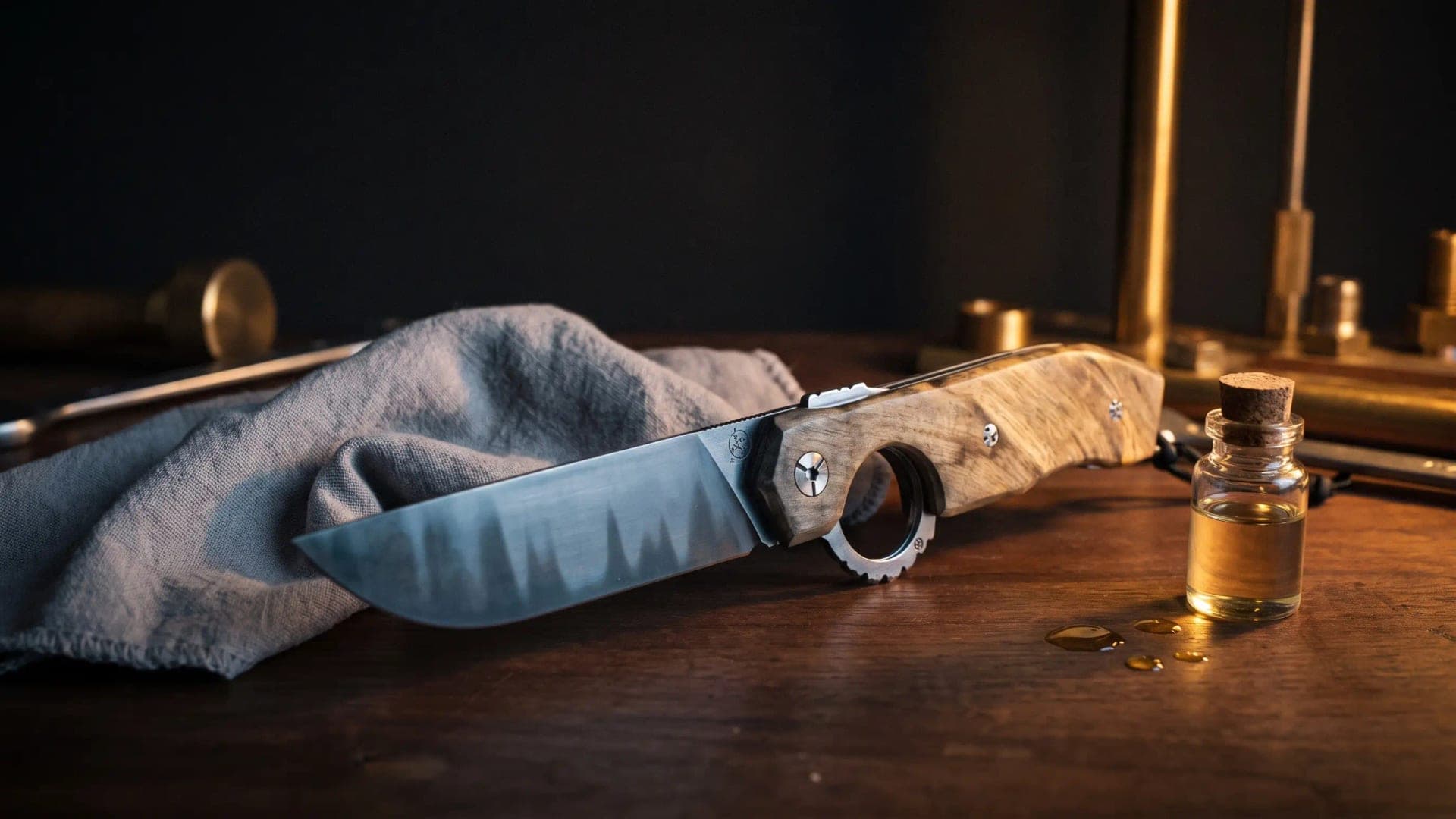
A vegetable-tanned leather knife sheath is cared for first by doing nothing to it: you keep it dry and let it develop its patina. By default, the Résiliant workshop advises putting no product on it; otherwise, an ordinary leather care product is enough. The rest comes down to a few gestures, only one of which needs attention: drying a sheath that has got wet.
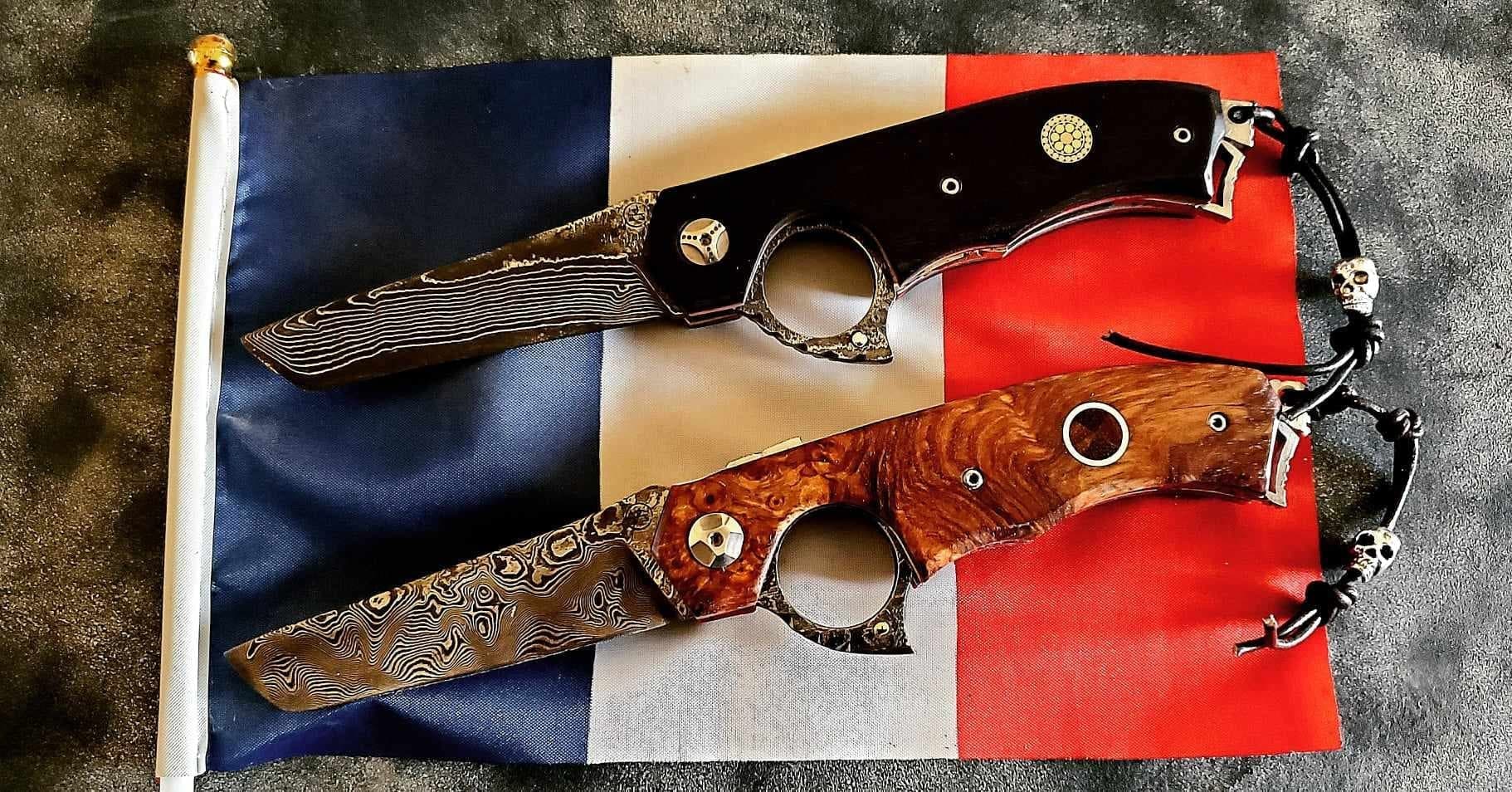
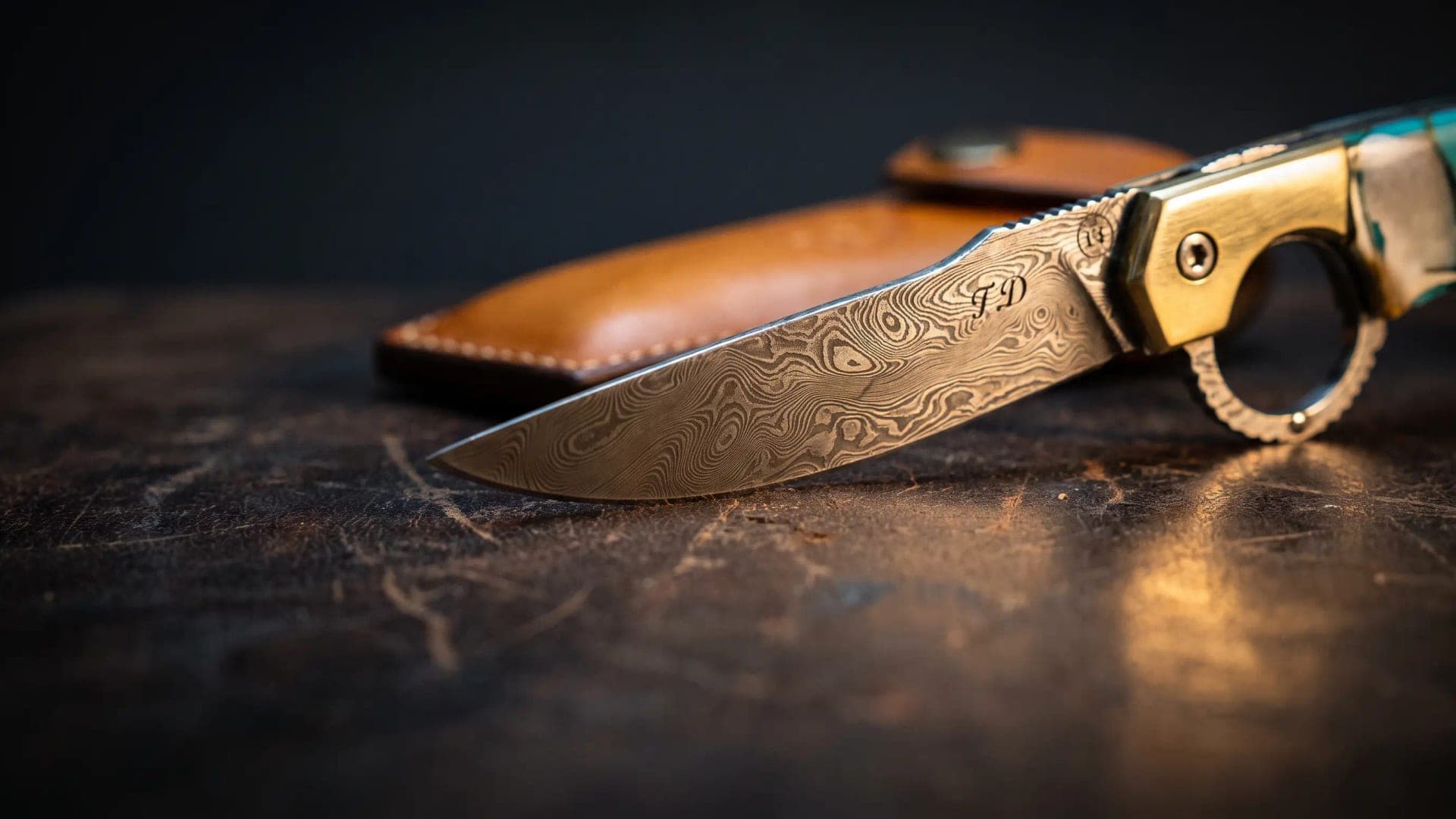
Le Résiliant Tanto, the workshop's first model, was designed as a work tool worn on the belt; the Mancharicou is kept in its sheath until it is drawn at the table. Around Thiers, the cutler sometimes comes across a stranger wearing a Résiliant on their belt: he recognises the knife anywhere. The leather of a sheath lives in contact with hands and time.
Here is what a sheath protects, why leather, what sets the two main kinds of tanning apart, who stitches the Résiliant sheaths, then the three gestures that matter: everyday care, drying a wet sheath, and the patina you let come.
The sheath, protecting the knife as much as the person who carries it
A sheath protects the knife from knocks, and it protects the person who carries it, as well as the pocket or the belt that holds it. What you ask of it depends on how the knife is used: worn on the belt, brought out at the table, slipped into a pocket or kept in a display cabinet.
The scabbard answers a simple question: how to carry a blade without hurting yourself and without damaging it. It has existed at least since the Bronze Age, made of leather, wood or metal. The sheath of a folding knife inherits that double role: protecting the blade, and protecting the person who carries it.
At Le Résiliant, use varies from one model to another. Le Résiliant Tanto is a work tool worn on the belt, on building sites, on roofs or in the workshop. Le Résiliant 2.0 is also worn in a sheath on the belt, or kept in a display cabinet. The Mancharicou, more compact, is carried discreetly in its sheath and drawn at the table.
Only the Mini Tanto truly slips into a pocket, in its leather pouch. The difference between a pocket knife and a belt knife is set out in the guide to French pocket knives.
Leather, a material that can be stitched and that takes a patina
Leather is a historical material for the scabbard. For a knife sheath, it brings together two qualities that the Résiliant workshop puts forward: it can be cut and stitched by hand, made to measure, around one specific knife; and, once vegetable-tanned, it develops a patina over the years.
Every Résiliant sheath is cut, stitched and finished by hand, made to measure, to order: leather lends itself to this work on the scale of a single object.
The Résiliant accessories page describes vegetable tanning as a natural, slow tanning process that lets the material live and develop a patina over the years. A new sheath is therefore not a finished sheath: it is the starting point of a leather that will change with its owner.
This living material has its counterpart: vegetable-tanned leather reacts to water, and this property decides how it should be looked after.
Vegetable or chrome tanning: two ways of making leather
Tanning turns a hide into leather. Vegetable tanning uses tannins extracted from plants: it is a slow process, and the resulting leather develops a patina over the years but is not stable in water. Chrome tanning, the other major family, uses chromium salts and works faster.
Two major families of tanning exist side by side: vegetable tanning and mineral tanning, of which chrome tanning is one form.
Vegetable tanning uses tannins extracted from plants: bark, wood, leaves or fruit. The process is slow, and the leather it produces develops a patina over time. This is the leather the VD Cuir workshop uses for the Résiliant sheaths.
Its limitation is well known: vegetable-tanned leather is not stable in water. It tends to discolour on contact with it, and if it is left to soak and then dries, it shrinks and becomes harder. Hence the two rules of this article: keep the sheath dry, and handle it gently when it has got wet.
Chrome tanning relies on chromium salts and works faster; it produces a different leather, which this article does not cover.
In Thiers, sheaths stitched a few streets from the workshop
The Résiliant sheaths are made in Thiers, right in the town centre, by the VD Cuir leather workshop, a neighbour of the cutler's workshop, who has been working with it for seven years. The leather is vegetable-tanned and stitched by hand. The sheath comes in two levels, plain or with a medallion, as an option on the quote.
The VD Cuir leather workshop is based in the centre of Thiers, a few streets from the cutler's workbench. The two workshops have been working together for seven years, knife and sheath designed for one another. Cutting, stitching and finishing are done in its own workshop; the work is 100% French, with no component from abroad.
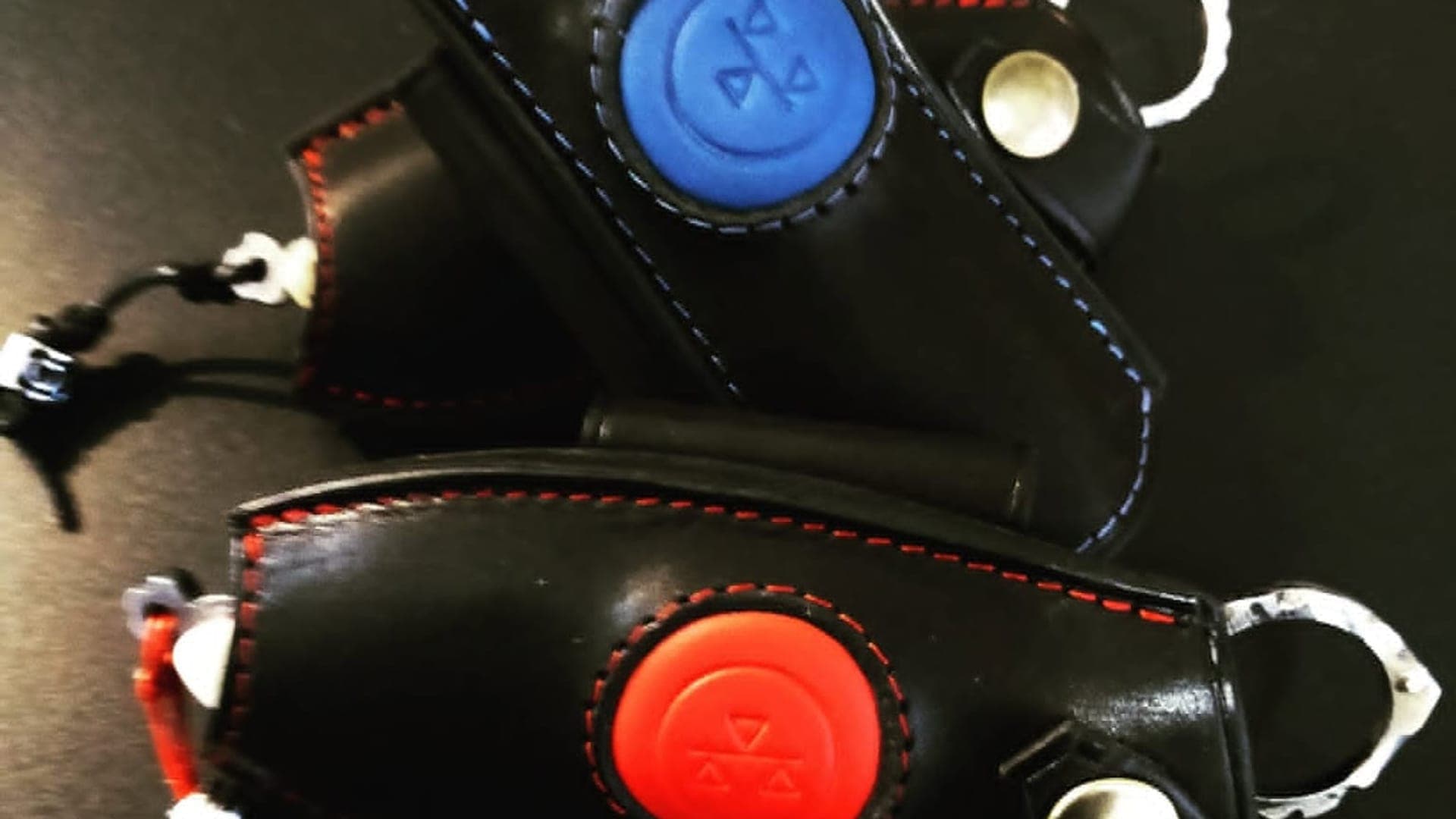
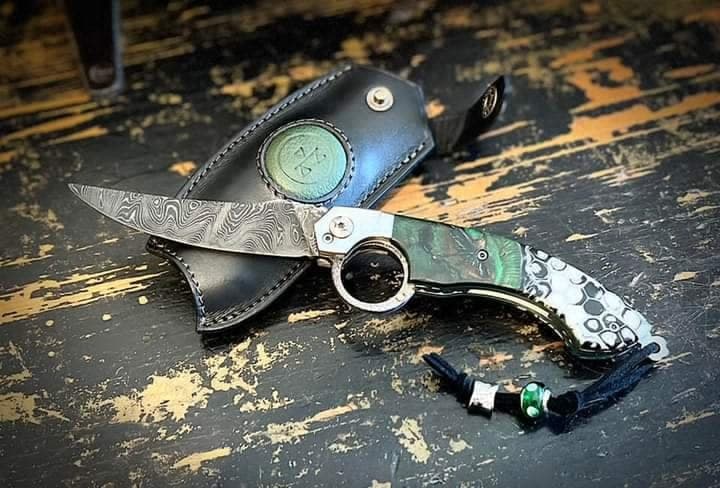
The sheath comes in two levels. The plain version, in black leather, goes with the knife without ornament. The version with a medallion carries the Résiliant logo medallion, in a colour matched to the knife's handle, with matching stitching. These are not two sheath shapes: both levels are stitched to measure, made to order.
The sheath is an option, chosen together with the knife: the level and the colours are specified in the quote request, and both levels are shown on the accessories page. For a knife intended as a gift, which is the case for around a third of the workshop's orders (30 to 35%), the sheath is chosen in the same request.
Caring for a leather sheath: by default, put nothing on it
To care for a vegetable-tanned leather knife sheath, the Résiliant workshop recommends by default putting nothing on it. If you do want to treat it, an ordinary leather care product is enough, applied sparingly. The rest is simple: keep the sheath dry and dust it off.
The workshop's recommendation fits into one sentence: by default, nothing. A new sheath needs no treatment to do its job, and vegetable-tanned leather develops its patina without help.
Conditioning or greasing a sheath is therefore not a required step. If you want to do it, an ordinary leather care product will do, in small quantities. The workshop recommends no brand and sets no schedule.
For dust and everyday grime, a dry cloth is enough. Water is no friend here: vegetable-tanned leather tends to discolour on contact with it. So it is better not to wash a sheath under running water, nor to machine-wash it.
The rest is a matter of storage. A sheath is kept in a dry place, and its knife only goes back into it once it is dry too.
A wet sheath dries in the air, and without its knife
When a leather sheath has got wet, take the knife out straight away, wipe and dry the blade, then leave the empty sheath to dry slowly in the open air. Vegetable-tanned leather is not stable in water: it can stain and, after soaking, shrink and harden as it dries.
A sheath worn on the belt will get wet sooner or later. The first gesture concerns not the leather but the knife: take it out of the sheath, wipe the blade and let it dry.
A blade put away damp in its sheath remains exposed to corrosion, whatever the steel: what happens next on the blade side is detailed in the article on rust and patina on a carbon blade.
The sheath itself dries empty and in the open air. If it has soaked, vegetable-tanned leather shrinks and hardens as it dries; and since the sheath is stitched to measure around its knife, if it shrinks it may no longer hold it as well. Hence the caution: let it dry at its own pace, without trying to speed things up.
The knife only goes back into its sheath once both are thoroughly dry, the blade as well as the leather.
Ageing a sheath: a patina that cannot be forced
The patina of a vegetable-tanned leather sheath comes with the years and with use: you do not provoke it, you let it happen. The workshop recommends no method to speed it up. Over time, each sheath ends up reflecting the way its knife is carried.
Ageing a sheath means wearing it: vegetable-tanned leather develops a patina over the years, and it only needs to be given that time.
The black leather of the Résiliant sheaths follows the same rule as any vegetable-tanned leather: it develops its patina at its own pace. Two sheaths identical at the start will not age in the same way, depending on whether they spend their days on a belt or stay in a display cabinet.
The medallion sheath adds one more link with the knife: its logo medallion and its stitching pick up the colour of the handle. On Le Fhiers, a tribute to the cutlers of Thiers, a damascus blade and a green handle rest on a black sheath with a green medallion: sheath and knife age together.
On the site's home page, the cutler sums up the role of the sheath in one sentence: "All my customers carry a piece of me, in a leather sheath."
- How do you care for a leather knife sheath?
- By doing very little. By default, the Résiliant workshop advises applying nothing to a vegetable-tanned leather sheath; if you want to treat it, an ordinary leather care product is enough, used sparingly. What matters is elsewhere: keeping the sheath dry, dusting it off and letting it develop its patina.
- Should you grease or condition a leather sheath?
- Not by default. The workshop's recommendation is to put nothing on a vegetable-tanned leather sheath. If you want to condition the leather, an ordinary leather care product will do, applied sparingly. No brand is recommended, and no care schedule is advised.
- What should you do when a leather sheath gets wet?
- Take the knife out without waiting, wipe and dry the blade, then leave the empty sheath to dry slowly in the open air. Vegetable-tanned leather is not stable in water: it can stain and, if soaked and then dried, shrink and harden. The knife only goes back in once both are dry.
- What is vegetable-tanned leather?
- It is leather tanned with tannins extracted from plants, such as bark, wood, leaves or fruit, rather than with chromium salts. The process is slow. The resulting leather develops a patina over the years, but it is not stable in water: it can stain, and harden if it dries after soaking.
- Does a Résiliant knife come with a sheath?
- Not automatically: the sheath is an option, never preselected, chosen in the quote request. It comes in two levels, plain black leather or with a logo medallion matched to the handle, both stitched by hand to measure in Thiers by the VD Cuir leather workshop.
Sources
- Wikipédia, « Tannage » — Définit le tannage comme l'opération qui transforme une peau en cuir et distingue le tannage végétal, aux tanins extraits de végétaux, du tannage minéral, dont le tannage au chrome.
- Wikipedia, « Tanning (leather) » — Décrit le tannage végétal et le tannage au chrome, et établit que le cuir à tannage végétal n'est pas stable à l'eau : il tend à se décolorer et, s'il a trempé puis séché, il rétrécit et durcit.
- Wikipedia, « Scabbard » — Définit le fourreau comme l'étui qui reçoit une épée, une dague ou un couteau, cite le cuir, le bois et le métal parmi les matières dont on l'a fait, et date son existence au moins de l'âge du bronze.