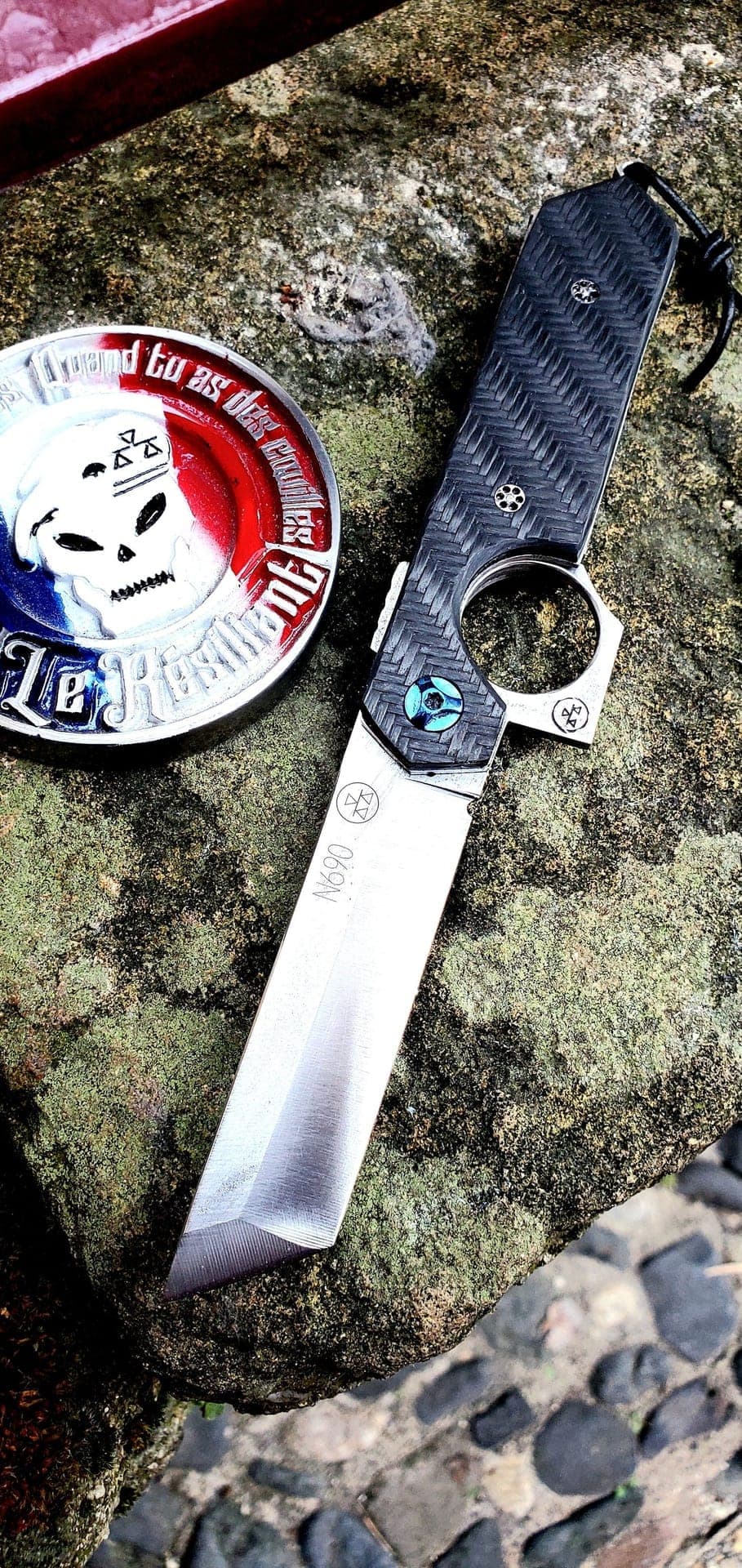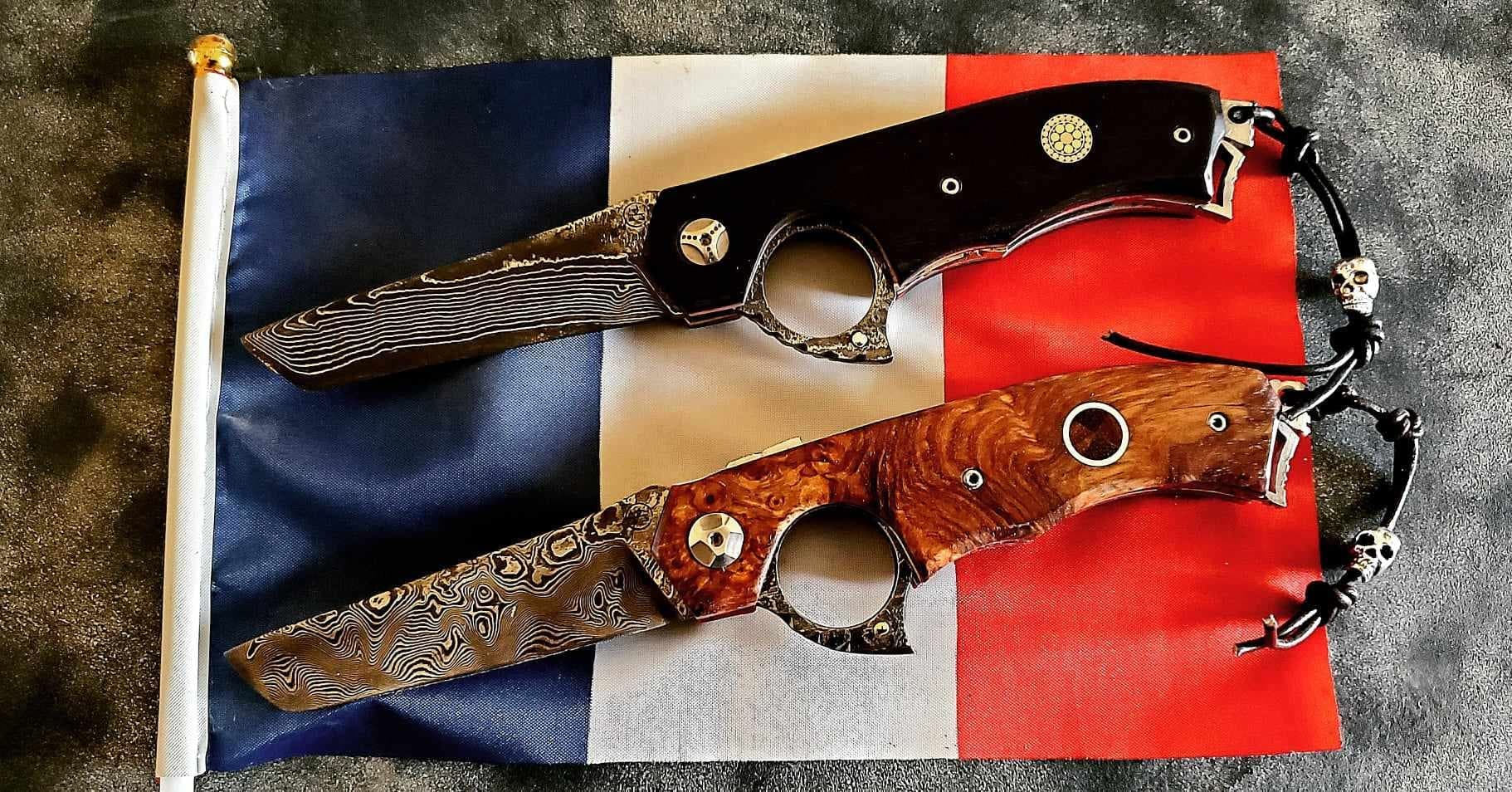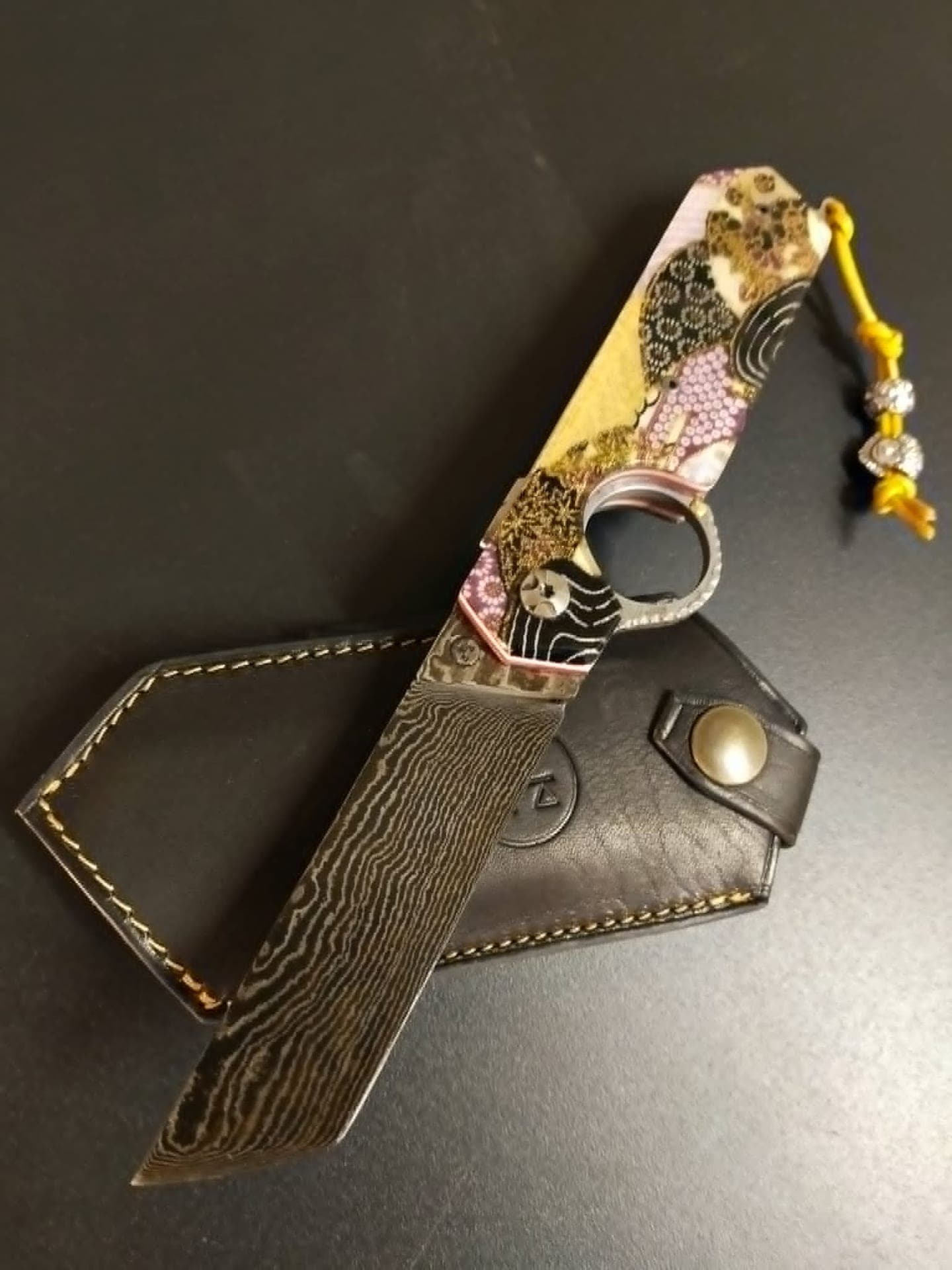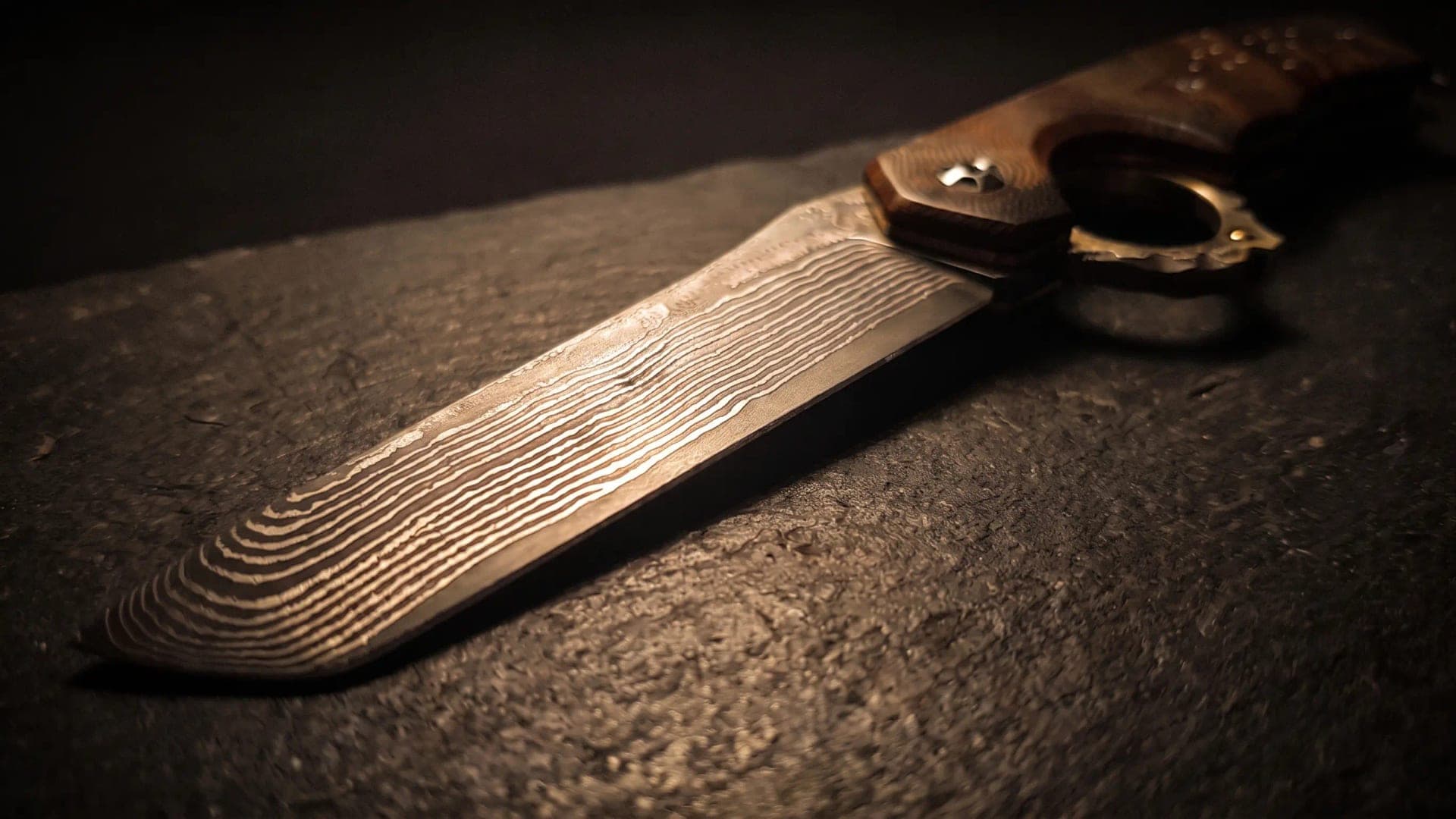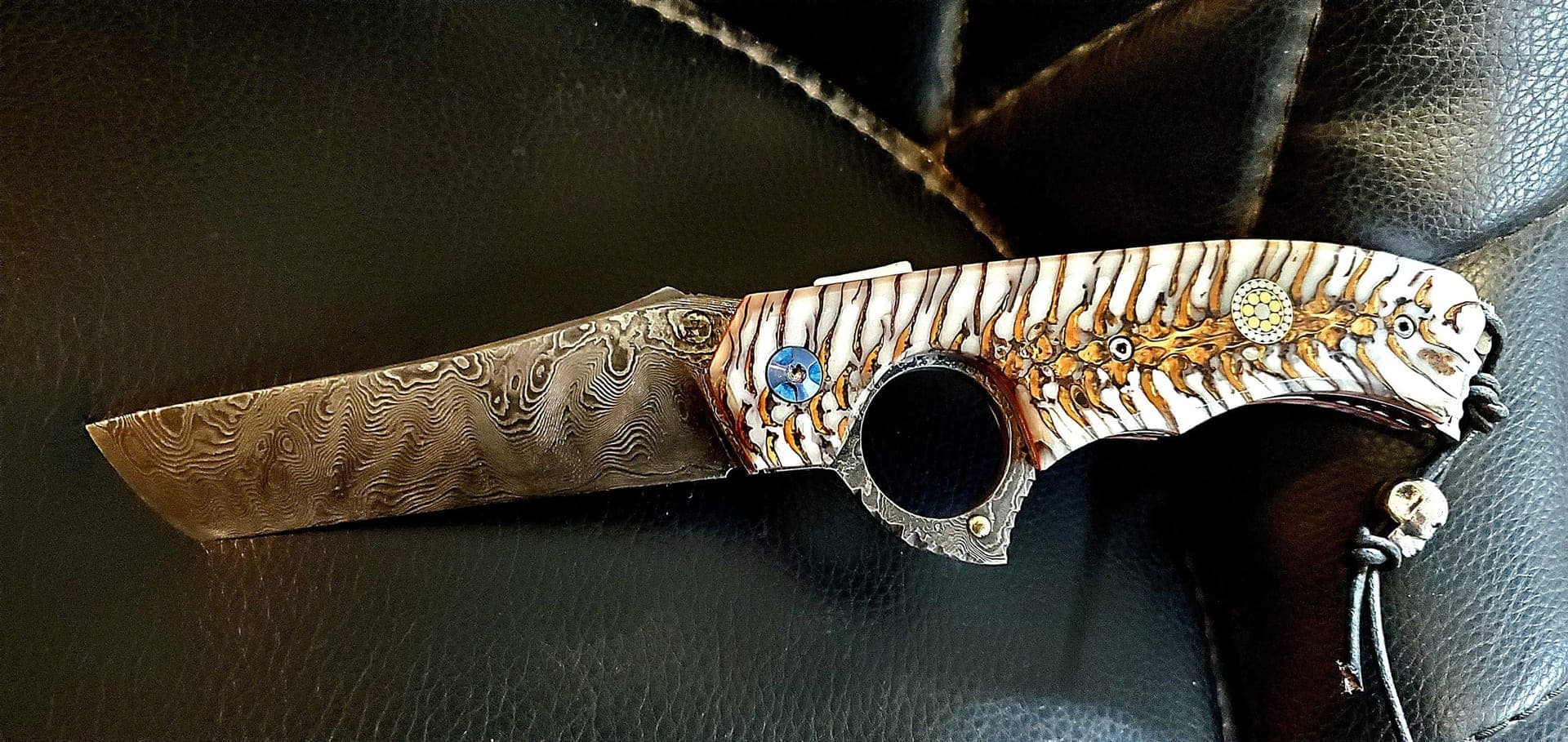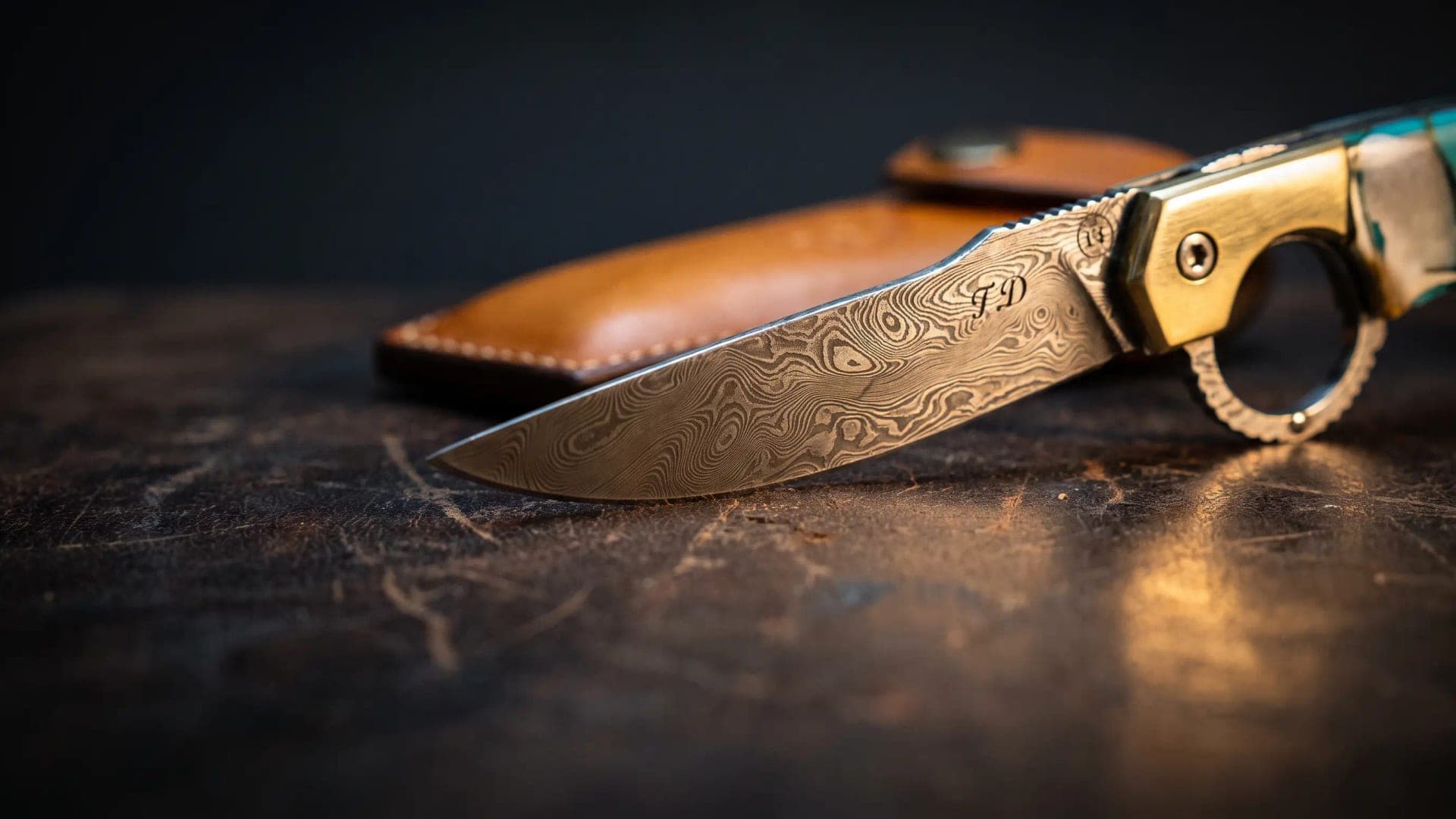
A folding knife can be found in a supermarket for a few tens of euros. From an artisan cutler, the same object, a blade, a handle, a pivot, costs several hundred euros. From a distance, nothing justifies the gap: both cut, both fold, both sit in the hand.
At Le Résiliant, in Thiers, a knife starts from €350 to €850 depending on the model, knife only. Asked what makes that gap, the cutler answers with three points: material, shape, and above all finishing time. Each of them corresponds to work that can be described.
This article takes them one by one, along with what surrounds them: what separates a factory knife from an artisan knife, the workshop's price grid, fitting and finishing, material and shape, artisan status, and finally the quote.
Why does an artisan knife cost more than a factory-made knife?
A factory knife spreads the cost of its machines across an entire run; an artisan knife pays above all for hand time, starting with finishing time. At Le Résiliant, the €350 to €850 gap between models comes down to material, shape and above all the time spent on finishing.
The word "factory" does not mean a bad knife. It describes a way of spreading costs: machines set up once, a long run, a unit price that falls as the run gets longer. The word "artisan" describes the opposite: few pieces, and a share of the price that pays for the time spent on each one.
The line is not watertight, and the workshop does not hide it. Of the eight models in the collection, two are semi-industrialised: for Le Mini Tanto and Le Tracker, cutting, heat treatment, grinding and handles are entrusted to different establishments, while polishing and assembly remain at the workshop. On the other six, the workshop does everything itself.
What remains the workshop's own work on each of the eight models, semi-industrialised ones included, is fitting the reverse-opening mechanism, polishing and assembly. It is in this work, and first of all in finishing, that the cutler places the price gap between his models.
From €350 to €850: what the workshop's price grid says
At Le Résiliant, the starting price of a knife on its own runs from €350 to €850 depending on the model. These are "from" prices: the quote is the only firm price. The leather sheath is never included; it is chosen as an option, at €50 for the plain black sheath or €70 for the black sheath with a tab.
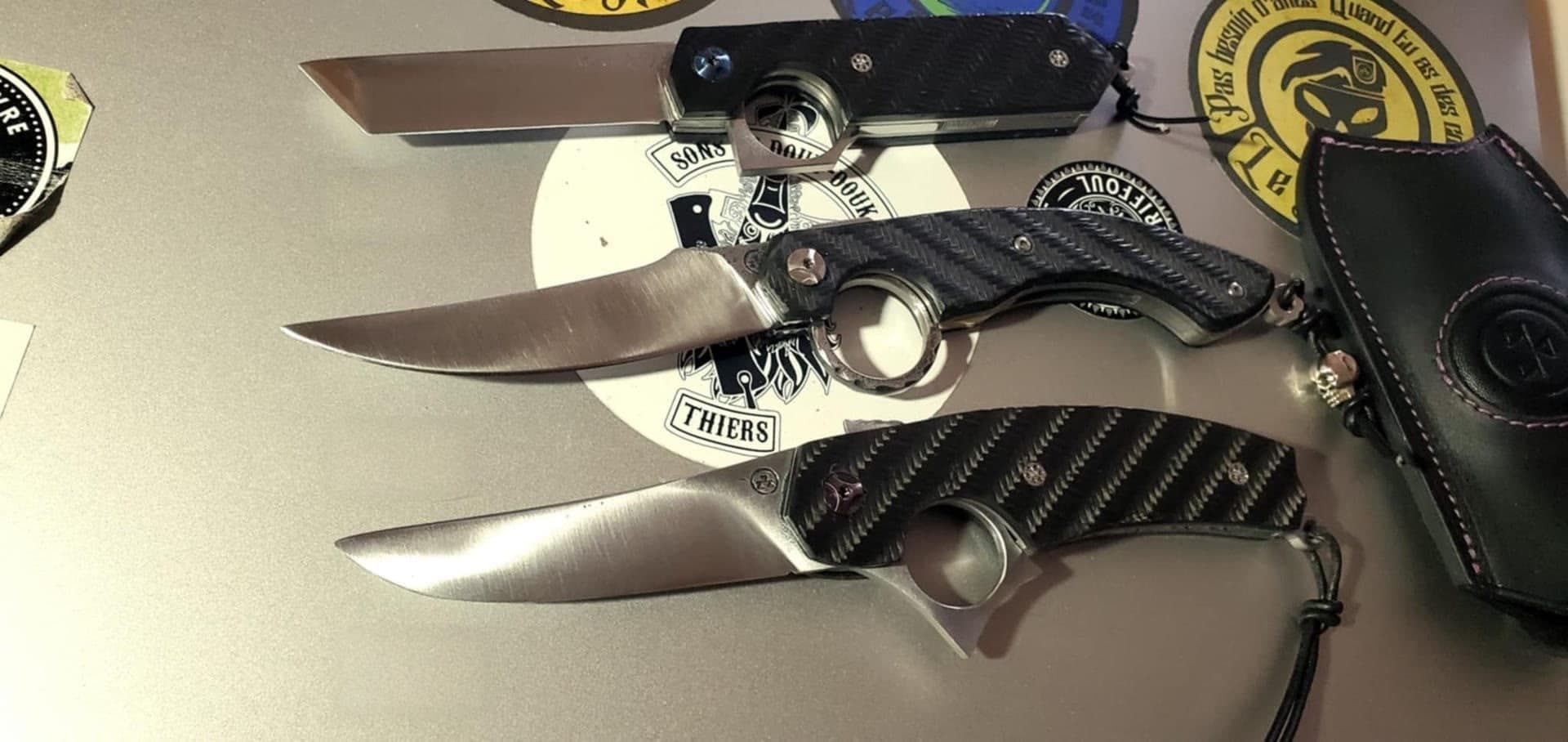
Three reference points are enough to read the grid. At the bottom, Le Mini Tanto and Le Tracker start at €350. They are also the only two semi-industrialised Résiliants, the two for which part of the steps is entrusted outside the workshop.
In the middle, Le Résiliant Tanto starts at €550. At the top, L'Archétype starts at €850. It exists only in damascus and is the culmination of five years of assembly, fitting and adjustment: a model that is handed down more than it is replaced.
Between these three markers, the other models range from €450 to €580. The model-by-model detail, and the logic of the damascus blade, are set out in the article on the price of a damascus knife. One rule is enough here: damascus replaces the starting price, it does not add to it.
These amounts can also be read on the site: the configurator calculates the starting price according to the blade, sheath and finishes chosen. It gives an idea before you get in touch; it does not replace the quote, the only firm price.
Fitting and finishing, two stages the workshop keeps apart
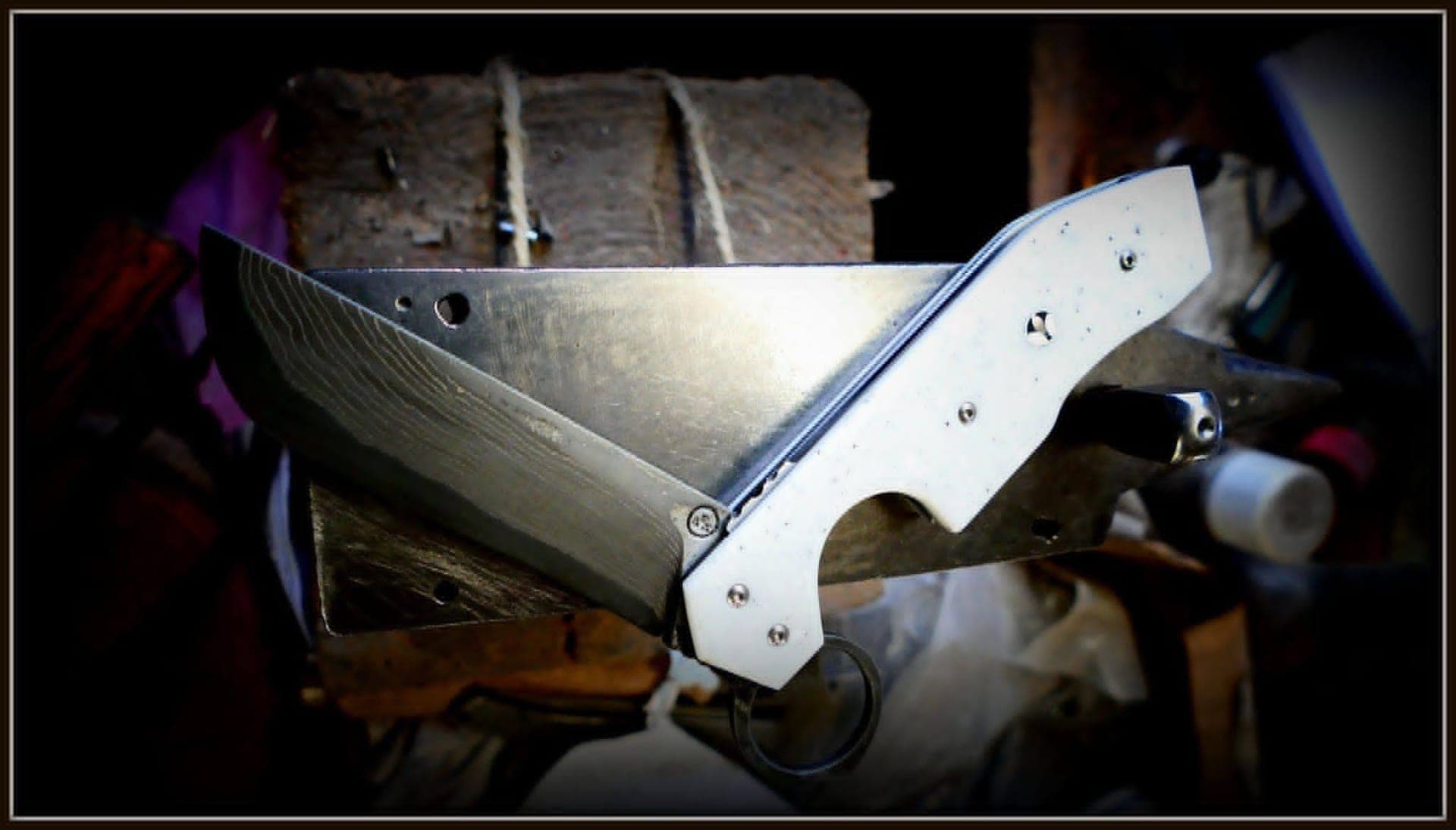
The cutler distinguishes two stages of work. Fitting is mechanical: the reverse-opening mechanism is adjusted in the vice, piece by piece; it is common to all eight models. Finishing is aesthetic, and it is above all on finishing that the price gap between models is decided.
Fitting concerns the mechanism specific to the Résiliant: a reversed liner lock, whose locking plate works at the top of the handle, and an entirely manual opening. It is done in the vice, piece by piece. This work is common to all eight models: it makes no distinction between the most accessible and the most expensive.
Finishing, on the other hand, has no obvious stopping point. The cutler puts it this way: "Once you start the finishing, you never stop." The sentence describes a method: he sets the knife down, comes back to it later, with fresh eyes, takes it apart, polishes it again, puts it back together. It is this finishing time that weighs most in the gap between models.
Polishing is done with cotton buffs and felts, using a greasy polishing paste. No varnish covers the result. The handle scales are screwed onto stainless steel liners, never glued.
What the price pays for here is not a material, it is hand time. The workshop publishes no finishing time, and this article gives none.
Material and shape, the other two lines of the price
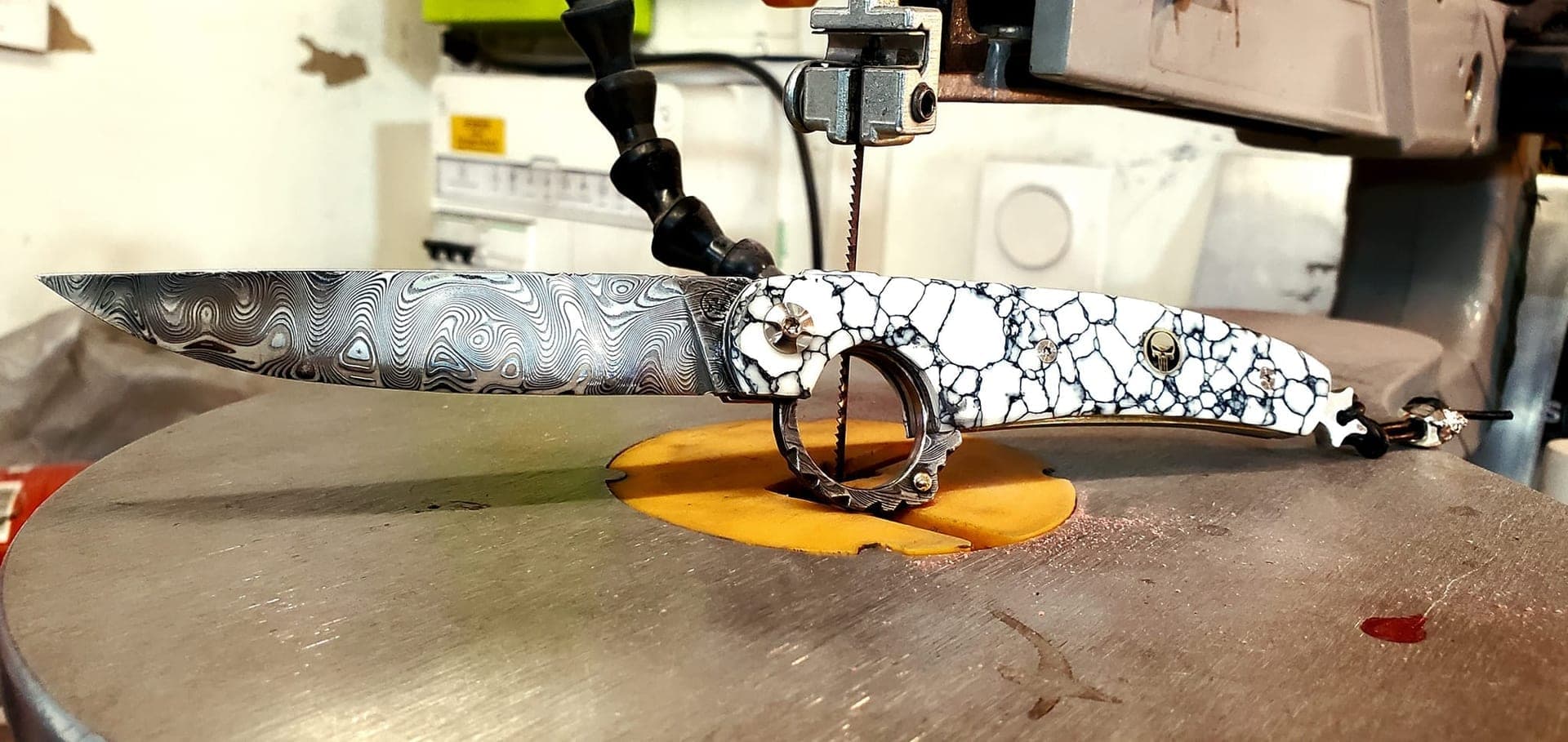
Alongside finishing, the cutler names two other causes of the price gap between his models: material and shape. Material means the steel of the blade and what dresses the handle. Shape means the design of the knife: some shapes are harder to finish by hand than others, and the price reflects it.
On the steel side, the workshop does not forge its blades. Damascus is bought in sheets, and each blade is cut out of it by hand. The D2 series, also known as Z160, are cut at a factory, a choice the workshop explains by the time saved relative to the selling price. The full process is described in how a Résiliant is born.
These two routes do not ask the same work of the workshop: a blade cut by hand from a damascus sheet occupies it from the cutting stage, a series blade arrives already cut. The "material" line of the price therefore covers both what the steel costs and what it demands.
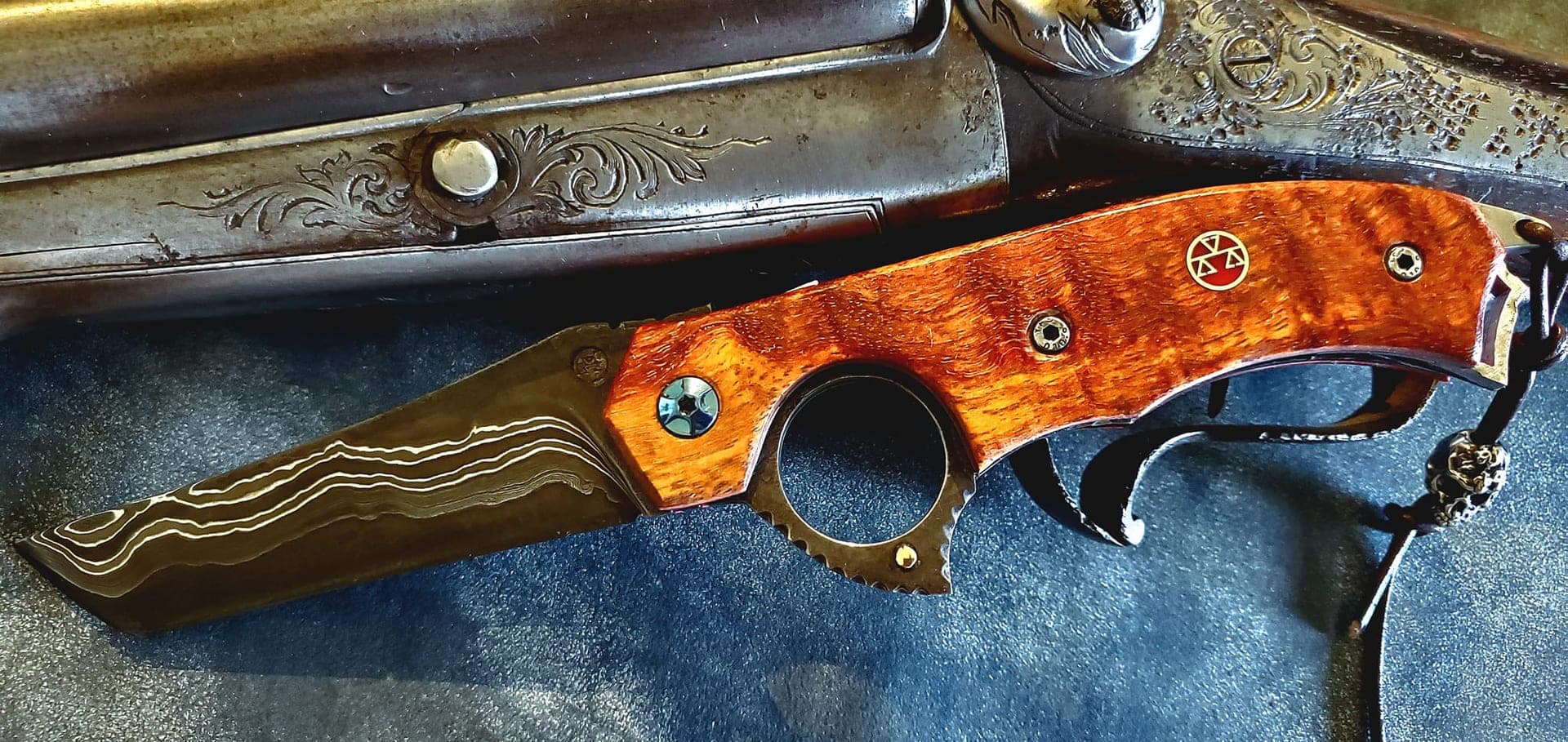
On the handle side, the workshop uses a great deal of wood from Burkina Faso, shea, ebony, padauk, roots, but also amboyna burl and pink ivory, a wood despite its name. Stabilisation is done on request and entrusted to a professional. Handles in reconstituted turquoise are kept for display pieces.
That leaves shape. According to the cutler, some shapes are harder to finish by hand than others; he has not named them, and this article does not do so in his place. Two knives in the same steel and the same wood therefore do not necessarily require the same finishing time.
Artisan: a status before it is a selling point
As defined by INSEE, the French statistics office, an artisanal business employs no more than ten employees, carries out an activity on a list set by decree and is registered in the trades directory. Le Résiliant's workshop falls under the Chambre de Métiers et de l'Artisanat: the word "artisan" designates a status, not a style.
The word appears on many labels. The status, however, can be checked: it rests on the size of the business, the nature of its activity and its registration. It says nothing, on the other hand, about how each piece was made, or about what was entrusted to others.
In Thiers, the distinction matters. The Thiers area produces nearly 80% of the knives made in France, and factories and workshops coexist there. The word "Thiers" therefore does not say who made the piece: that is the subject of the Journal article on the genuine Thiers knife.
There are also two main methods of making a blade: forging, which shapes the steel hot, and stock removal, which starts from a sheet and removes material from it. Le Résiliant's workshop works by stock removal; neither method, on its own, makes an artisan.
What the artisan does himself is simpler to state. On six of the eight models, the workshop does everything itself. On Le Mini Tanto and Le Tracker, it polishes and assembles blades and handles prepared by other establishments. The workshop says so openly.
A price set by quote, piece by piece
A Résiliant is sold by quote, with no online shop, because every piece is configured: model, steel or damascus, handle material. The quote sets the firm price. Under article L221-28 of the French Consumer Code, a piece made to its buyer's specifications carries no right of withdrawal.
The customer chooses three things: the model, the steel or damascus, and the handle material. Their detail is set out in the article on the personalised knife. The combination changes from one order to the next: the site therefore displays starting prices, and it is the quote that sets the price of the piece ordered.
This way of selling has a legal consequence worth knowing before ordering. Article L221-28 of the French Consumer Code excludes the right of withdrawal for goods made to the consumer's specifications or clearly personalised. A piece personalised by quote falls under this exception: it cannot be sent back like a catalogue purchase.
After delivery, the knife keeps a link with the workshop: "Any knife that has left the workshop can be sent back for its edge to be re-established, free of charge: only shipping remains down to its owner. Please get in touch before sending anything."
To get a firm price, simply request a quote, stating the model, steel and handle you have in mind. The quote gives the price of the piece; no figure published here replaces it.
- What determines the price of an artisan knife?
- Three things, according to Le Résiliant's cutler: the material of the blade and handle, the shape of the knife, some shapes being harder to finish by hand, and above all finishing time. Fitting the mechanism, for its part, is common to all eight models.
- Why are the Mini Tanto and the Tracker the most accessible Résiliants?
- Le Mini Tanto and Le Tracker start at €350, the lowest starting price in the collection. They are also the only two semi-industrialised models: cutting, heat treatment, grinding and handles are entrusted to different establishments, while polishing and assembly remain at the Thiers workshop.
- Is the price shown on the site the final price?
- No. The amounts shown are "from" prices. The site's configurator calculates a starting price according to the blade, sheath and finishes chosen; the only firm price is the one on the quote. The leather sheath, hand-stitched in Thiers, is an option, never included in the price of the knife.
- Can you withdraw from an order for a personalised knife?
- Article L221-28 of the French Consumer Code excludes the right of withdrawal for goods made to the consumer's specifications or clearly personalised. At Le Résiliant, a piece personalised by quote therefore carries no right of withdrawal.
- What is an artisan cutler?
- For INSEE, three criteria make an artisanal business: a workforce of no more than ten employees, an activity on a list set by decree, and registration in the trades directory. It is a verifiable status, not a decorative label. Le Résiliant's workshop, in Thiers, falls under the Chambre de Métiers et de l'Artisanat.
Sources
- Légifrance, Code de la consommation, article L221-28 — Le texte qui exclut le droit de rétractation pour les biens confectionnés selon les spécifications du consommateur ou nettement personnalisés.
- INSEE, définition « Artisanat » — Les critères de l'entreprise artisanale : pas plus de dix salariés, une activité figurant sur une liste établie par décret, une immatriculation au répertoire des métiers.
- Wikipédia « Coutellerie de Thiers » — Le bassin thiernois, qui produit près de 80 % des couteaux fabriqués en France.
- Wikipedia « Knife making » — Les deux méthodes de fabrication d'une lame : la forge et l'enlèvement de matière (stock removal).
- Wikipédia « Économie d'échelle » — La baisse du coût unitaire obtenue en répartissant les coûts fixes sur une production plus grande : le mécanisme qui rend un couteau de série moins cher à l'unité.