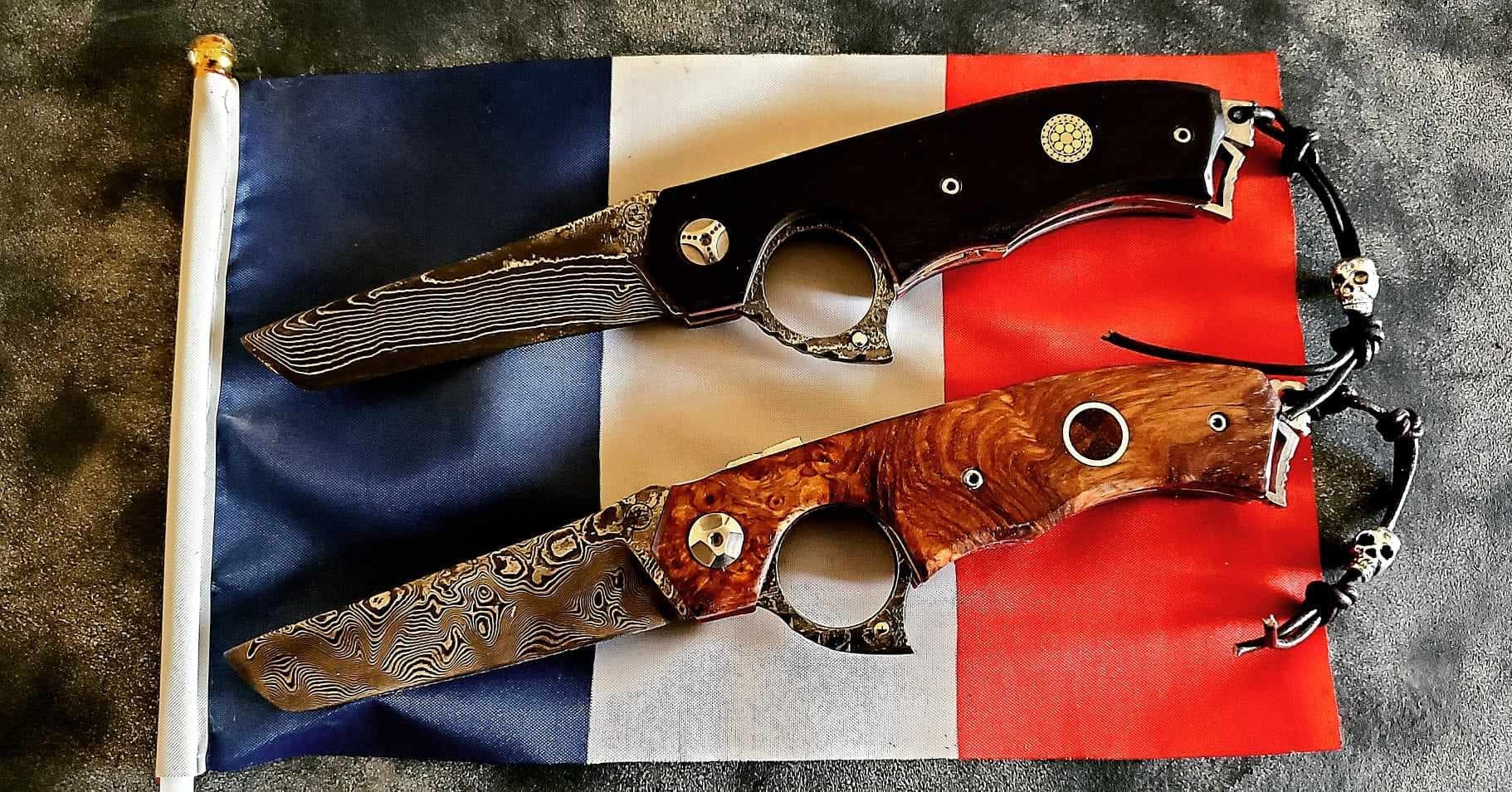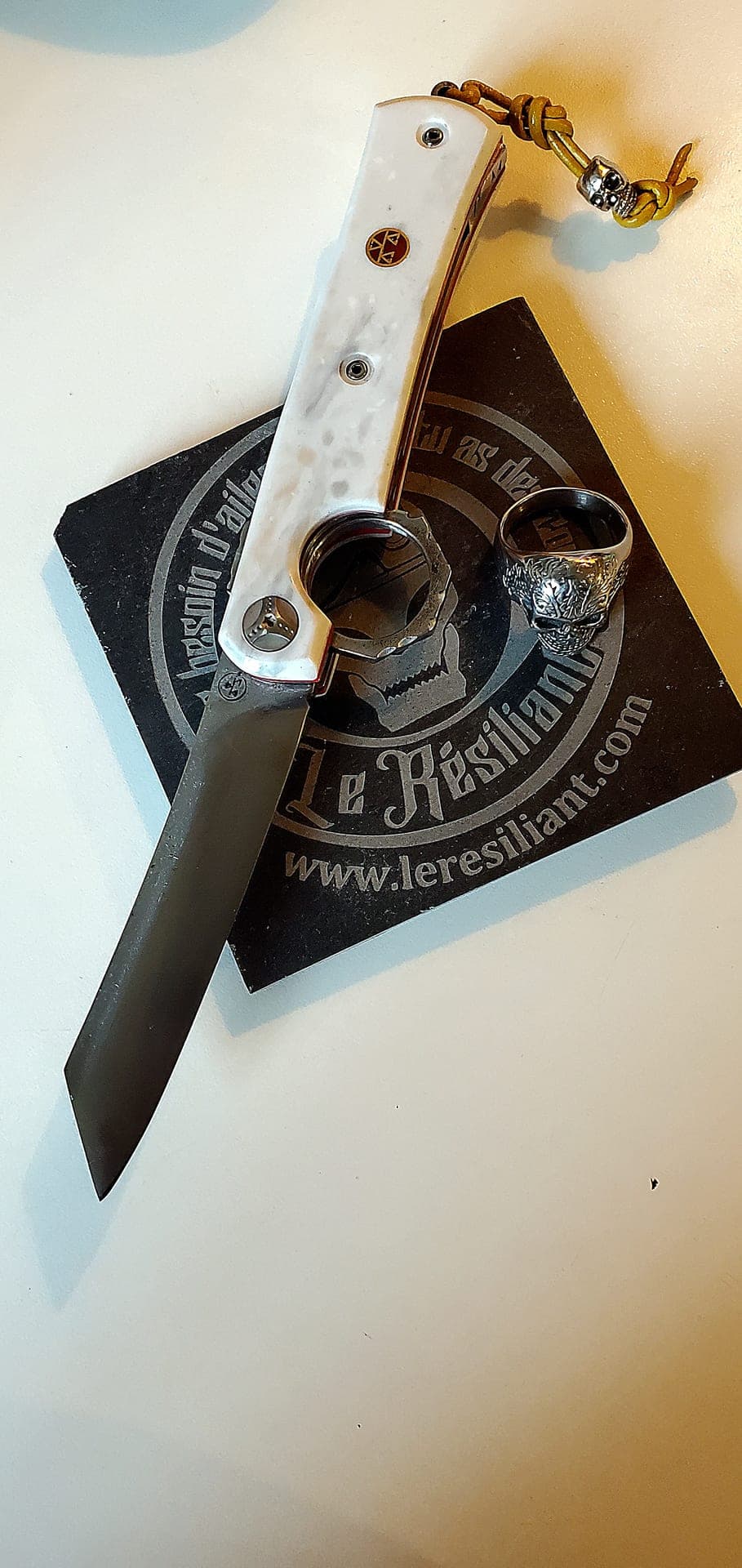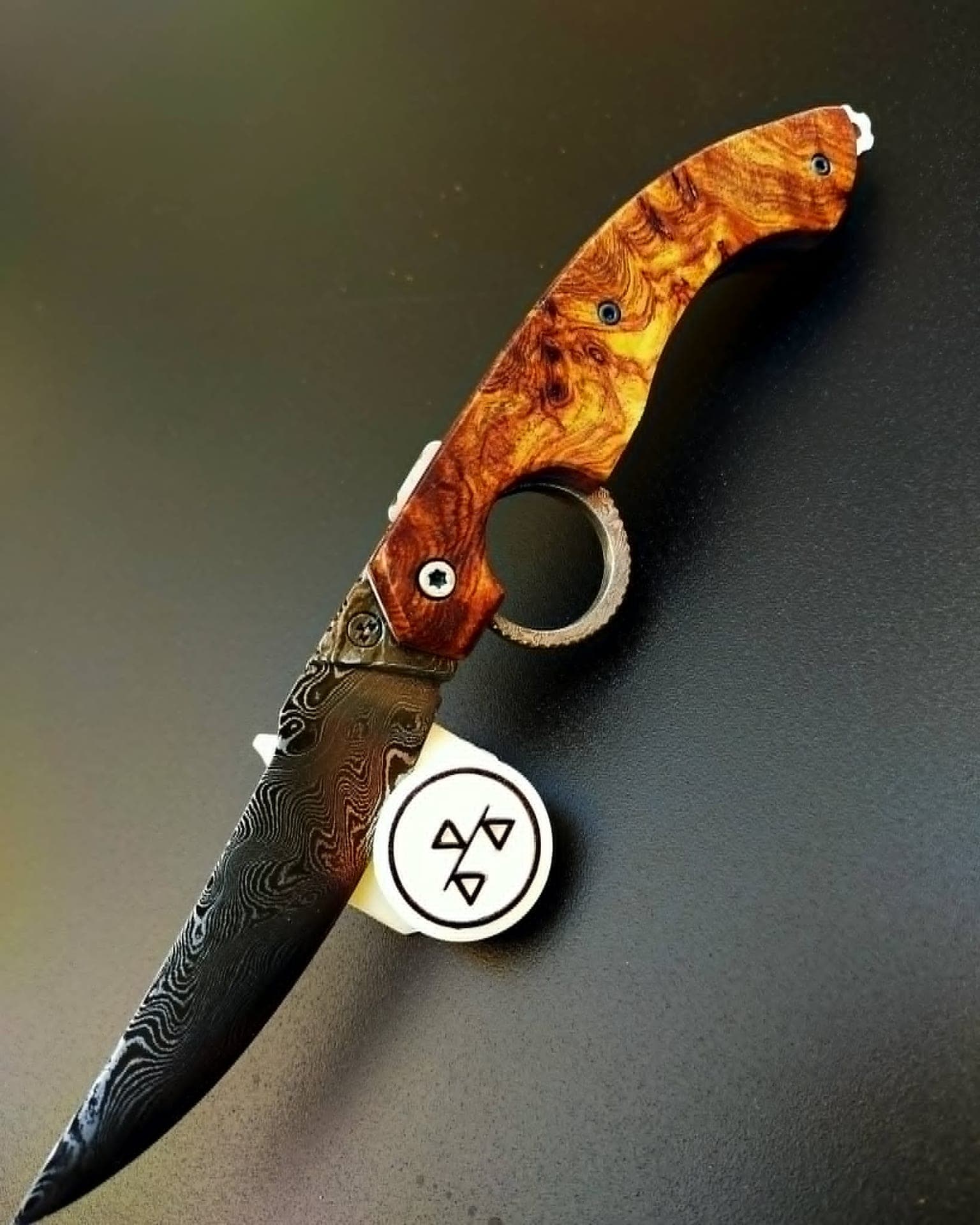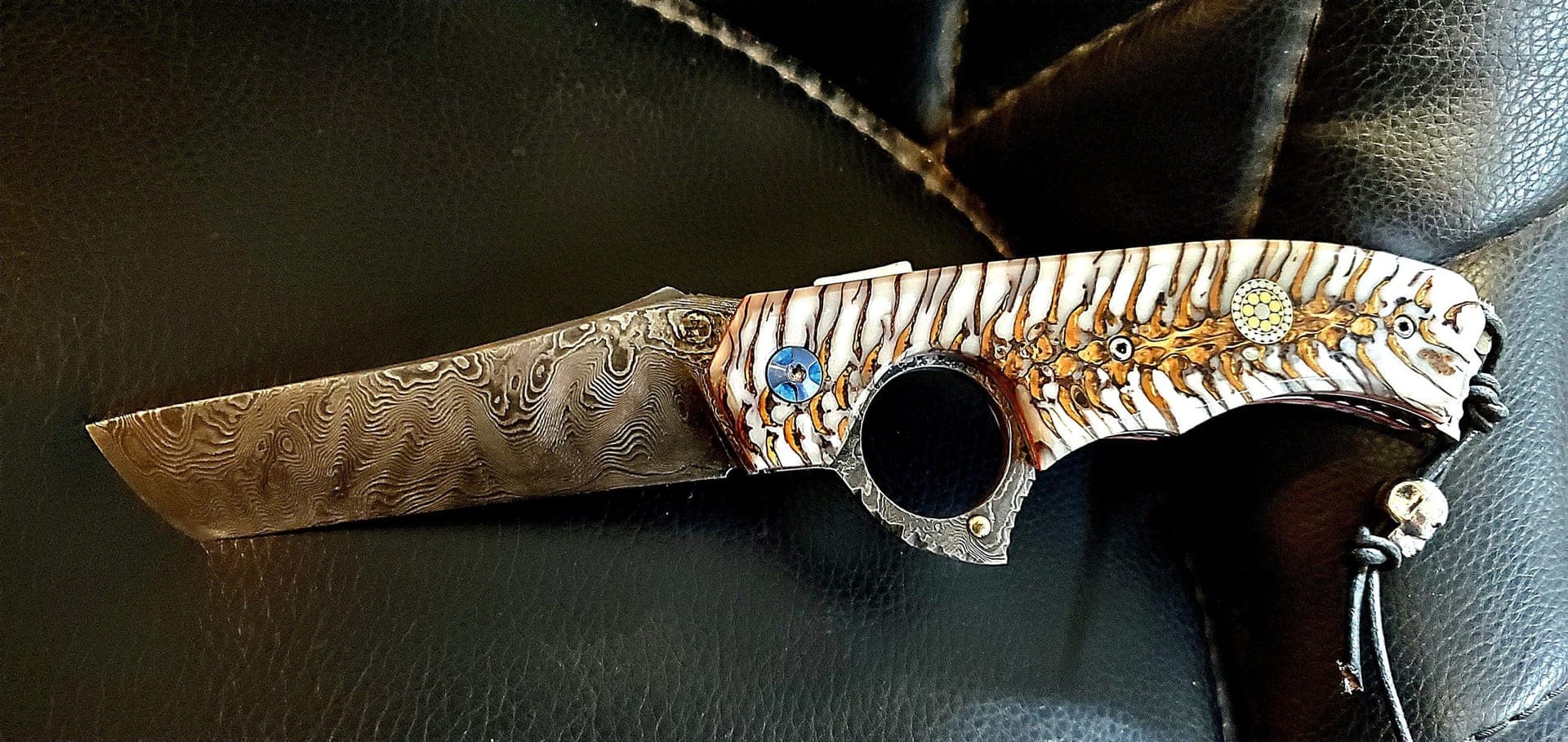
How much does a damascus steel knife cost? The question comes up constantly, and the answers stay vague. At a workshop that works to quote, every model still has a starting price, and that price follows a simple logic, one worth knowing before reading a quote.
The misunderstanding usually starts in the same place: people picture damascus as an option, one more line added to a price already set. Le Résiliant's pricing grid works differently, and that changes the way you read a quote.
This article sets out that grid as it stands today: what damascus replaces, what it includes, what it never includes, and what that choice changes once it reaches the workshop.
Damascus does not add to the price, it replaces it
Choosing a damascus blade does not add to the price of a knife, it replaces it. At Le Résiliant, a damascus blade starts at €760 on five models and at €560 on the two most accessible ones; L'Archétype, damascus from birth, starts at €850. The quote remains the only firm price.
Damascus is often read as an option you would add to an already-priced knife, a supplement stacked on top of a base price. That is not how Le Résiliant's grid works. Damascus is a choice of blade, and a blade is priced on its own terms: it replaces the model's starting price, it does not add to it.
Take Le Shotokan. In classic steel, it starts at €450. In damascus, it starts at €760. The damascus price is therefore not 450 plus 760, but €760 net: the classic blade's price simply drops out of the calculation once damascus is chosen.
The same logic applies to L'Archétype, with one nuance: this model exists only in so-called birth damascus, it never had a classic-steel version to compare itself with. Its starting price, €850, is therefore a full price, not a supplement.
All these figures remain starting prices. The model, the steel or the damascus, the handle material and the options are decided together at the quote stage, the only document that sets a firm price.
A damascus price does not follow the model's price
Starting prices in classic steel range from €350 to €580 depending on the model, but five models share the exact same damascus starting price, €760. It is the blade you are paying for, not the model: the gap between two models disappears once you move to damascus.
In classic steel, the collection's eight models do not all start at the same price. Le Mini Tanto and Le Tracker open the range at €350, Le Shotokan and Le Fhiers follow at €450, Le Résiliant 2.0 and Le Résiliant Tanto at €550, Le Mancharicou closes it at €580.
Once you move to damascus, this hierarchy tightens. Five models, Le Mancharicou, Le Résiliant 2.0, Le Résiliant Tanto, Le Shotokan and Le Fhiers, share exactly the same damascus starting price: €760. Whether they start at 450, 550 or €580 in classic steel no longer matters, the damascus blade brings them back to the same starting point.
Two models are the exception, for a reason tied to how they are made: Le Mini Tanto and Le Tracker, semi-industrialised, start at €560 in damascus, a more accessible price than the other five. L'Archétype, for its part, escapes the comparison entirely, since it exists only in damascus, starting at €850.
The practical reading is simple: at the quote stage, the price gap between two models in classic steel no longer applies once you move to damascus. It is the blade you are paying for, more than the model carrying it.
- Le Résiliant Tanto: €550 in classic steel, €760 in damascus.
- Le Résiliant 2.0: €550 in classic steel, €760 in damascus.
- Le Mancharicou: €580 in classic steel, €760 in damascus.
- Le Shotokan: €450 in classic steel, €760 in damascus.
- Le Fhiers: €450 in classic steel, €760 in damascus.
- Le Mini Tanto: €350 in classic steel, €560 in damascus.
- Le Tracker: €350 in classic steel, €560 in damascus.
- L'Archétype: damascus from birth, from €850.
What the price of a damascus blade includes, and what it does not
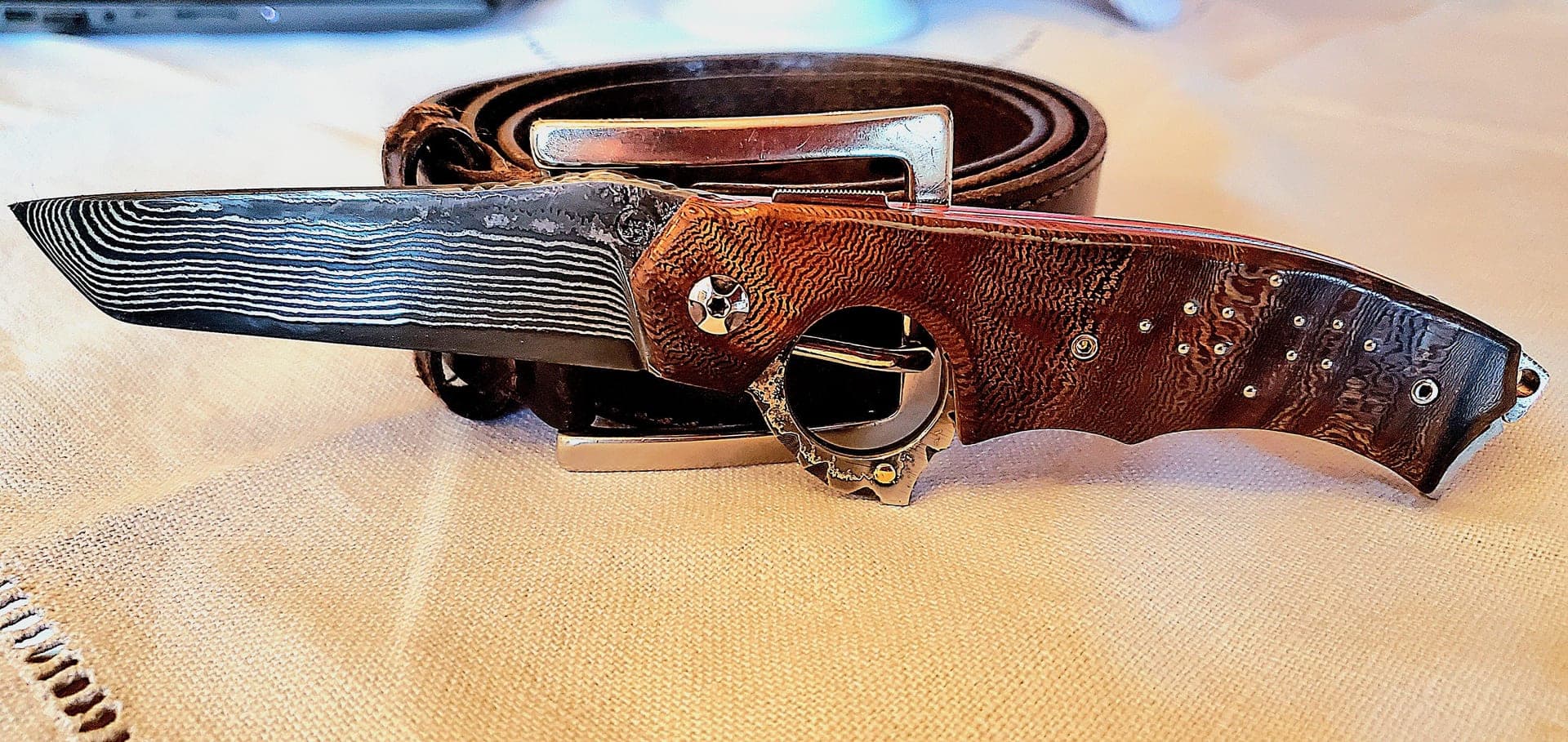
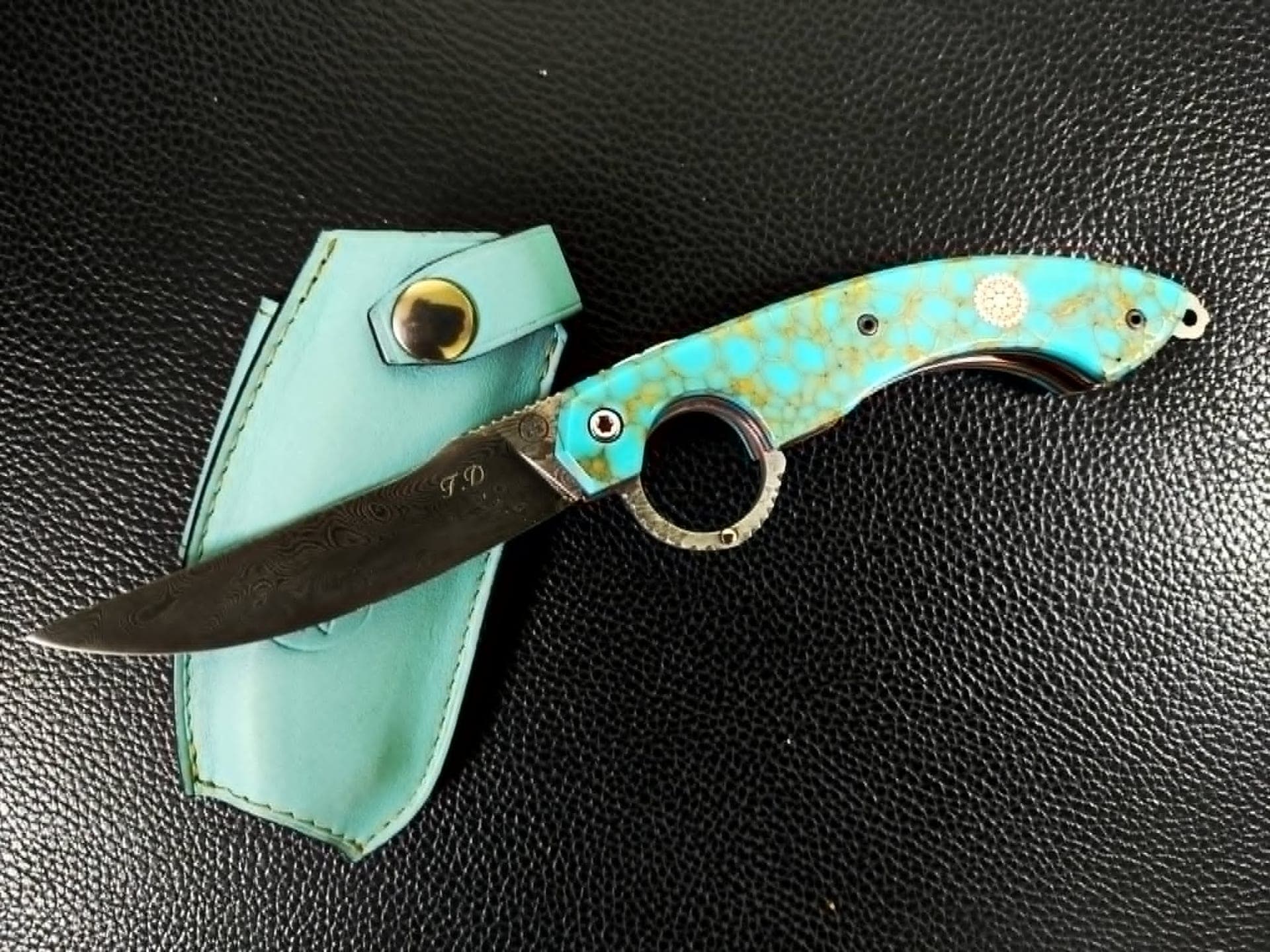
On a damascus blade, the workshop's four finishes, mosaic rivet, engraved bolster, engraved blade and silver hallmark, are included, when they are charged from €30 to €60 on a classic blade. The small silver fish on damascus versions comes at no extra cost either. The leather sheath, on the other hand, is never included.
A damascus blade at Le Résiliant includes, at no extra cost, the four finishes the workshop offers as options on a classic blade: the mosaic rivet, at €30, the engraved bolster, at €60, the engraved blade, at €40, and the silver hallmark, at €30.
On a classic blade, these finishes add to the starting price; on a damascus blade, they are included. One signature is added specifically to damascus versions: a small silver fish, the workshop's signature, also at no extra cost. Le Mini Tanto and Le Tracker only offer these finishes in damascus, not in classic steel.
The leather sheath, meanwhile, never enters into these prices, damascus or not: it remains an option to choose separately, never preselected. Two levels exist, plain leather at €35, and leather with a colour tab matched to the handle at €70, both hand-stitched in Thiers.
Engraving, for its part, remains a paid option, quoted individually: the workshop does not communicate a fixed rate beyond that step.
What the workshop buys, and what it does itself
The workshop does not forge its damascus: it buys it in sheets and cuts each blade out by hand, while blades in the D2 or Z160 series are cut by machine. Part of the price gap comes from there, from the material bought and the work it then requires.
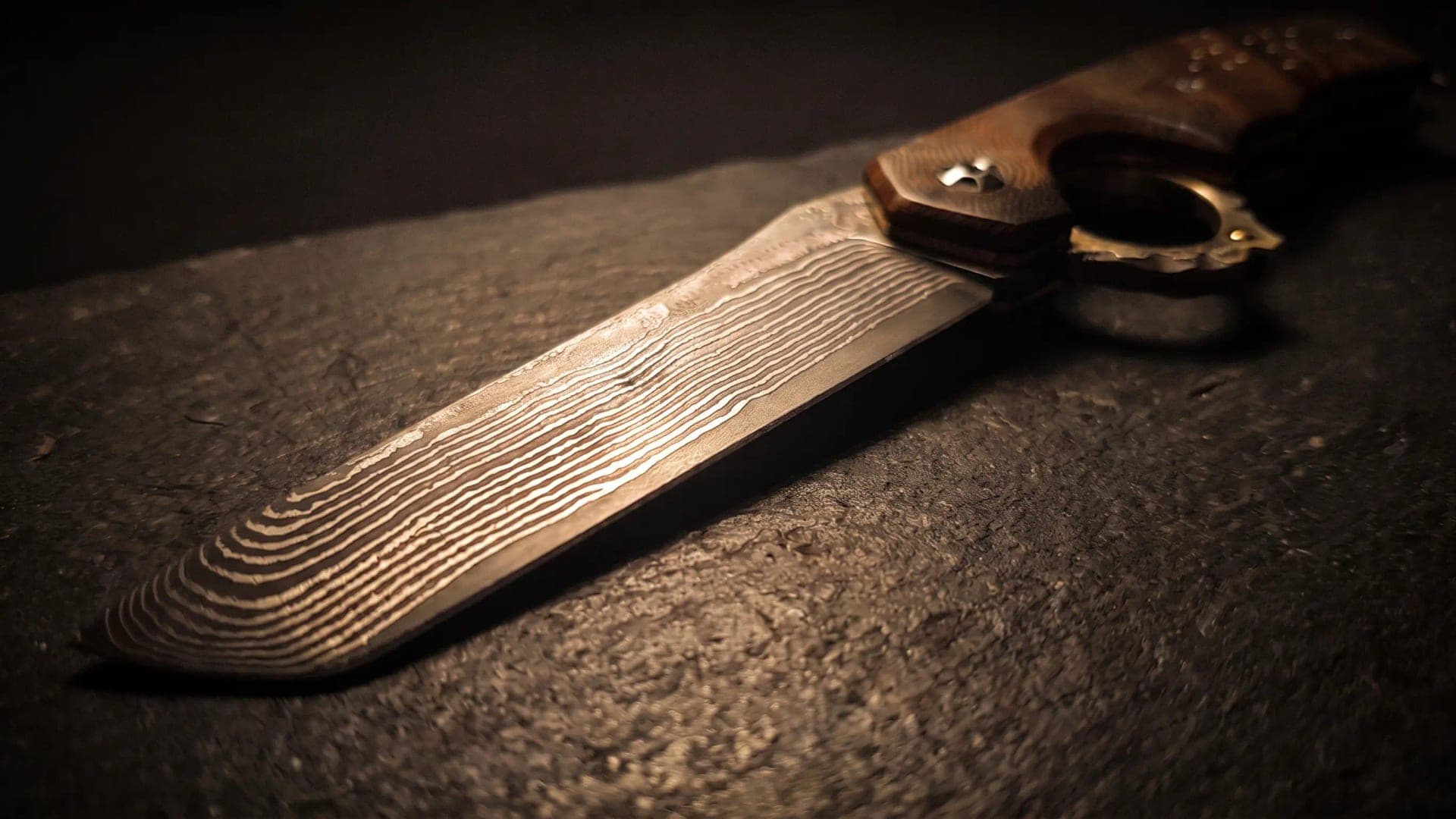
The workshop does not forge its damascus blades: the material arrives as sheets that are already pattern-welded, bought ready-made. Each damascus blade is then cut out by hand from that sheet, using a scribe, a pillar drill and an angle grinder.
The D2 or Z160 series, on the other hand, take a different route: their blades are cut by machine, a choice driven by the time saved relative to the selling price of those models.
Part of the gap between a classic blade and a damascus blade sits in that difference: the price of the damascus sheet itself, and the time its hand-cutting demands afterwards, before hardening and assembly even begin. For the full process, see how a Résiliant is born and the article on damascus steel.
Damascus costs no more to maintain
Maintaining a damascus blade is no different from maintaining the steel it is made of, nothing more, nothing less: wiping it after use, keeping it dry, a drop of oil, a honing steel to true the edge. No special product, no upkeep budget tied to the pattern itself.
A damascus knife costs no more to maintain because it is damascus. What determines the upkeep is the steel the blade is made of, not its pattern: carbon damascus develops a patina and needs the same care as any classic carbon steel, stainless damascus is content with simpler upkeep.
The gestures themselves are not specific to this article: wiping the blade after use, keeping it dry, oiling it lightly during long periods of inactivity. Their detail, and how to remove surface rust without damaging the edge, is covered in the article on rust and patina.
As for the edge, the routine remains the honing steel, which straightens the edge without removing material; the sharpening stone remains the fallback, once the steel is no longer enough. Neither of these two gestures carries any cost tied to damascus: they apply to any blade in the collection.
And when a blade, damascus or not, truly stops cutting, the edge-service applies the same way: « Any knife that has left the workshop can be sent back for its edge to be re-established, free of charge: only shipping remains down to its owner. Please get in touch before sending anything. »
Choosing damascus, or not, at the quote stage
Damascus is a choice of appearance and of an author's piece, not a cutting advantage: it is decided at the quote stage, together with the model and the handle material, within the limits of a template that does not bend. The eight models do not offer it at the same price.
Damascus is not a cutting advantage: on that point, the answer has already been given elsewhere, damascus does not cut better than a well-treated monosteel blade. It is a choice of appearance, and an author's piece: every sheet has its own pattern, no blade is strictly identical to another.
Within the collection, damascus does not occupy the same place across models. L'Archétype exists only in damascus, from birth, with no other option. Le Shotokan comes in either suminagashi or artisanal carbon damascus. Le Mancharicou also carries the workshop's small silver fish on its damascus versions, at no extra cost.
This choice is made at the quote stage, together with the model and the handle material, within the limits of the template specific to each model, months in the making: the reverse-opening mechanism does not bend, the blade and the finish do. The workshop stays in Thiers, where every piece is fitted by hand.
Damascus therefore does not cost the same across the whole collection, and it is never chosen on its own: it is at the quote stage that the price is set, model by model.
- How much does a damascus steel knife cost?
- At Le Résiliant, a damascus blade starts at €760 on Le Mancharicou, Le Résiliant 2.0, Le Résiliant Tanto, Le Shotokan and Le Fhiers, and at €560 on Le Mini Tanto and Le Tracker. L'Archétype, damascus from birth, starts at €850. The quote remains the only firm price.
- Is damascus a supplement added to the price of the knife?
- No. Damascus replaces the model's classic-steel starting price, it does not add to it. A damascus Shotokan starts at €760, not at €450 plus €760. Only L'Archétype, damascus from birth, never had a classic-steel version to compare against.
- Are the finishes included on a damascus blade?
- Yes. The mosaic rivet, the engraved bolster, the engraved blade and the silver hallmark, charged from €30 to €60 on a classic blade, are included on a damascus blade. The workshop's small silver fish is added as well, at no extra cost.
- Is the leather sheath included in the price of a damascus knife?
- No, the sheath is never included, damascus or not. Two levels exist as an option: plain leather at €35, leather with a colour tab matched to the handle at €70. Both are hand-stitched in Thiers, never preselected at the quote stage.
- Does a damascus knife cost more to maintain?
- No. Upkeep depends on the steel, not the pattern: carbon damascus develops a patina and needs the same care as classic carbon steel, wiping, keeping it dry, a drop of oil. No extra product or gesture is tied to damascus itself.
Sources
- Wikipédia « Acier de Damas » — Distingue le wootz historique du damas de corroyage moderne, celui qu'on achète aujourd'hui en plaques déjà soudées.
- Knife Steel Nerds, « Wootz, the true Damascus steel ? » — Synthèse technique publiée par un docteur en science des matériaux : ce qui fait la coupe d'une lame, c'est l'acier et son traitement thermique, pas le motif.
- Wikipédia « Suminagashi (type d'acier) » — Le damas japonais dit « encre coulante », celui que porte Le Shotokan en option.
- Wikipédia « Coutellerie de Thiers » — Sept siècles de coutellerie dans le bassin thiernois, où l'atelier du Résiliant façonne aujourd'hui ses lames, damas compris.