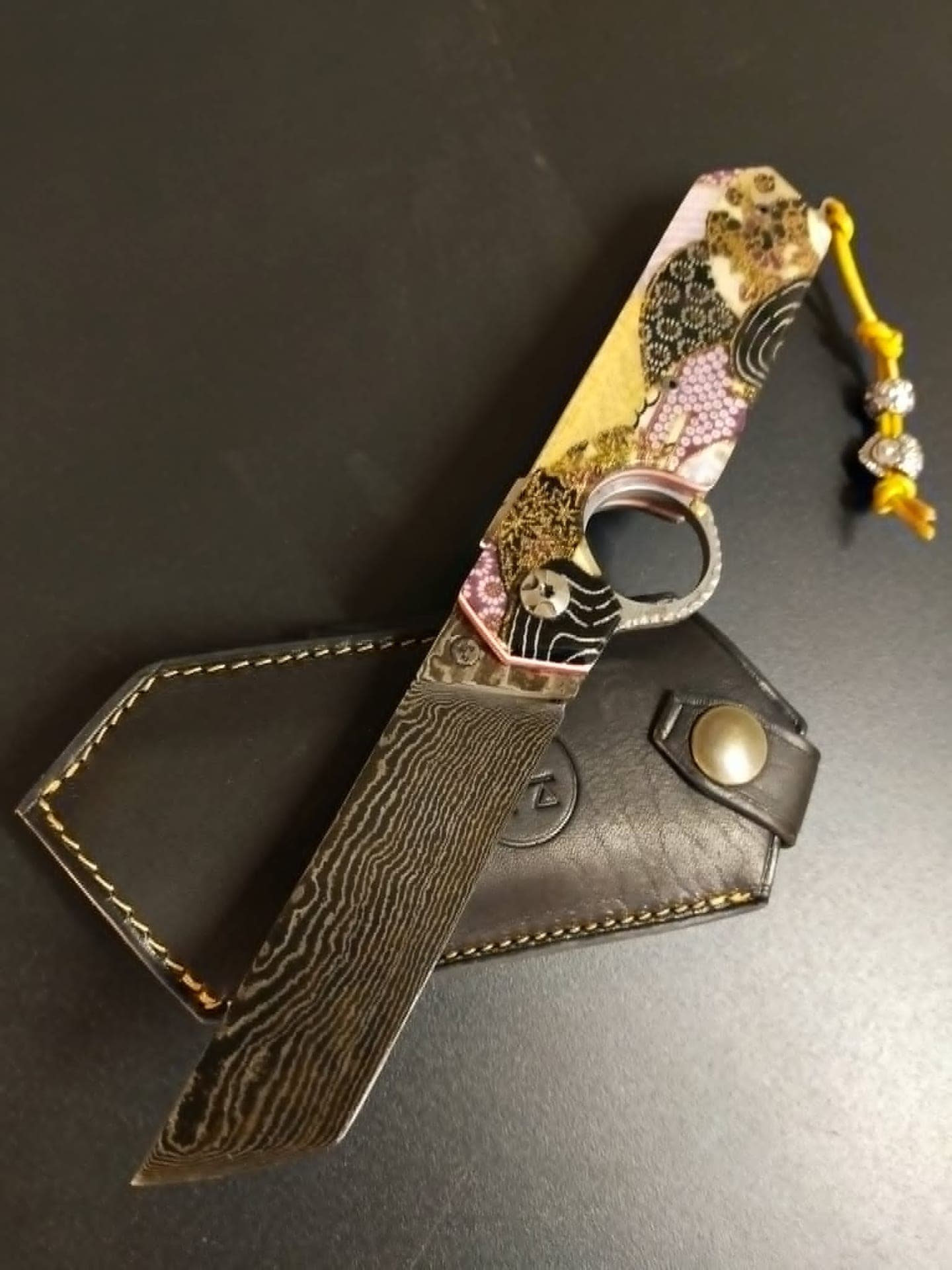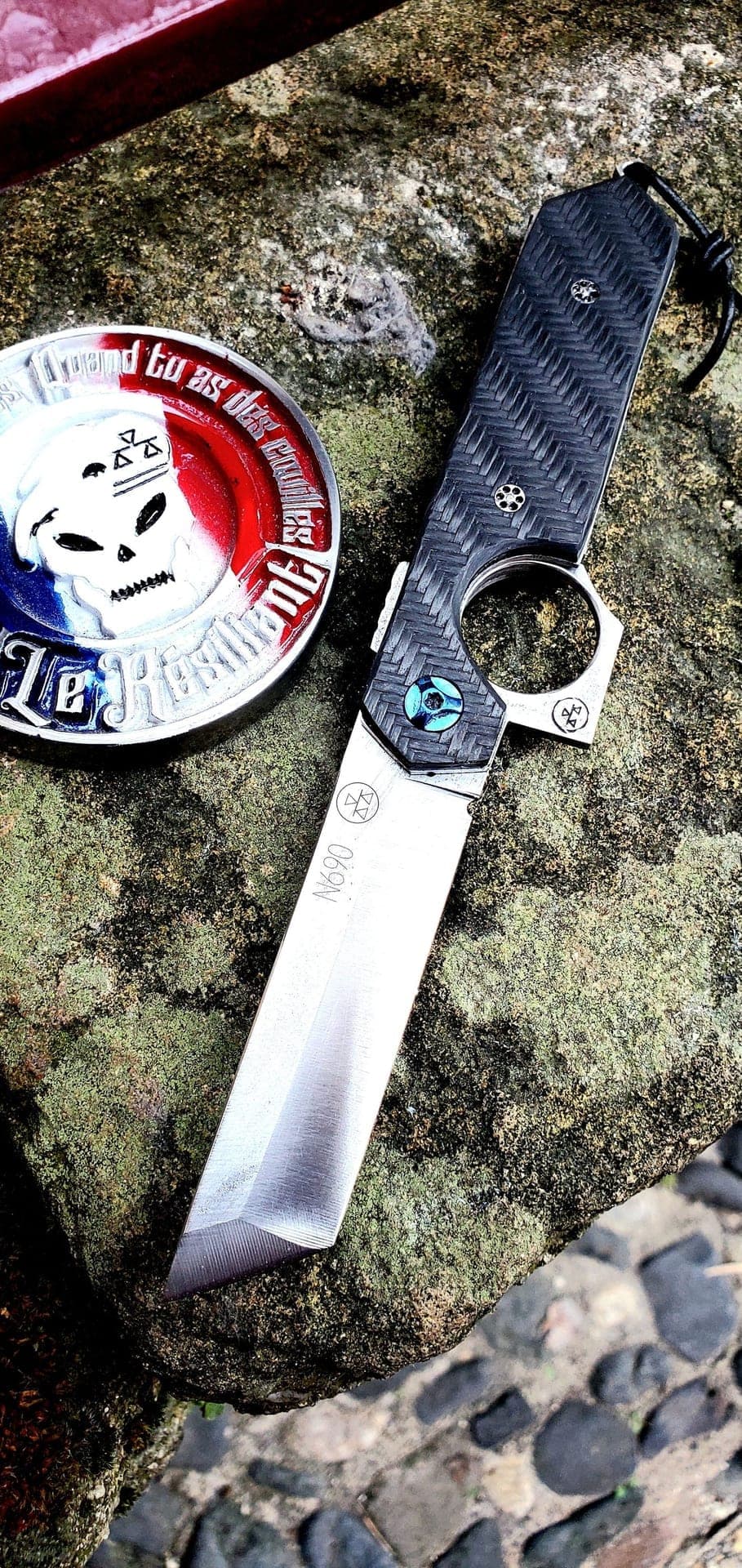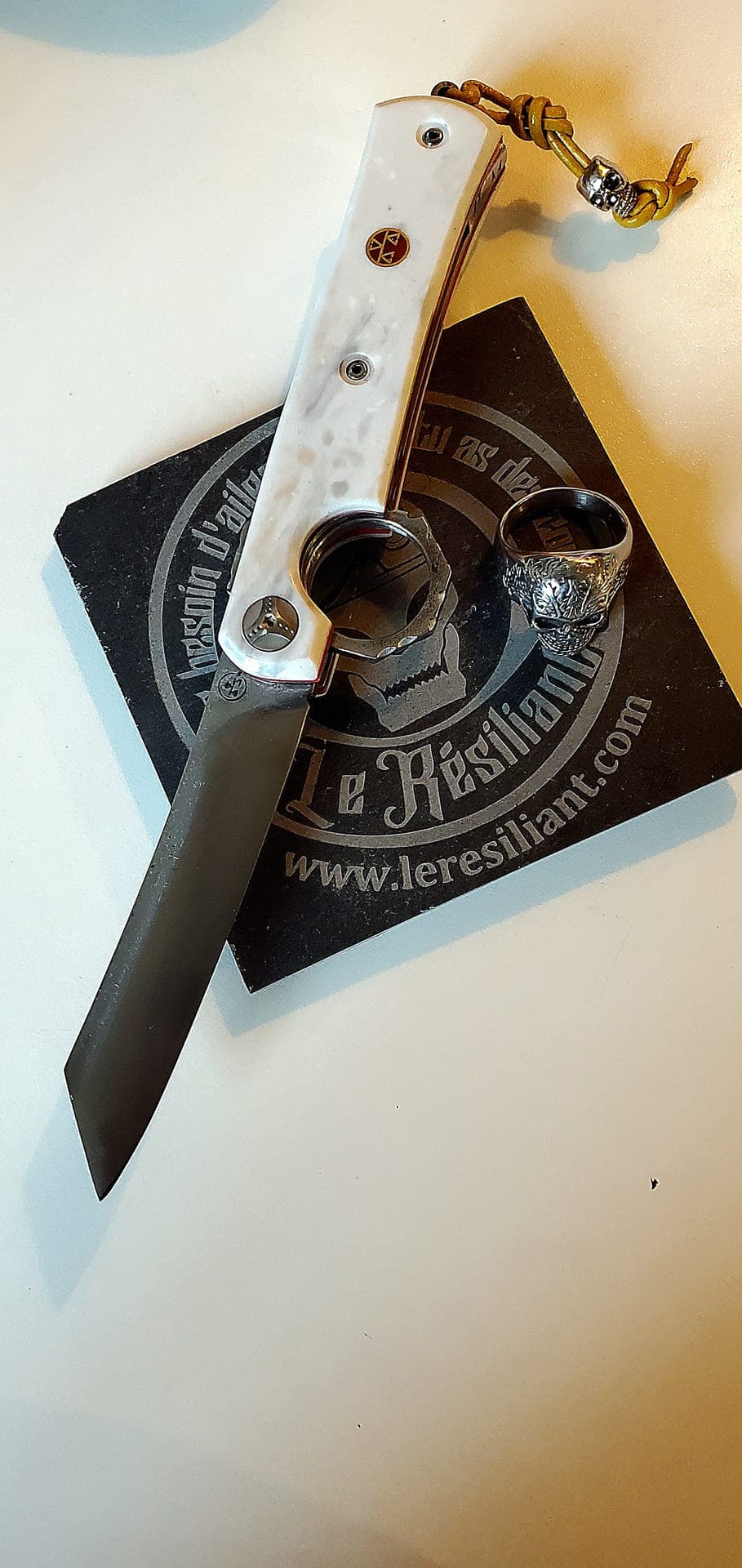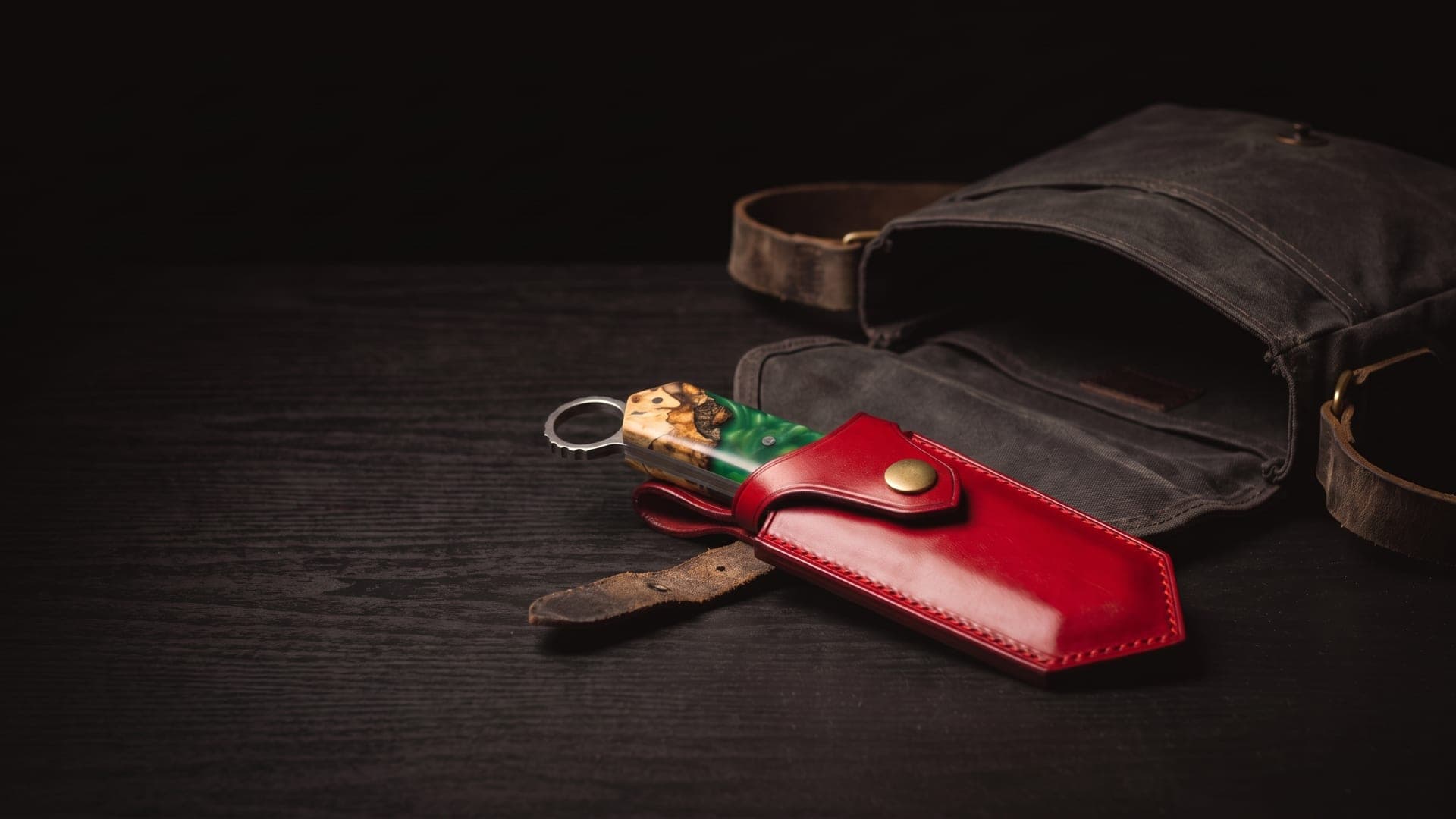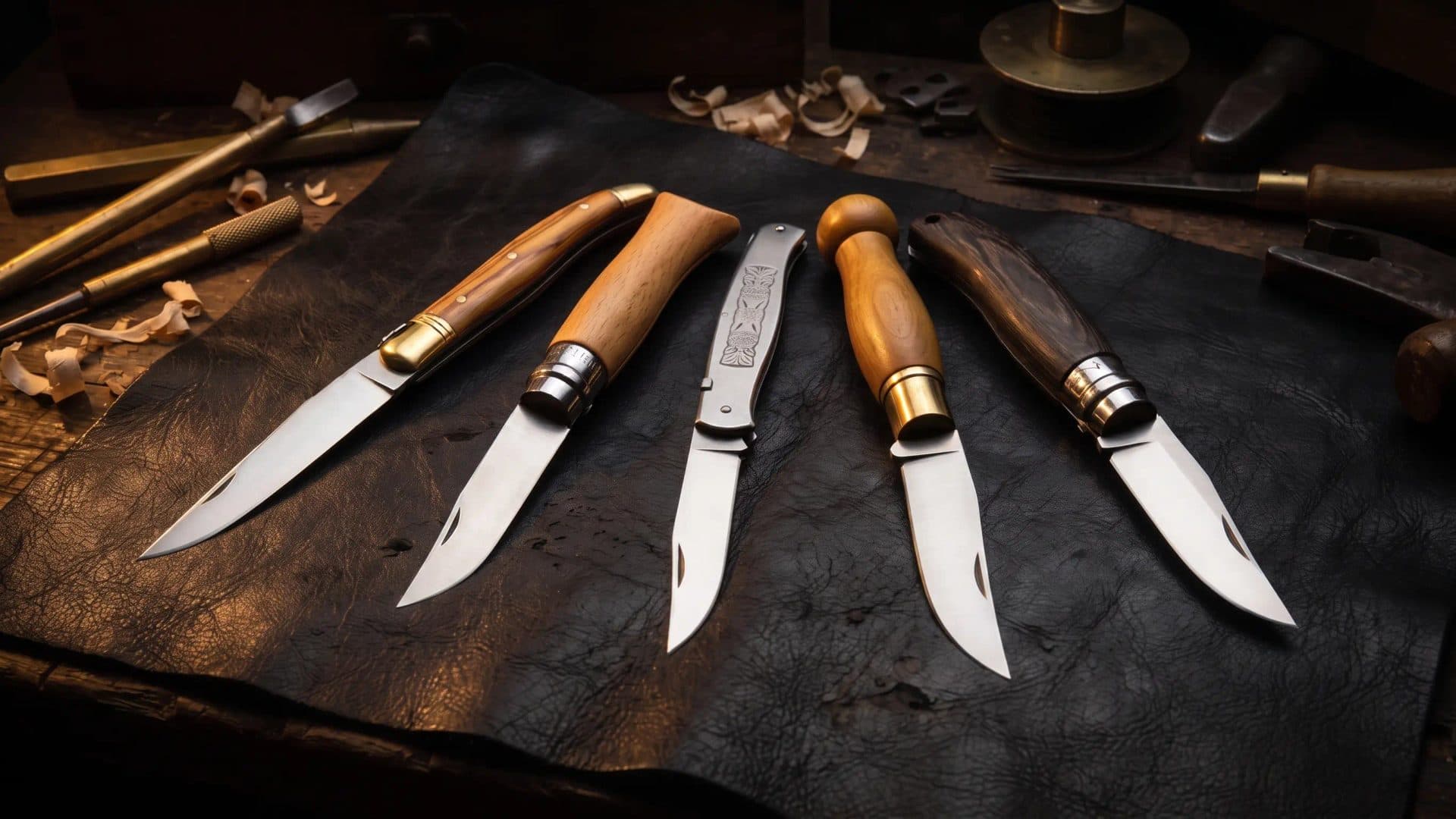
In France, the phrase "pocket knife" covers objects that share almost nothing beyond folding shut and fitting in a pocket. A table Opinel, a Laguiole pulled out for cheese, a Douk-Douk carried in a back pocket and a Résiliant worn on a belt all belong to the same family of words, not the same family of objects.
Each of these knives was born from a place, a trade and a constraint, and what really tells them apart is not the shape of the blade but how it opens and locks, a lesson every regional family below had to learn in its own way. A knife that has fit in a pocket for two centuries had to solve one problem before any other: staying closed when it should, staying open when it is used.
This guide starts from what the term actually covers, moves through five documented regional families, details the opening systems that truly separate them, helps choose a knife by use, recalls what French law allows, and ends in Thiers, where a workshop has added to these families a knife defined by its mechanism rather than its region.
What a pocket knife actually covers
A pocket knife is a folding knife: its blade retracts into the handle, unlike a fixed blade carried in a rigid sheath. The word "canif" historically named this small folder. The real dividing line is not size but locking: a blade merely held by a spring, or a blade locked in the open position.
The format sets its own rules, and has done for as long as knives have travelled in pockets. A knife that has to disappear into a pocket or a belt sheath cannot be too long, too thick or too heavy: its blade folds precisely to fit that space, while staying sturdy enough to cut bread, whittle wood or open a parcel.
This size constraint has made locking the cutlers' obsession for centuries. A folder without a lock closes at the slightest badly aimed pressure, which limits it to light tasks. A locked folder behaves, for the length of the cut, almost like a fixed blade, which explains why so many different systems were invented to solve the same problem.
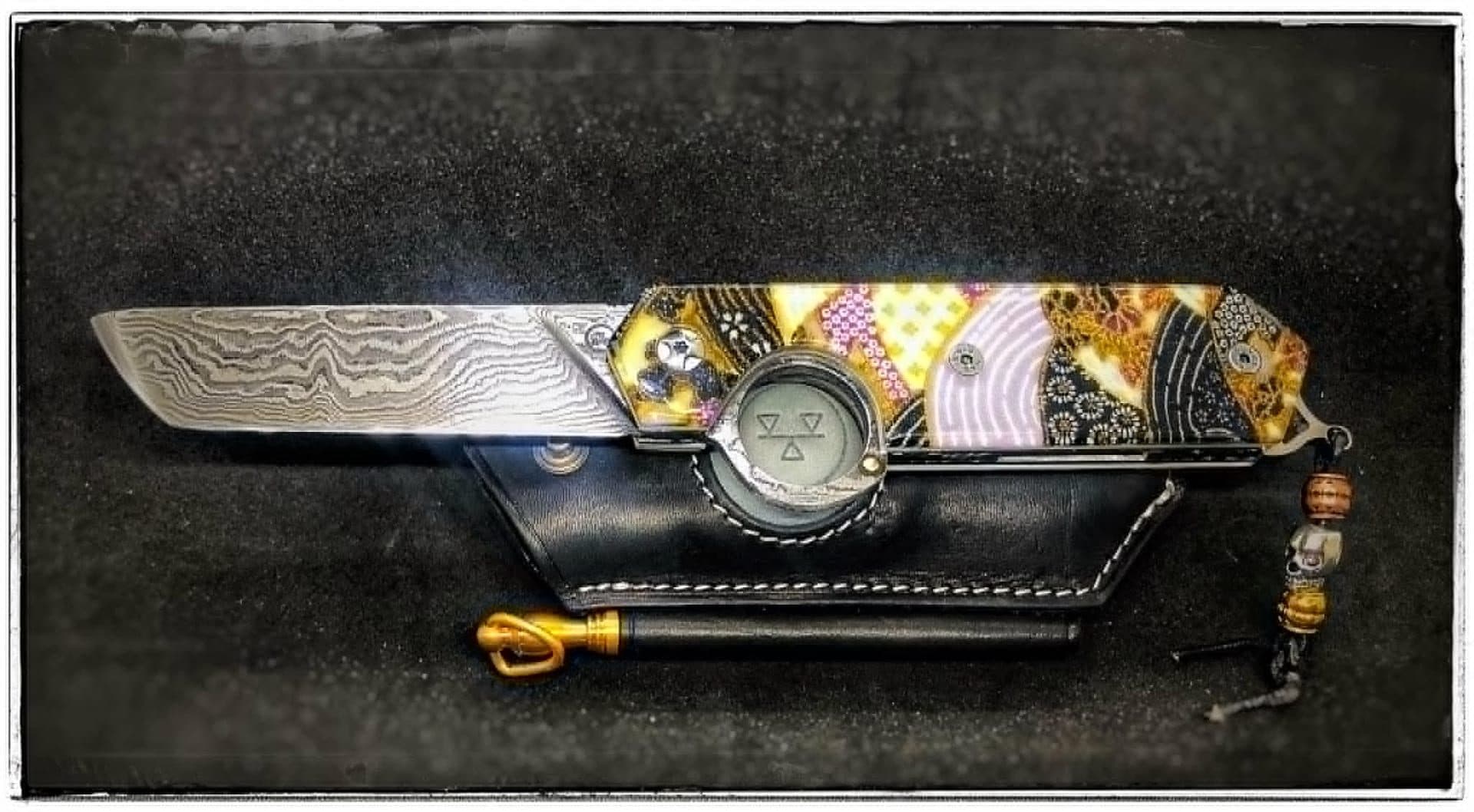
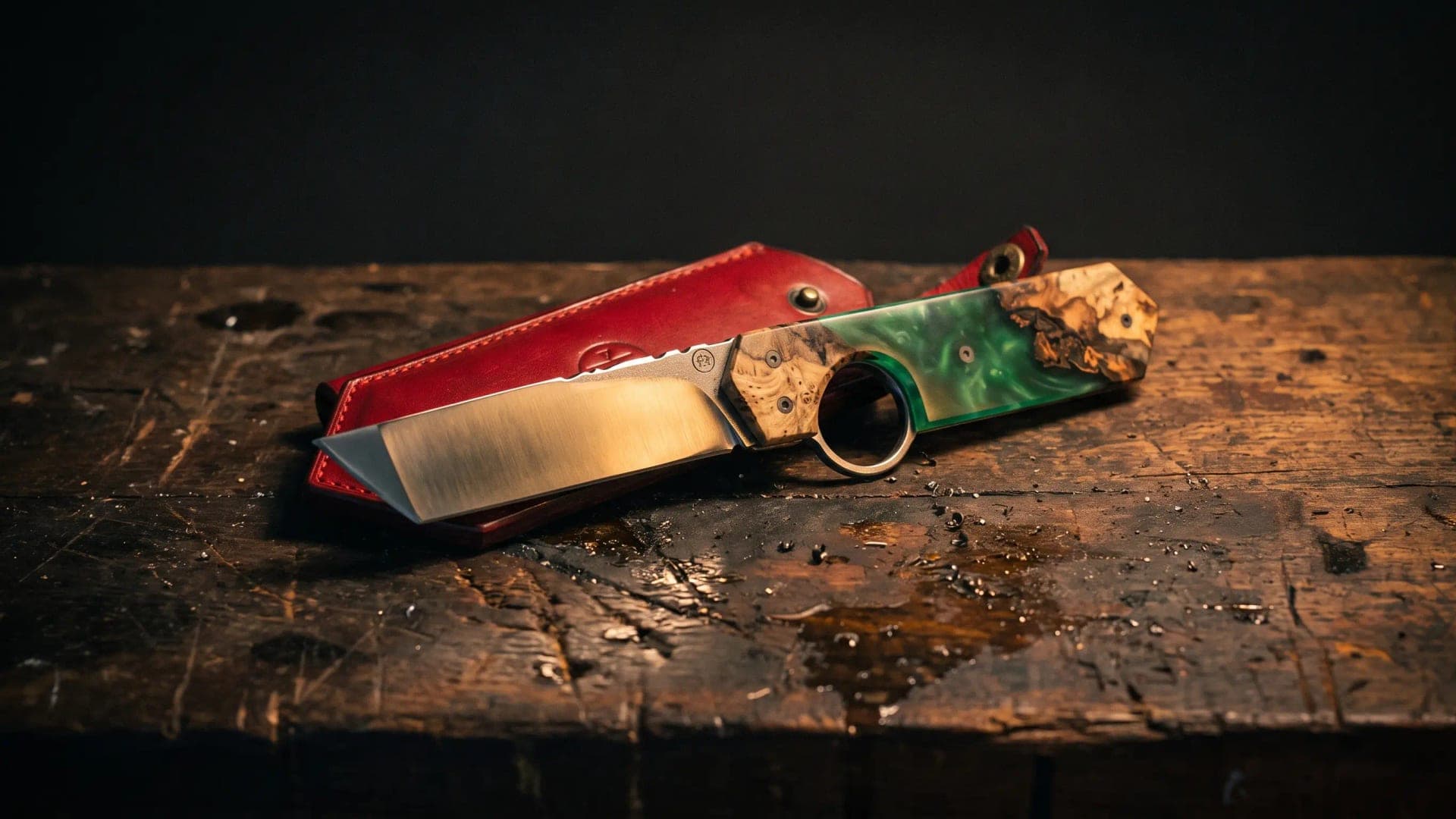
The word "pocket" also hides a wider reality than it suggests. Many of these knives do not travel loose at the bottom of a trouser pocket: they are carried in a sheath, often leather, tucked into a belt or a bag. That is the case for several models from the Résiliant workshop, in Thiers, whose hand-stitched leather sheath is chosen at the quote stage, in plain leather (black) or with a stud (colour matched to the handle). It is worth remembering when weighing a knife's true size.
The cutler puts it more bluntly still: most of his models are not pocket knives in the strict sense. A Résiliant Tanto or a Résiliant 2.0 is worn in a sheath, on the belt, or kept in a display cabinet; only the Mini Tanto, with its reduced size, truly slips into a pocket, in its leather pouch.
Five families born from five territories
Five regional families of folding knives are documented in France: the Nontron, the Laguiole, the Opinel, the Douk-Douk and Le Thiers. Each is recognised less by its region of origin than by one precise manufacturing detail: a ferrule, a spring, a collar, a stamp. None is older or more legitimate than another.
Five families are singled out here because they rest on dated, verifiable facts, not on local reputation. Each reads on the same grid: a place, a date, a distinctive sign, and a story worth telling on its own.
These five stories follow no hierarchy: they tell local answers to the same need, a closing, sturdy and identifiable knife.
- Nontron (Périgord, Dordogne): boxwood handle and copper ferrule, a type attributed to Guillaume Petit in 1815, with pyrography motifs on the handle.
- Laguiole (Aubrac, 1829): born under Calmels, yatagan blade and bee; covered in detail in the article "Thiers or Laguiole".
- Opinel (Savoie, 1890): invented by Joseph Opinel in Albiez-le-Vieux, beech handle, crowned-hand emblem adopted in 1909.
- Douk-Douk (Thiers, 1929): folded sheet steel, made by the Cognet cutlery house for colonial markets in Oceania, Melanesian-inspired handle decoration.
- Le Thiers® (1993-1994): created by the Thiers cutlery trade as a guild, filed with a reference knife in 1994, double-wave spine and T stamp.
Mechanism: what truly separates two folding knives
The decisive difference between two folding knives is not blade shape but how the blade opens and locks. Four families of systems stand out in France: the slip joint, the back lock, the liner lock and the ring lock, each answering the same locking question differently.
All four systems answer the same question: how a folding blade stays open long enough to cut, then closes again safely once the cut ends. Each French family answered it differently, from a simple spring to a rotating collar that covers the slot, which makes comparing mechanisms more telling than comparing blade shapes.
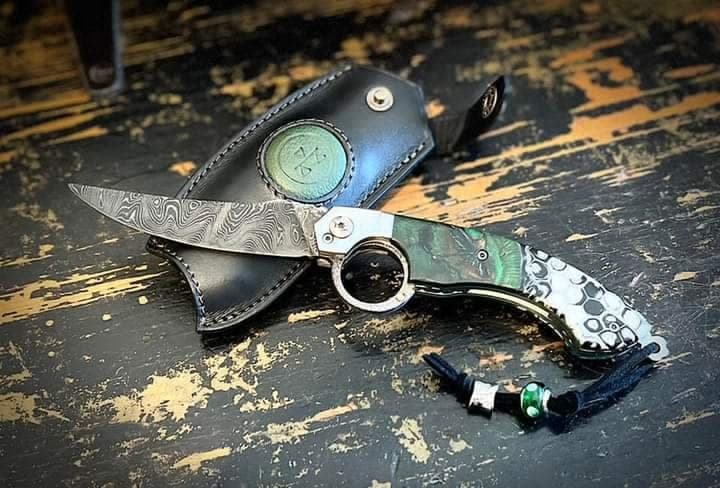
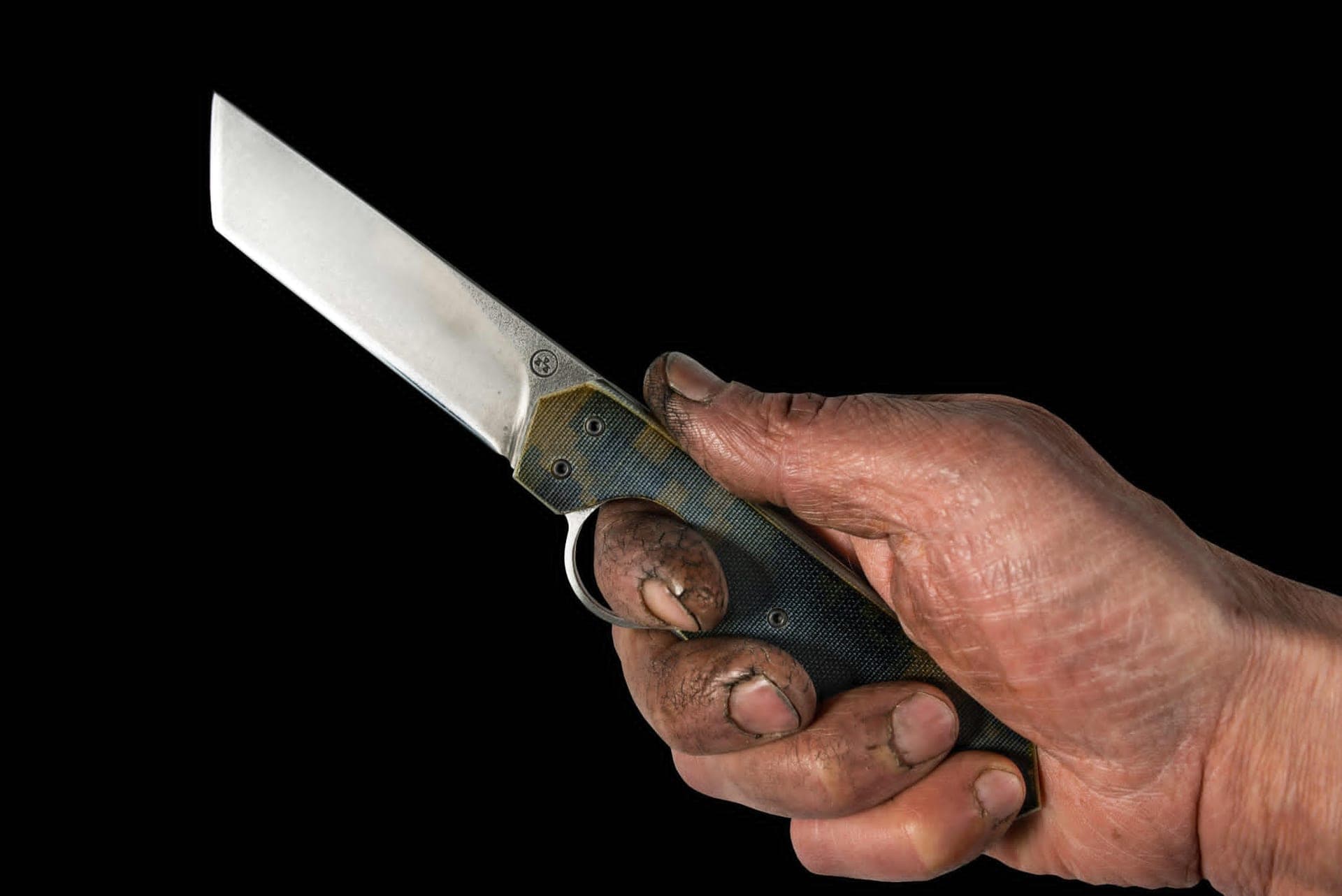
On a Résiliant, the blade rises from the top of the handle, edge first, driven by a ring fixed to the heel through which the index finger passes; locking uses a reversed liner lock, with the liner working at the top of the handle, and opening stays entirely manual, with no spring. The full gesture is developed in the article "What is a reverse-opening knife?".
- Slip joint: the blade stays open under spring pressure alone, with no true lock, used since the earliest folding knives; it closes as soon as the opposite angle is forced.
- Back lock: a bar set into the spine of the handle locks the blade open, and releases under pressure at the same spot.
- Liner lock: a springy liner slides behind the heel of the open blade to stop it returning; the principle is attested from the late nineteenth century, brought to its modern form by American Michael Walker in the 1980s.
- Ring lock: a rotating collar that slides over the handle to cover the slot and lock the blade, like the Virobloc invented by Marcel Opinel in 1955.
The right pocket knife is the one that fits a use
There is no single best pocket knife, only different uses: a table knife, a work tool carried on a belt, a small everyday utility knife or a collector's piece. Use dictates format, locking system and handle material, not the other way round.
A knife meant to accompany a building site or a day on a roof does not need the same things as a knife that waits patiently in a drawer for Sunday cheese. The Résiliant Tanto, the workshop's original model, is worn on a belt as a work tool, on sites, roofs or in the workshop itself: its D2 steel blade is built for sturdy daily use.
At the other end of the need sits the small utility knife, the one slipped into a pocket without a second thought. The Mini Tanto, a reduced-size Tanto in N690 steel with a carbon-fibre handle, answers that use: light, no-nonsense, described at the workshop as "the most carefree of the Résiliants".
Between the two, a versatile folder finds its place equally at the table and outdoors. The Shotokan, whose Higonokami inspiration the workshop claims, a Japanese folding knife from the late nineteenth century, comes in carbon, semi-stainless Z160 or damascus: a choice of steel handled elsewhere, in the article devoted to that subject.
Whatever the model, minimal care keeps a blade clean and safe, and it applies equally to every model described here; the everyday gesture, a regular pass on a butcher's steel, is detailed in the dedicated article. The stone only comes into play once an edge is truly blunted.
What French law allows with a pocket knife
A knife is classified as a category D weapon in France: buying and keeping one at home are both free. Carrying or transporting it outside the home is, however, banned without legitimate grounds, a notion assessed case by case according to place, circumstances and context, not a fixed list.
A pocket knife, even handmade and even given as a gift, remains legally a weapon. That does not mean the law bans it: it governs its use outside the home, without banning the object itself. The central rule, stated by service-public.fr, fits in one sentence: owning is free, carrying it away from home is only allowed for legitimate grounds.
Legitimate grounds cover concrete situations: professional use (cooking, building work, farming), an outdoor activity such as fishing or camping, or carrying a knife just bought on the way home; it is a matter of context, not of intention alone. What these grounds do not cover, however, is the feeling of being ready to face a danger: the law does not recognise that reason.
Putting a knife away in a sheath protects the blade and the hand, but it does not remove the need for a legitimate reason. The workshop's hand-stitched leather sheath is chosen at the quote stage, in plain leather (black) or with a stud (colour matched to the handle). For the exact wording and its limits, the official service-public.fr fact sheet remains the reference, as this article is not intended as legal advice. The full framework, penalties and the 2025 texts included, is set out in what French law says about carrying a knife.
In Thiers, a family born from a reversed mechanism
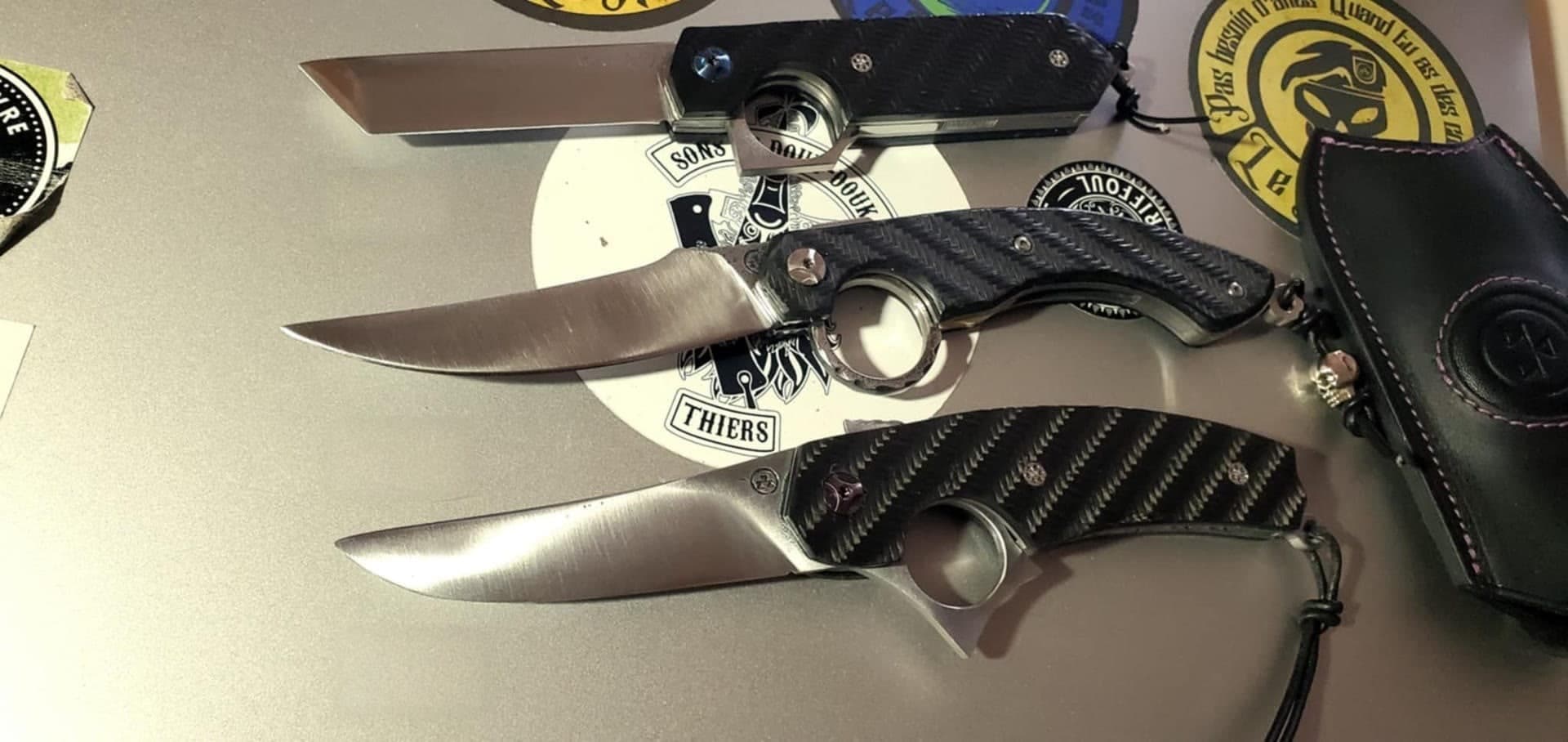
In Thiers, France's cutlery capital, the Résiliant workshop has added to the existing regional families a knife defined by its own mechanism rather than by its region: eight models, all reverse-opening, vice-fitted and carefully hand-assembled, each sold individually to order.
The workshop's eight models replay none of the five families presented above: they share a single mechanism, reverse opening, which sets them apart more than any region could. Here, it is the mechanism, not a territory, that makes a family.
The blades are shaped by material removal from steel and damascus plates or bars, never forged: the full process, from cutting to assembly, is explained in the article "From steel plate to finished knife".
Every knife is ordered exclusively to a quote, with its hand-stitched leather sheath made in Thiers chosen at the same moment, in plain leather (black) or with a stud (colour matched to the handle): there is no online shop and no stock available for immediate purchase. Like the five regional families that precede it, this knife is born from a place and a deliberate manufacturing choice, without claiming to be the best pocket knife, just one more knife, made differently. It is, in its own way, a sixth answer to an old French question.
- What is the difference between a "canif" and a pocket knife?
- Historically, "canif" named the small folding knife used to cut quill pens, while "pocket knife" now covers all folding knives carried on the person. In everyday use the two words overlap widely; size is sometimes the only thing that still sets a "canif" apart, as the smaller one.
- What is a slip-joint pocket knife?
- A slip-joint knife holds its blade open through spring pressure alone, with no mechanical lock. The blade stays in place as long as it is not forced the other way, but it can close under a badly aimed push: a simple, unlocked system.
- What is the Virobloc system on an Opinel?
- The Virobloc is the rotating metal collar invented by Marcel Opinel in 1955: once the blade is open, it turns to cover the handle's slot and lock the blade in place, preventing it from closing accidentally during use.
- Is it legal to carry a pocket knife in France?
- Buying and keeping a knife at home are both free, a knife being classified as a category D weapon. Carrying or transporting it outside the home requires legitimate grounds, assessed case by case: professional use, an outdoor activity, or carrying a knife just purchased.
- Is a Résiliant a pocket knife?
- Yes and no. It is indeed a folding knife, reverse-opening, its blade retracting into the handle. But most models are worn in a sheath, on the belt, or kept in a display cabinet; only the Mini Tanto, with its reduced size, truly slips into a pocket.
Sources
- Wikipédia FR « Opinel » — Établit l'invention de 1890 par Joseph Opinel en Savoie, l'adoption de la main couronnée en 1909 et le blocage Virobloc de 1955.
- Wikipédia EN « Douk-Douk » — Établit la production du Douk-Douk à Thiers par la coutellerie Cognet depuis 1929 et l'origine mélanésienne du décor.
- Wikipédia FR « Liste de centres de production coutelière » — Établit le type de Nontron (manche de buis, virole de cuivre) attribué à Guillaume Petit en 1815, et situe les centres couteliers français.
- Wikipédia FR « Canif » — Établit le vocabulaire du couteau fermant et les systèmes d'ouverture et de blocage.
- service-public.fr, fiche F33658, « Peut-on porter une arme pour se défendre (couteau, bombe lacrymogène…) ? » — Établit le classement du couteau en catégorie D et l'interdiction de port ou de transport hors domicile sans motif légitime.