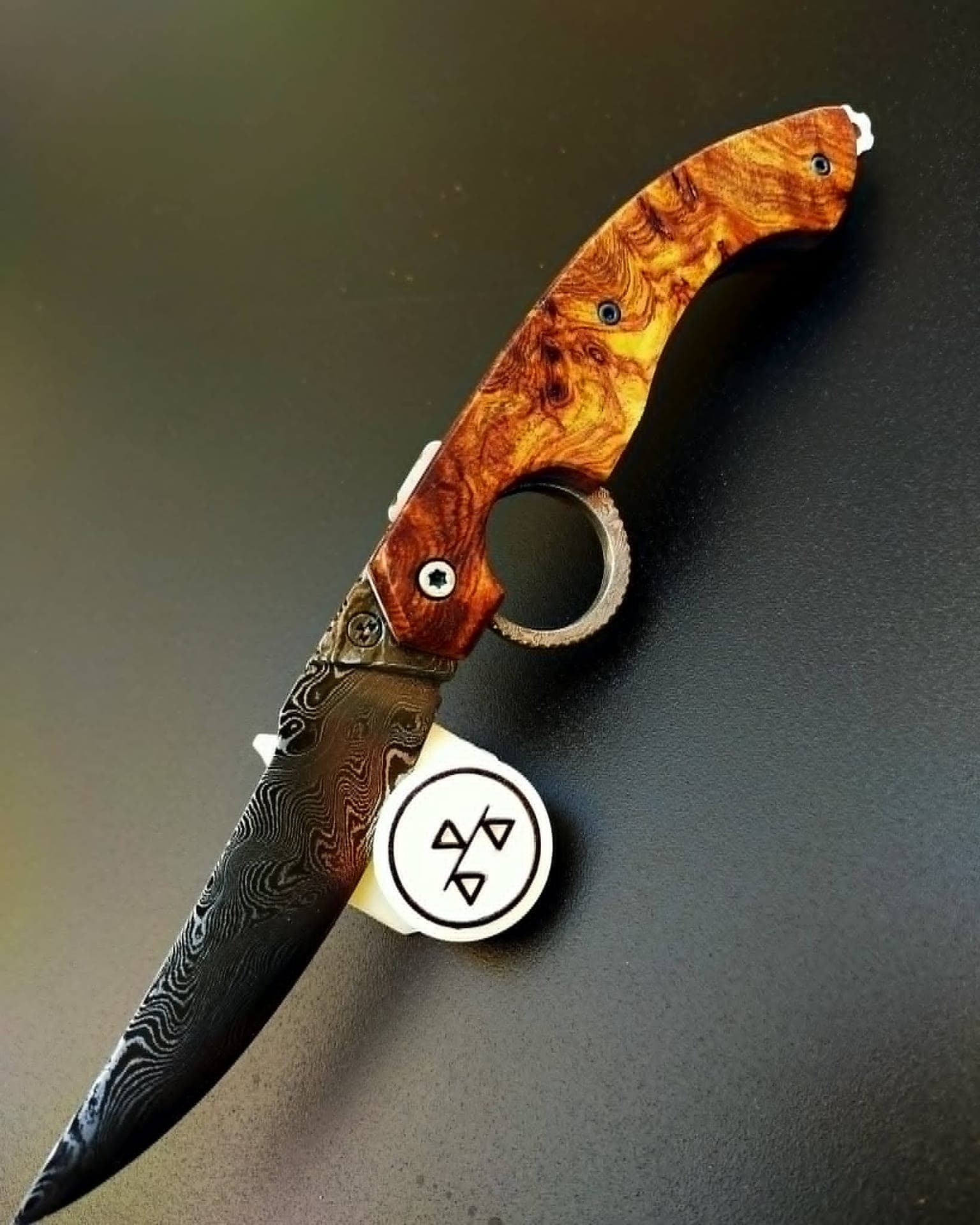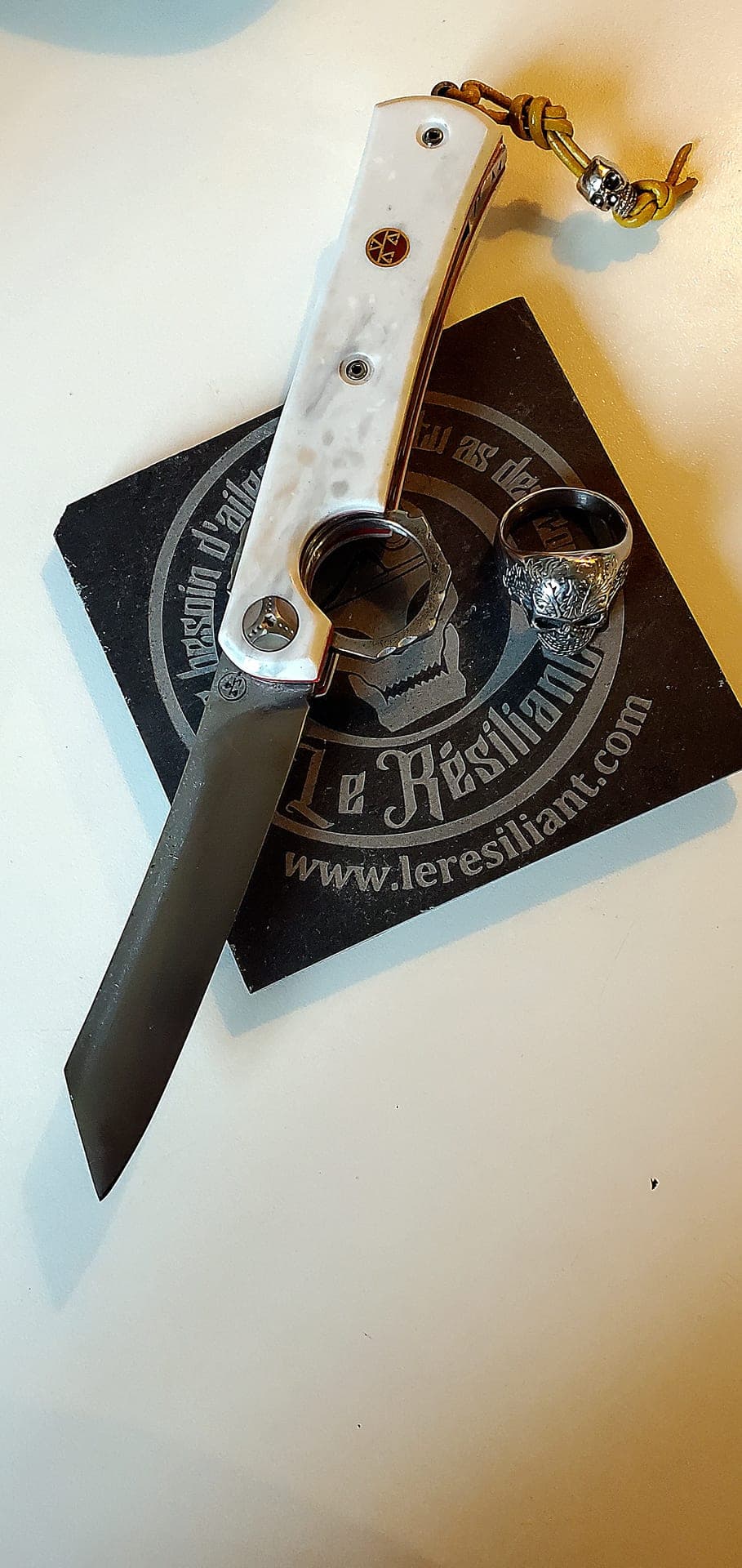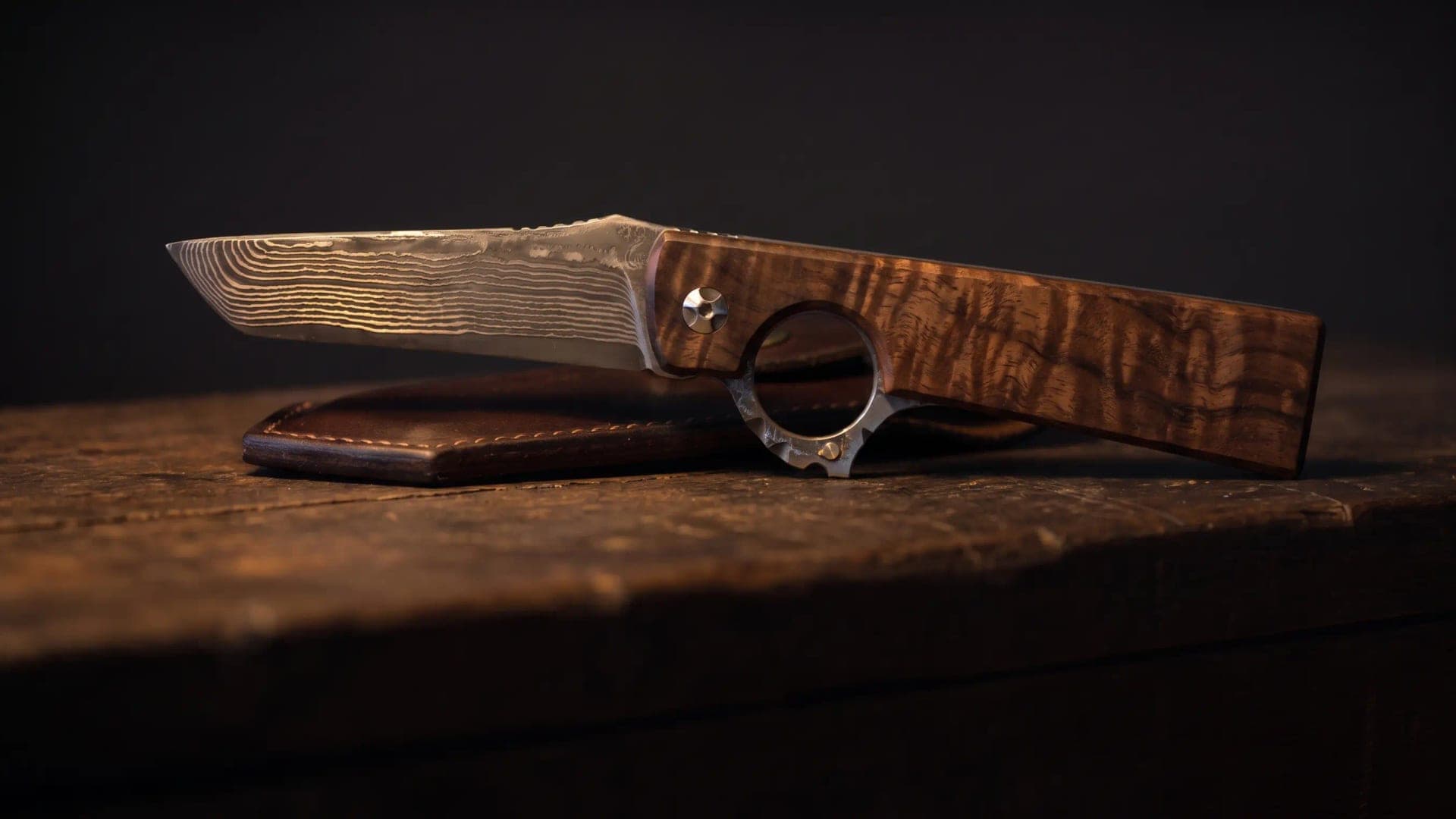
A Latin motto, "si vis pacem para bellum". A cross of Lorraine. Both really went through Le Résiliant's workshop in Thiers, and they already say what matters: what you have engraved on a knife speaks of the person who will carry it. A phrase you chose, a symbol you hold to: the engraving is the part of the knife that belongs to its owner alone.
What can be engraved is already covered in this Journal, in the article on what a craftsman's bespoke work allows. The question here is a different one, and it comes first: where the engraving goes on a knife, and on which material it really reads. A blade or a handle, a stainless steel with a plain surface or a damascus already covered in patterns: the same text will not come out the same way.
So here is what to know before ordering an engraving: what the two surfaces of a knife change, why stainless shows it off while damascus covers it up, what the word engraving covers between laser and hand tool, how to prepare a text or a drawing, and how the Thiers workshop has its knives engraved.
Blade or handle: two surfaces that read differently
On a knife, an engraving goes on the blade or on the handle, and Le Résiliant's workshop in Thiers accepts both. The blade offers a steel surface; the handle depends on the material chosen at the quote stage, wood, carbon fibre or resin. Where it goes is therefore chosen along with the model and the handle.
The blade and the handle do not present the same surface to the engraver. The blade is steel, a hard material that runs continuously along its whole length. The handle has no set material: depending on the model and the choice made at the quote stage, it can be wood, carbon fibre, resin, or combine several of these in one handle.
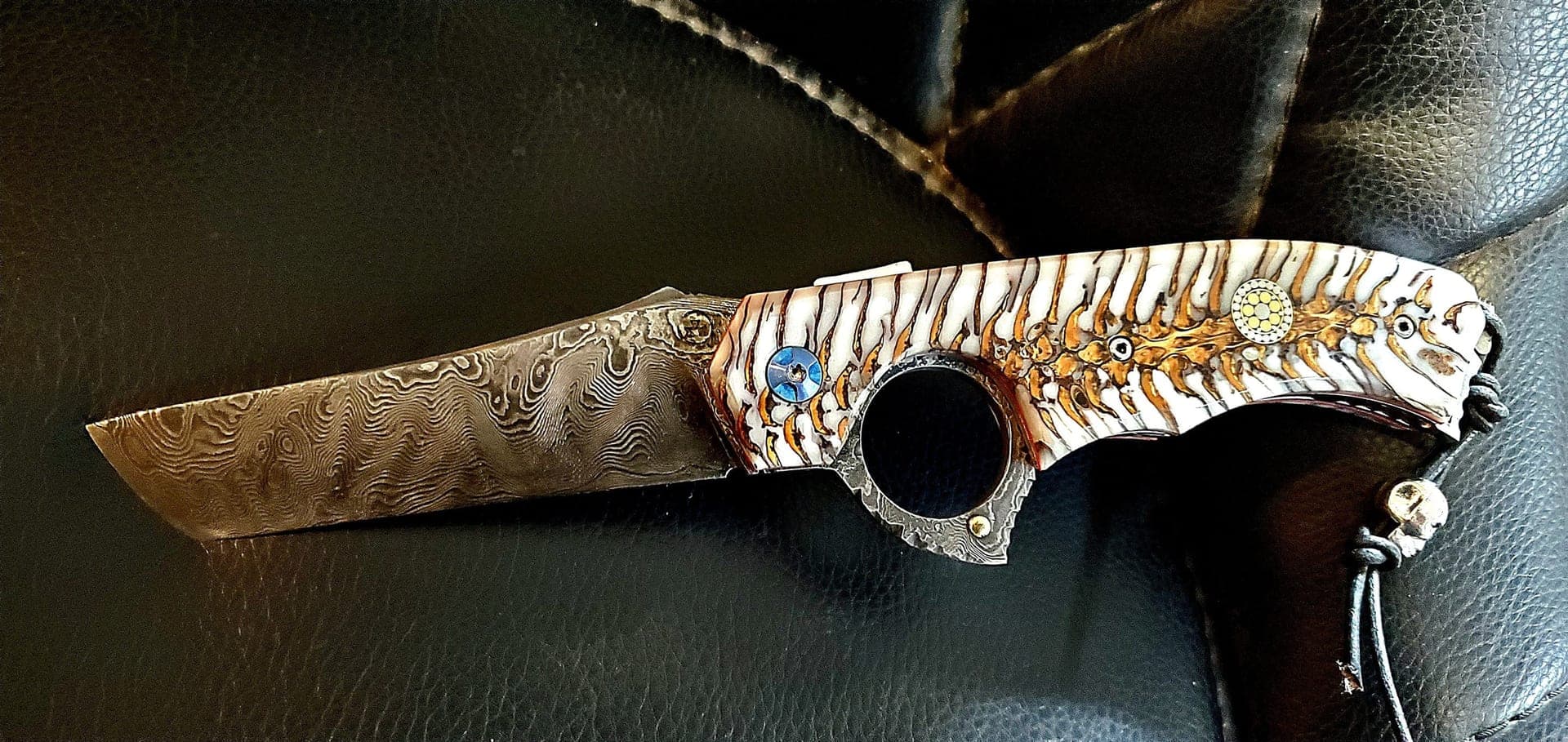
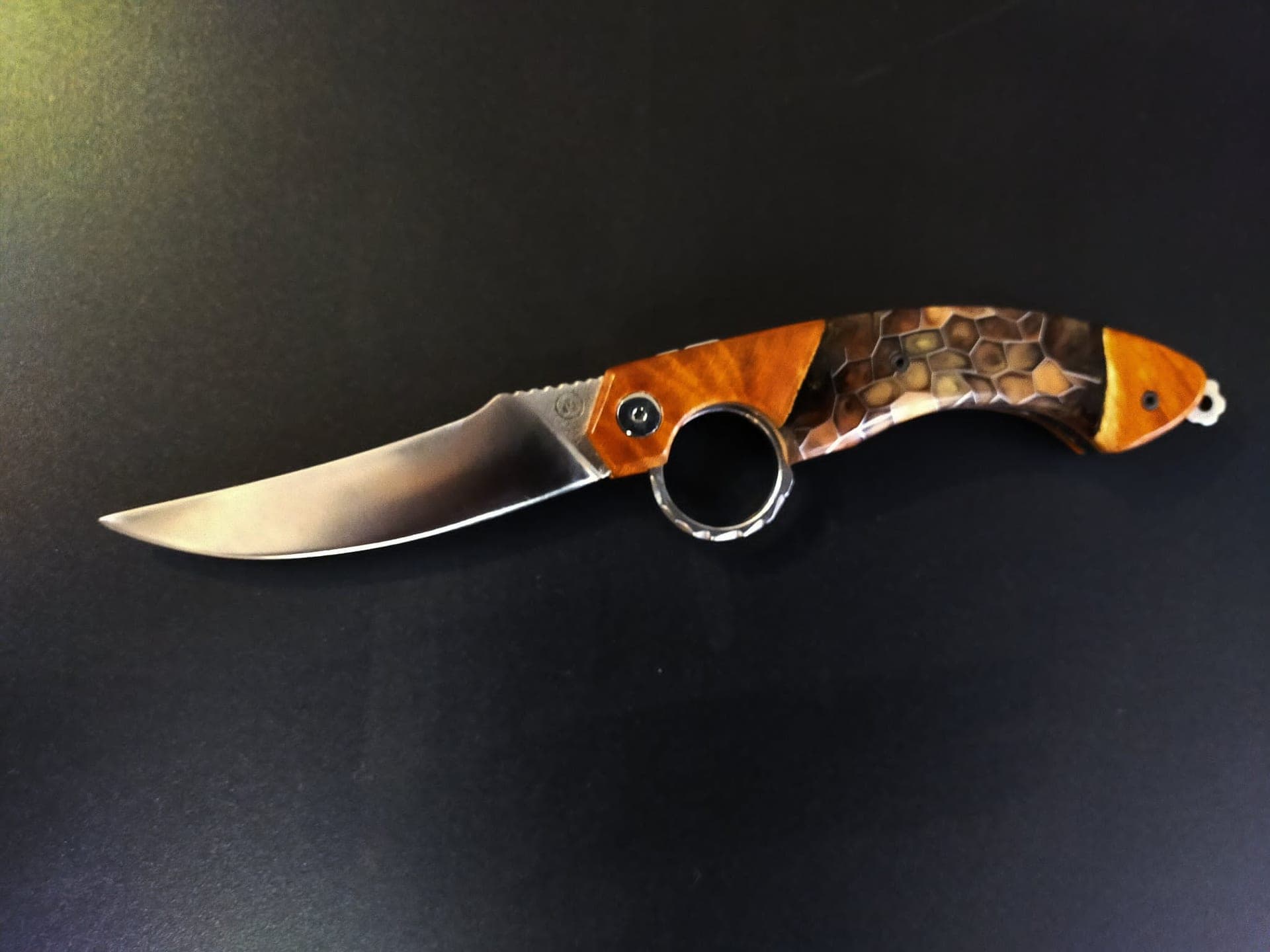
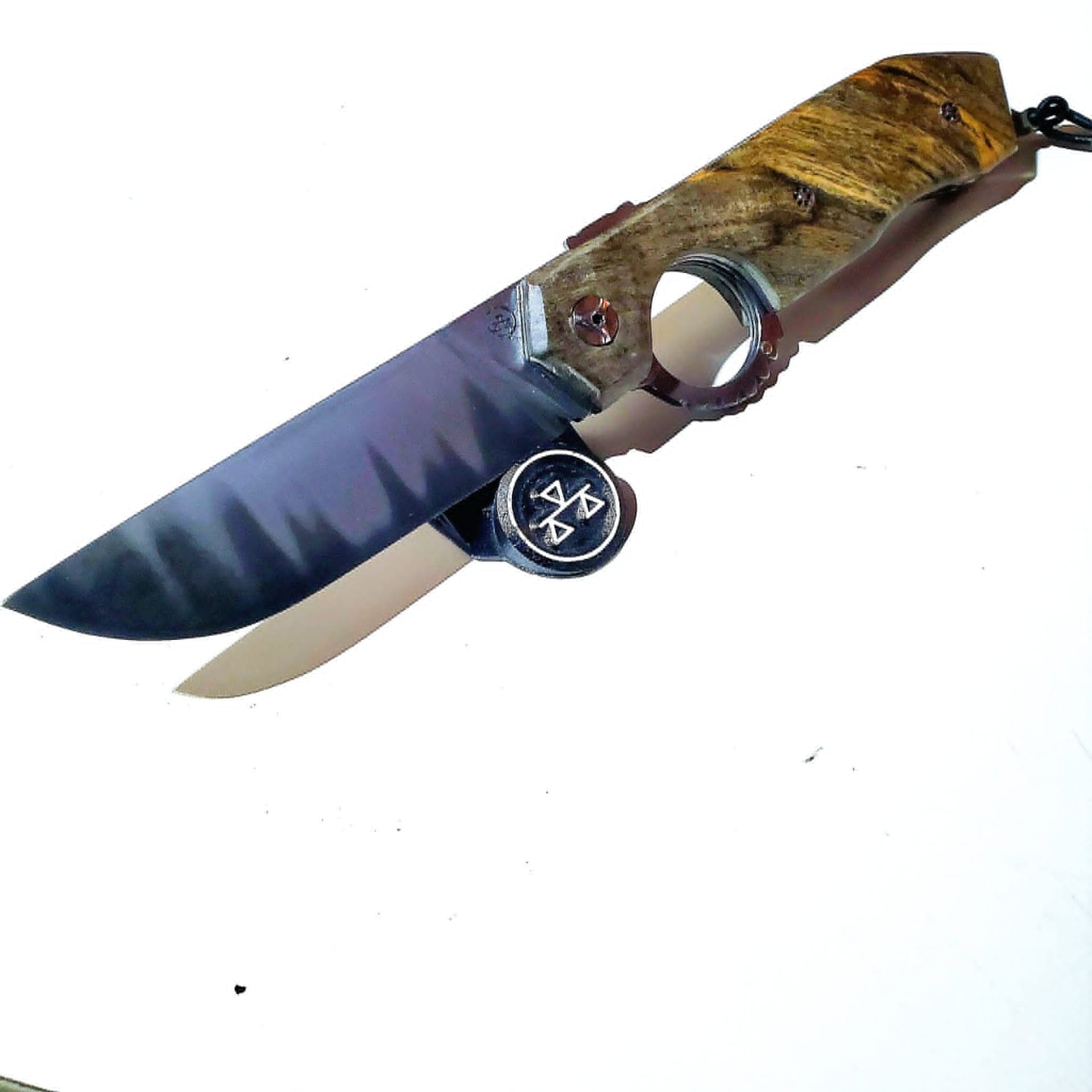
The Mancharicou photographed below is one example: its hybrid handle combines a figured wood with aluminium honeycomb set in resin. On a piece like this, the question of placement is not the same as on a blade: the engraving meets a material that already has its own pattern, its grain, its cells. How an engraving looks on a handle therefore depends on the material chosen, and that choice is made with open eyes.
The detail of the woods and other materials has its own article in this Journal: the handle materials are presented there one by one, and they are not repeated here. For an engraving, one thing matters. At Le Résiliant, the handle material is chosen at the quote stage, along with the model and the steel: that is the moment to say whether an engraving is planned, and where it should go.
On the blade, stainless shows an engraving off, damascus covers it up
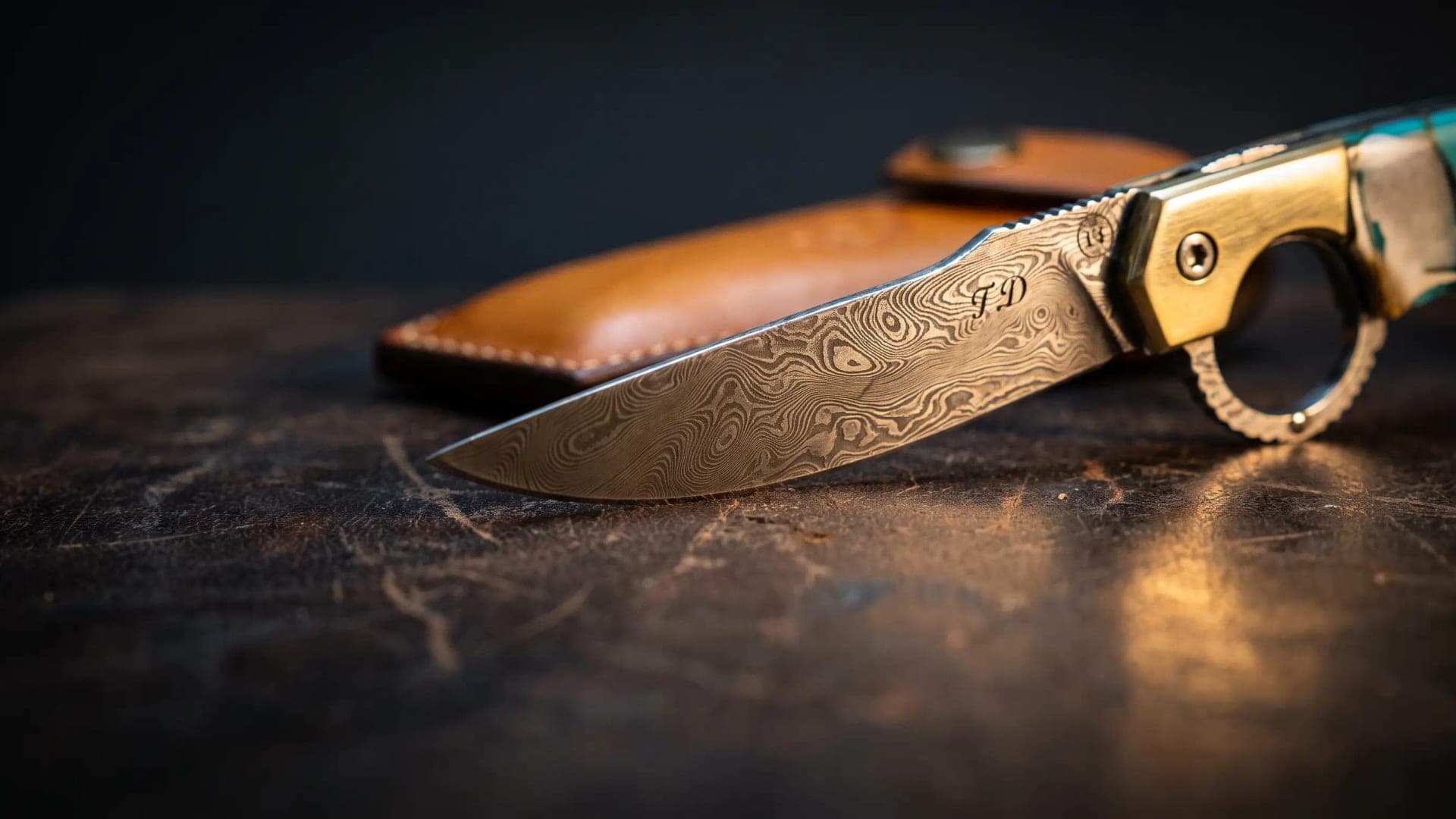
On a blade, an engraving comes out better on stainless steel, whose surface is plain. On damascus, the pattern born of alternating layers of different steels mingles with the line and partly hides it: Le Résiliant's workshop has few damascus blades engraved. It can be done, but it reads less clearly.
An engraving reads by contrast: the line stands out against a surface that stays uniform around it. A polished stainless blade offers exactly that, an expanse of steel with no pattern of its own, where nothing competes with the engraved text or symbol. This is the surface on which an engraving comes out best.
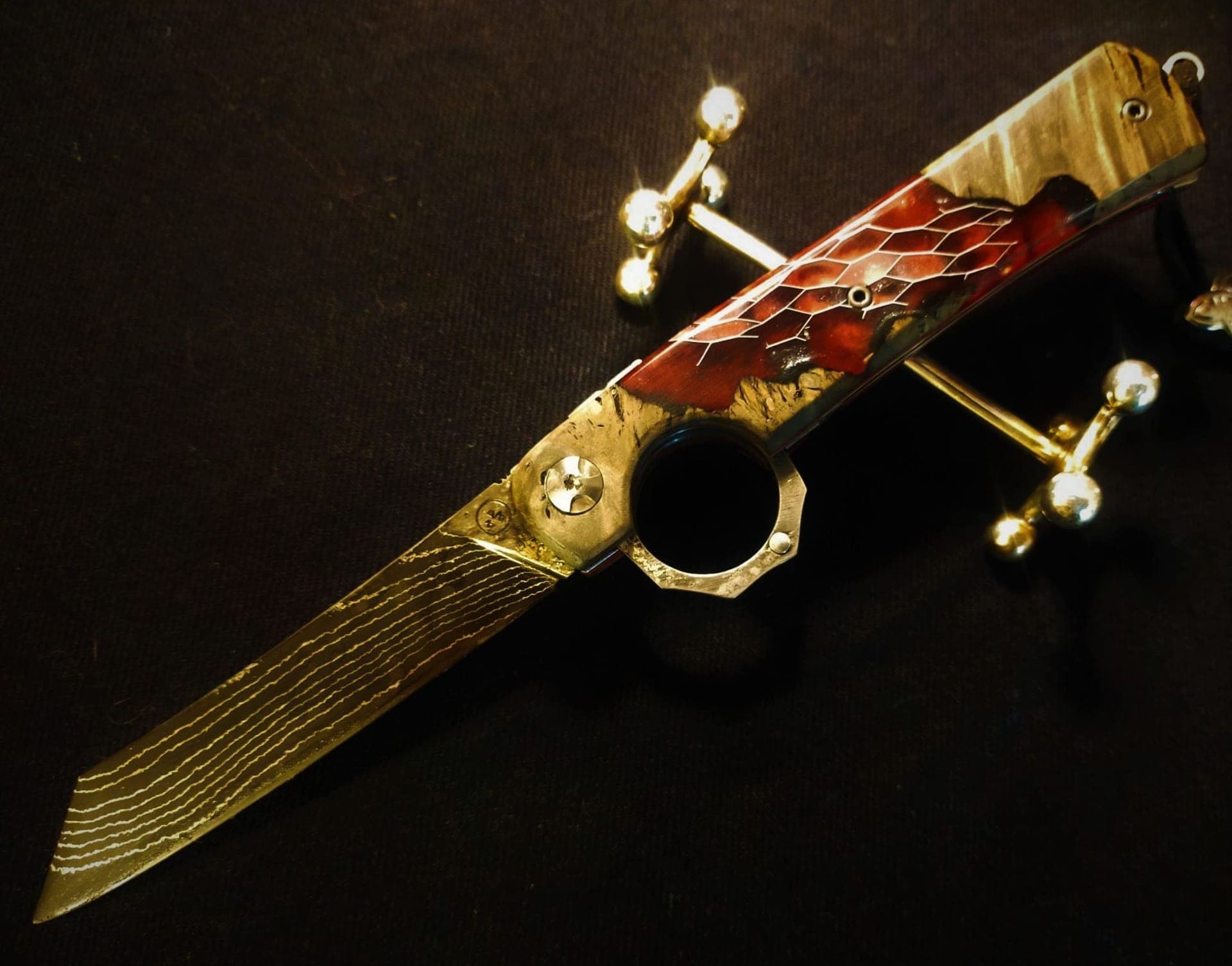
Damascus is the opposite. Its pattern comes from alternating layers of different steels, which are then revealed: on Le Shotokan, the model's page describes an "artisan carbon damascus, its patterns revealed in acid". The blade therefore already carries a pattern over its whole surface, and an engraving is laid on top of it: the pattern mingles with the line and hides it. How these patterns form is explained in the article on the patterns of a damascus blade.
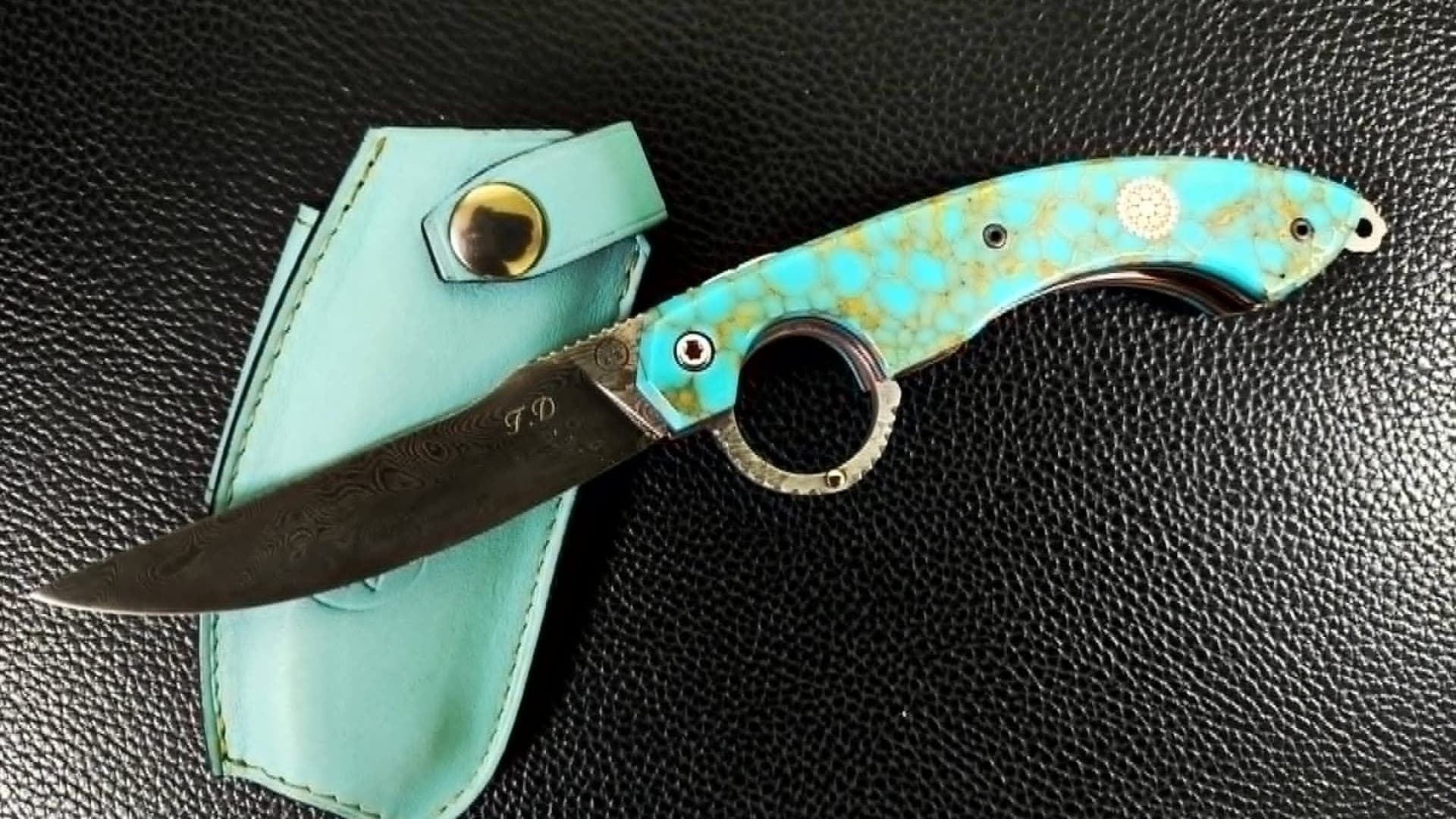
That is why the workshop has few damascus blades engraved. Few does not mean never: the photo at the top of this article shows a Mancharicou with a damascus blade engraved with initials. The engraving is there, it simply reads less sharply than it would on a plain steel.
In the collection, three stainless or semi-stainless steels offer that surface: D2, which the French standard calls Z160, semi-stainless; the N690 of the Mini Tanto; and the 14C28N of the Tracker. What separates these steels from a carbon steel is covered in the article on stainless and carbon; this article sticks to the surface they offer an engraving.
The choice arises in practice on Le Shotokan, the most varied of the Résiliants: 90MCV8 carbon, semi-stainless Z160 or damascus. Anyone set on a very legible engraving knows it before deciding. L'Archétype exists only in damascus: on this model, the steel is not a choice, and an engraving will read together with its pattern.
Laser or graver: what the word engraving covers
Strictly speaking, to engrave is to remove material in order to cut a design. Laser marking, by contrast, only alters the surface, through a change of colour for instance, and stays shallower. Metals are harder to engrave than other materials, because they resist heat and conduct it: pulsed lasers are used for them.
Engraving, in its first sense, is the incising or hollowing out of a design. With a hand tool, a burin, it is the hand that cuts the line into the material. The word has stayed, but it now covers different processes, and the most useful distinction to know before ordering separates engraving from mere marking.
In laser engraving, the beam removes material: the depth reaches 100 µm, a tenth of a millimetre, and can go further. In laser marking, it only alters the surface, through a change of colour for instance: the result is shallower. Both processes use a laser; they do not do the same thing to the metal.
On a metal, the job asks more than on other materials: metal resists heat and conducts it. Pulsed lasers are therefore used, with a wavelength the metal absorbs well. Around 1,064 nanometres, the wavelength of fibre lasers, light is better absorbed by most metals than that of a CO2 laser, which emits at around 10,600 nanometres.
This article does not rank these processes against each other: their durability, their cost or how they look on a given steel are not compared here, for want of a source that does so. What the buyer can do is ask the question at the quote stage: by which process will the engraving be done, and on which surface of the knife.
Preparing your text or drawing before handing it over
A text to be engraved is fixed word for word before ordering: spelling, accents, date. A drawing is sent to the workshop as a PDF file. Two confirmed examples have gone through Le Résiliant's workshop: a Latin motto, "si vis pacem para bellum", engraved on a Résiliant 2.0, and a cross of Lorraine.
It is wiser to treat an engraving as permanent. The text is therefore checked before it is sent, letter by letter, accents and capitals included, and a date is written in the exact form in which you want to read it, in figures or in words. Having someone else read the text costs nothing and catches the typo you no longer see yourself.
A short text or a symbol suits the surface of a knife better than a long sentence: this is common-sense advice, not a workshop rule, and what fits on the blade or on the handle is discussed at the quote stage. For a drawing, the format is simple: a PDF file, sent to the workshop when the order is placed. Before sending it, open the file and check that it shows the drawing you want, clean, with nothing stray.
The motto engraved on a Résiliant 2.0 has a long history. "Si vis pacem, para bellum", "if you want peace, prepare for war", is attributed to Vegetius, a Roman writer of the late fourth and first half of the fifth centuries and the author of the Epitoma rei militaris. Yet the phrase does not appear in this exact form in his work.
The cross of Lorraine carries two histories. It has been the symbol of Lorraine since the Battle of Nancy in 1477, which pitted the soldiers of René II against Charles the Bold. It is also the emblem of Free France, adopted on the proposal of Vice-Admiral Muselier on 1 July 1940.
A text on one side, a symbol on the other: these are the two main ways of having a knife engraved, and both are settled before the order, not after. The model on which the motto was engraved, the Résiliant 2.0, has its own page in the collection.
Ordering an engraving in Thiers: the workshop entrusts it to a neighbouring engraver
At Le Résiliant, engraving is not done in the workshop: it is entrusted to a neighbouring engraver. It is decided when the order is placed, at the same time as the model, the steel and the handle material, and priced at the quote stage as a paid option. The text or drawing is sent to the workshop in Thiers.
Better to say it plainly: Le Résiliant's workshop does not do the engraving itself. It entrusts this work to a neighbouring engraver, just as it entrusts the stabilisation of a wood to a professional when a client asks for it. This is not a caveat in small print; it is how the workshop works: it says what it does, and what it has done by others.
For the client, it is an order like any other. Engraving is decided at the same time as the model, the steel and the handle material; a drawing reaches the workshop as a PDF file, and the cutler sums up what follows in one sentence: "I take care of the rest." It is a paid option, priced at the quote stage, and its amount is published nowhere else.
The question matters all the more because around a third of the workshop's orders, 30 to 35%, are gifts. When the knife is given, an engraving can carry the message: a few letters or a symbol, chosen for someone else and read by them each time they take out their knife.
There is no online shop at Le Résiliant: each of the eight models in the collection, engraved or not, is ordered on a quote, through the contact form. That is where you specify the model, the steel, the handle material and the engraving you want, to have your knife personalised at the workshop, in Thiers.
- Where can I get a knife engraved?
- For a new knife, engraving is planned when ordering, with the cutler; for a knife you already own, an engraver can do the work. At Le Résiliant in Thiers, engraving is decided at the order stage, priced in the quote, and the workshop entrusts it to a neighbouring engraver.
- Can you engrave a knife's handle instead of the blade?
- Yes. An engraving can go on the blade or on the handle, and Le Résiliant's workshop accepts both. On the handle, the result depends on the material chosen at the quote stage: wood, carbon fibre or resin. Where it goes is therefore decided with the model and the handle.
- Can damascus steel be engraved?
- Yes, but the engraving reads less well. The damascus pattern, born of alternating layers of different steels, mingles with the line and partly hides it. Le Résiliant's workshop has few damascus blades engraved: on a stainless blade, with its plain surface, an engraving comes out better.
- Who engraves Le Résiliant's knives?
- A neighbouring engraver. Le Résiliant does not do its own engraving: it entrusts this work to that engraver. The client places the order with the workshop in Thiers and sends it the text or drawing; engraving is a paid option, priced at the quote stage.
- How do I send a design to be engraved on a knife?
- As a PDF file, sent to the workshop when the order is placed. At Le Résiliant, engraving is decided with the model, the steel and the handle material, on a quote: that is when the drawing is sent. Before sending it, check that the file shows the drawing you want.
- What is the difference between laser engraving and laser marking?
- Laser engraving removes material: its depth reaches 100 µm and beyond. Laser marking only alters the surface, through a change of colour for instance, and stays shallower. On metals, which resist heat and conduct it, pulsed lasers are used.
Sources
- Wikipédia, « Végèce » — Attribue la formule « Si vis pacem, para bellum » à Végèce, auteur romain de la fin du IVe et de la première moitié du Ve siècle, et précise qu'elle ne figure pas sous cette forme exacte dans son œuvre.
- Wikipédia, « Croix de Lorraine » — Établit que la croix de Lorraine est le symbole de la Lorraine depuis la bataille de Nancy (1477) et l'emblème de la France libre, adopté sur proposition du vice-amiral Muselier le 1er juillet 1940.
- Wikipedia, « Laser engraving » — Distingue la gravure laser, qui retire de la matière (100 µm et au-delà), du marquage laser, plus superficiel, et explique pourquoi les métaux demandent des lasers pulsés, vers 1 064 nm plutôt qu'à 10 600 nm.
- Wikipédia, « Acier de Damas » — Établit que le motif d'une lame damas naît de l'alternance de couches d'aciers différents.
- Wikipédia, « Gravure » — Établit la définition de la gravure comme l'incision ou le creusement d'une image, d'un texte ou d'une inscription dans la matière.