A knife becomes a collector's piece when what it carries cannot be made again: a blade whose pattern belongs to it alone, a form developed by its maker, a material chosen to be looked at. It is worth keeping when you know whether it is meant for use or for display, how to care for it, and where it can return.
Rarity alone is not enough. The age of a piece, or the small number in a limited series, tells you how many examples exist, not what each one has of its own, and sales sites are full of both. What counts is what cannot be made again identically.
Here are the three criteria that make a collector's piece, what the Résiliant workshop in Thiers shows of them, then what a kept piece asks: knowing whether it is used or looked at, keeping it dry, and leaving it an address to come back to.
What turns a knife into a collector's piece?
A knife becomes a collector's piece through three criteria that cannot be bought in series: a piece with no double, through pattern or material; a recognisable maker's form, through template and mechanism; and an origin that can be traced, a workshop, a town. The rarity of a limited series or age add to these: they are not enough.
Rare and singular do not mean the same thing. A rare piece exists in few examples; a singular piece can only exist as one, because its material or its design cannot be reproduced. A blade whose pattern was born in the steel cannot be made again.
Public collections keep origins first. The Thiers cutlery museum holds 14,000 objects, including 6,000 knives, and displays about 700 of them, from French and foreign cutlery centres, from the 16th century to the present day. What such a collection keeps is a place and a period as much as an object; the museum visit is told elsewhere in the Journal.
Thiers is also where art cutlers show their work. The 35th edition of Coutellia, the international festival of art and traditional knives, announced 300 exhibitors from 22 countries for 16 and 17 May 2026. The third criterion, origin, reads like this: a collector's knife comes from a workshop you can name, in a town you can locate.
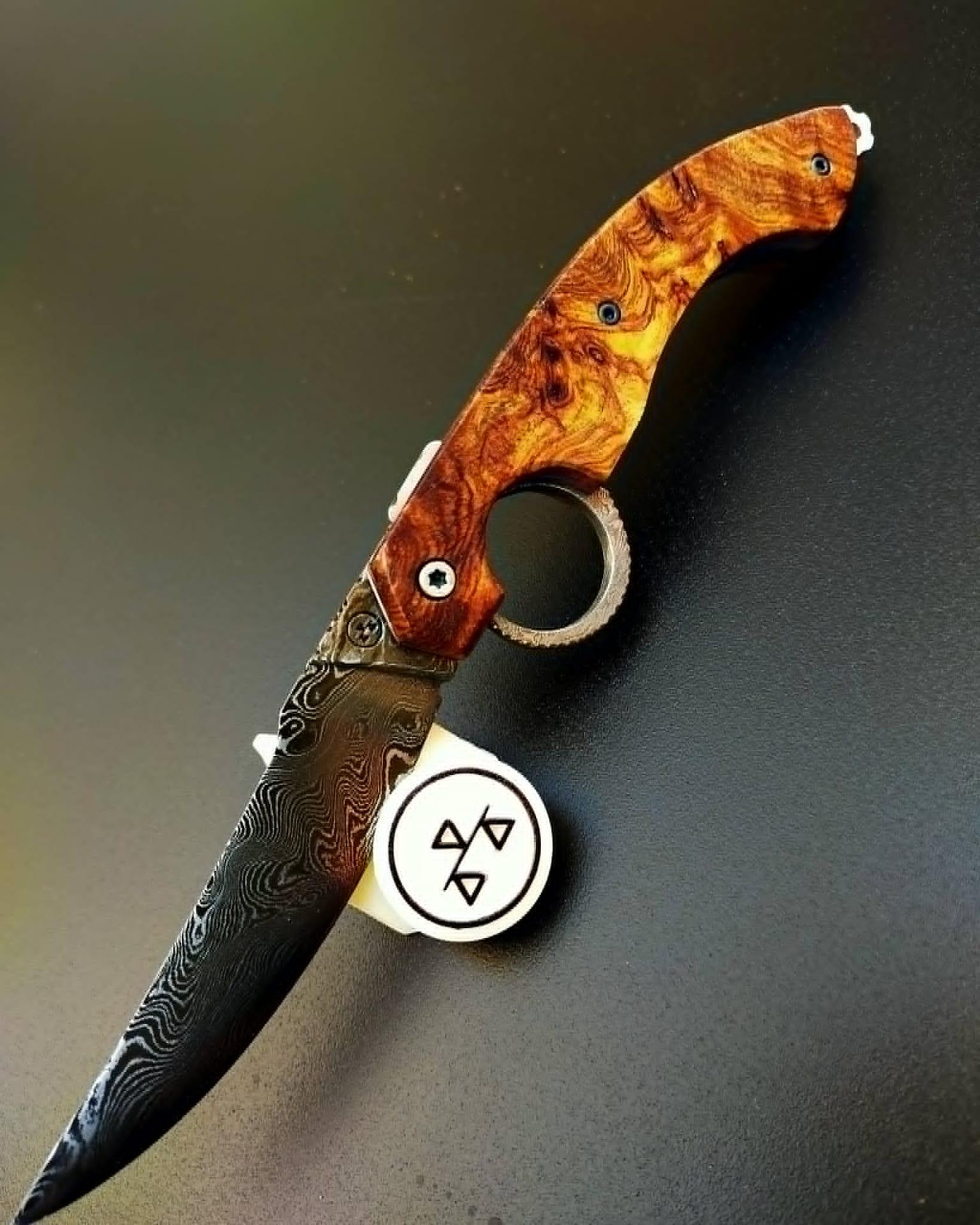
L'Archétype: a damascus blade with no double
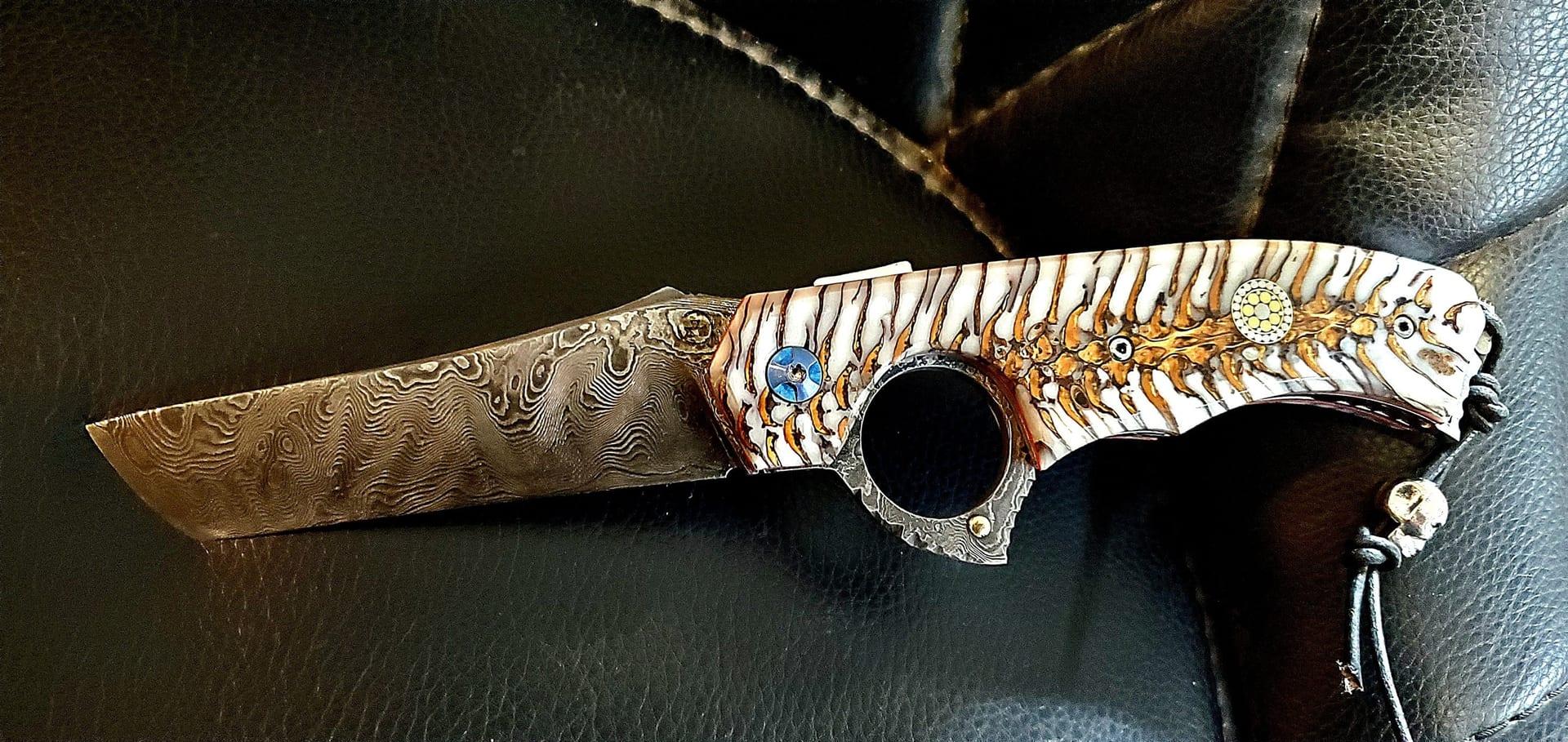
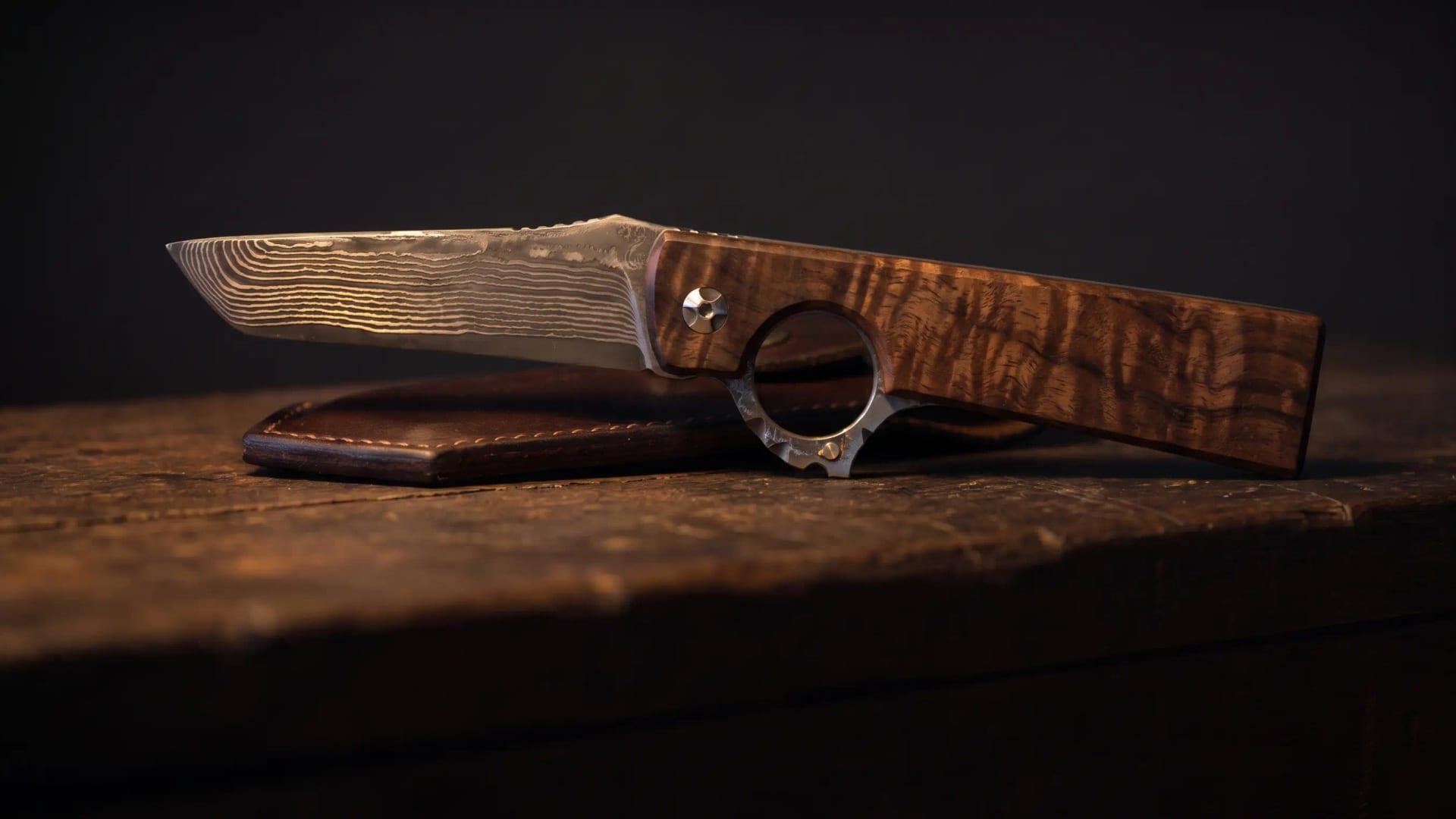
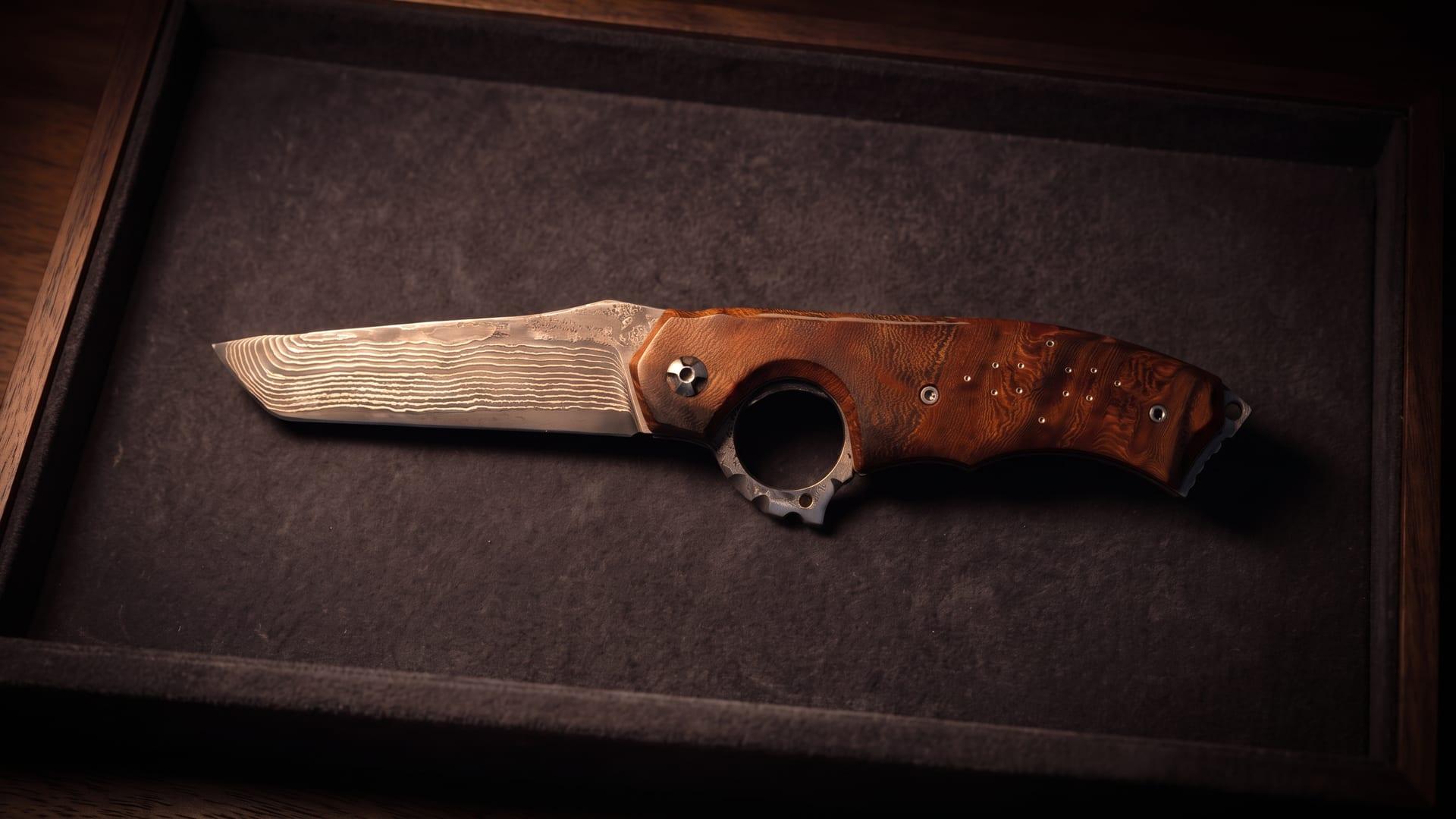
L'Archétype is Le Résiliant's collector's model. The outcome of five years of assembly, adjustment and fitting, it exists only in damascus. Each blade is cut by hand from a damascus plate, and its pattern, revealed by acid, belongs to it alone: no two Archétypes ever carry the same design.
The model's page says it plainly: L'Archétype is aimed at dedicated collectors. It is the only one of the eight Résiliants to exist solely in damascus.
The workshop does not make this damascus: it buys it in plates and cuts each blade from them by hand. Hardening, grinding the bevels, polishing and assembly then happen at the Thiers workshop. The pattern was already in the plate; the acid reveals it. How these designs are born in the steel is explained in the article on damascus.
L'Archétype is not the only damascus piece in the collection. Le Shotokan also comes in artisanal carbon damascus, a version its page intends for collectors. And on the damascus versions of Le Mancharicou, a small silver fish is inlaid, the workshop's signature, at no extra cost.
For the collector, the consequence is simple: you choose the model and the handle, but not the design of the blade. A pattern cannot be ordered; it is discovered.
A maker's form, adjusted in Thiers
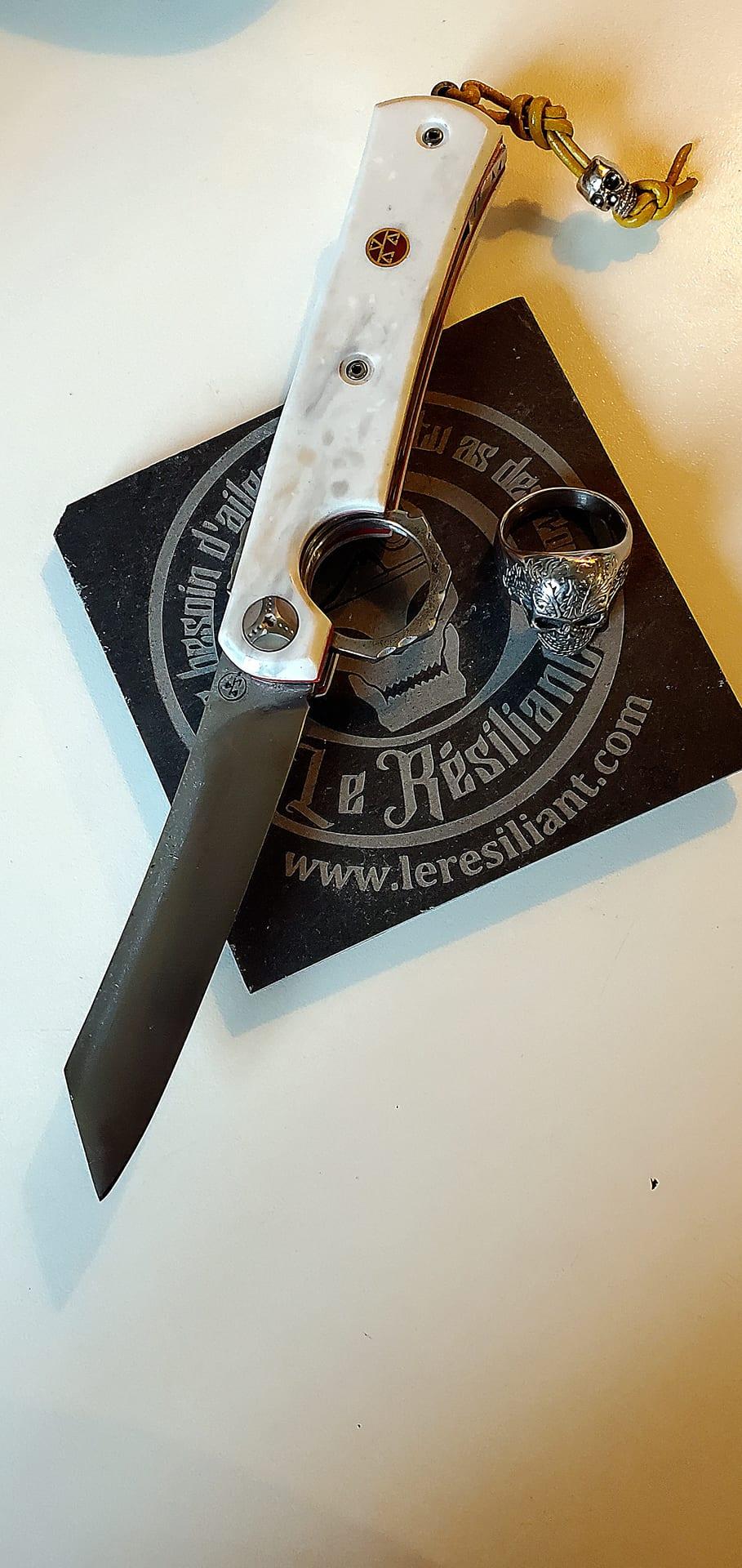
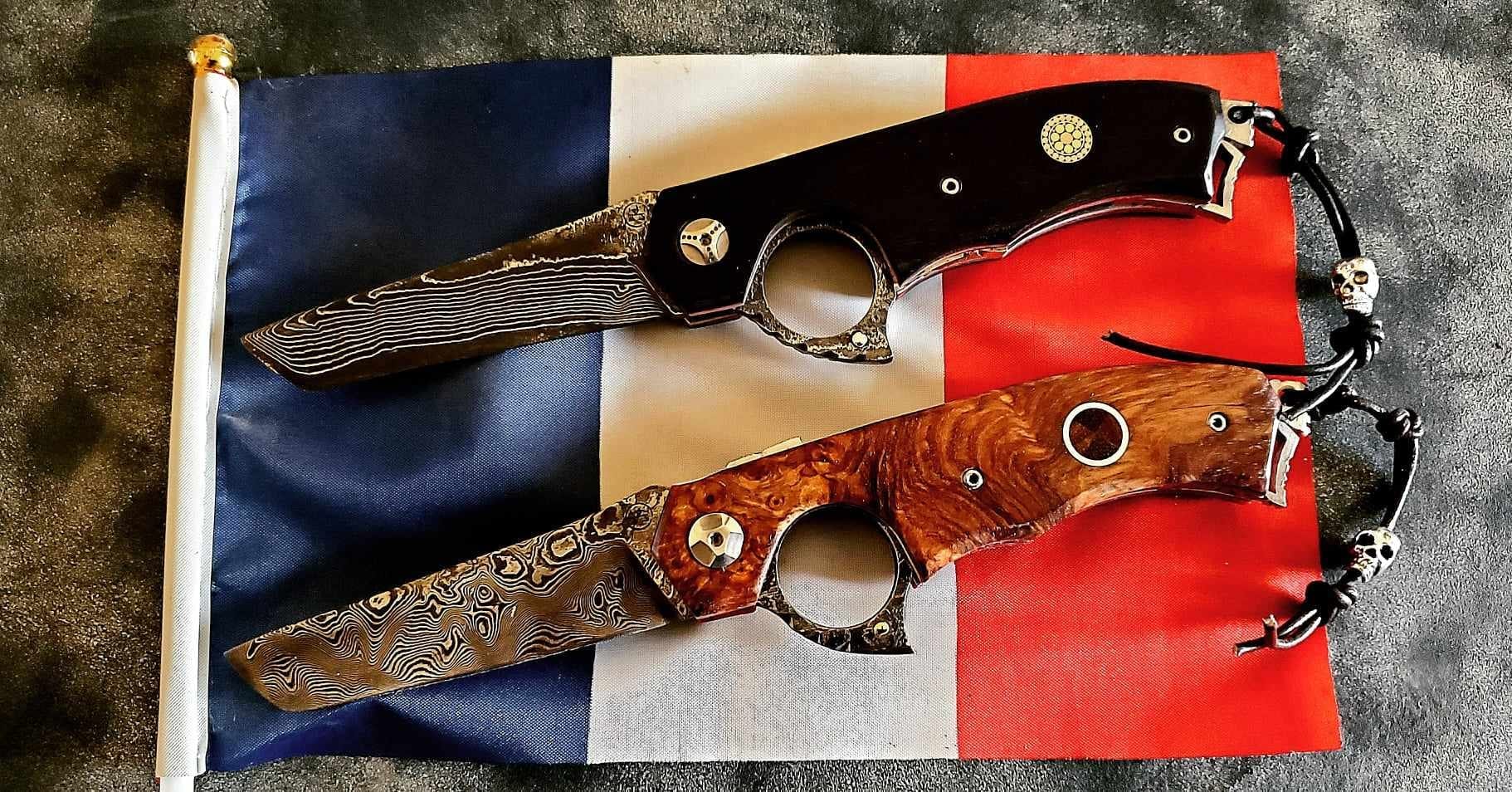
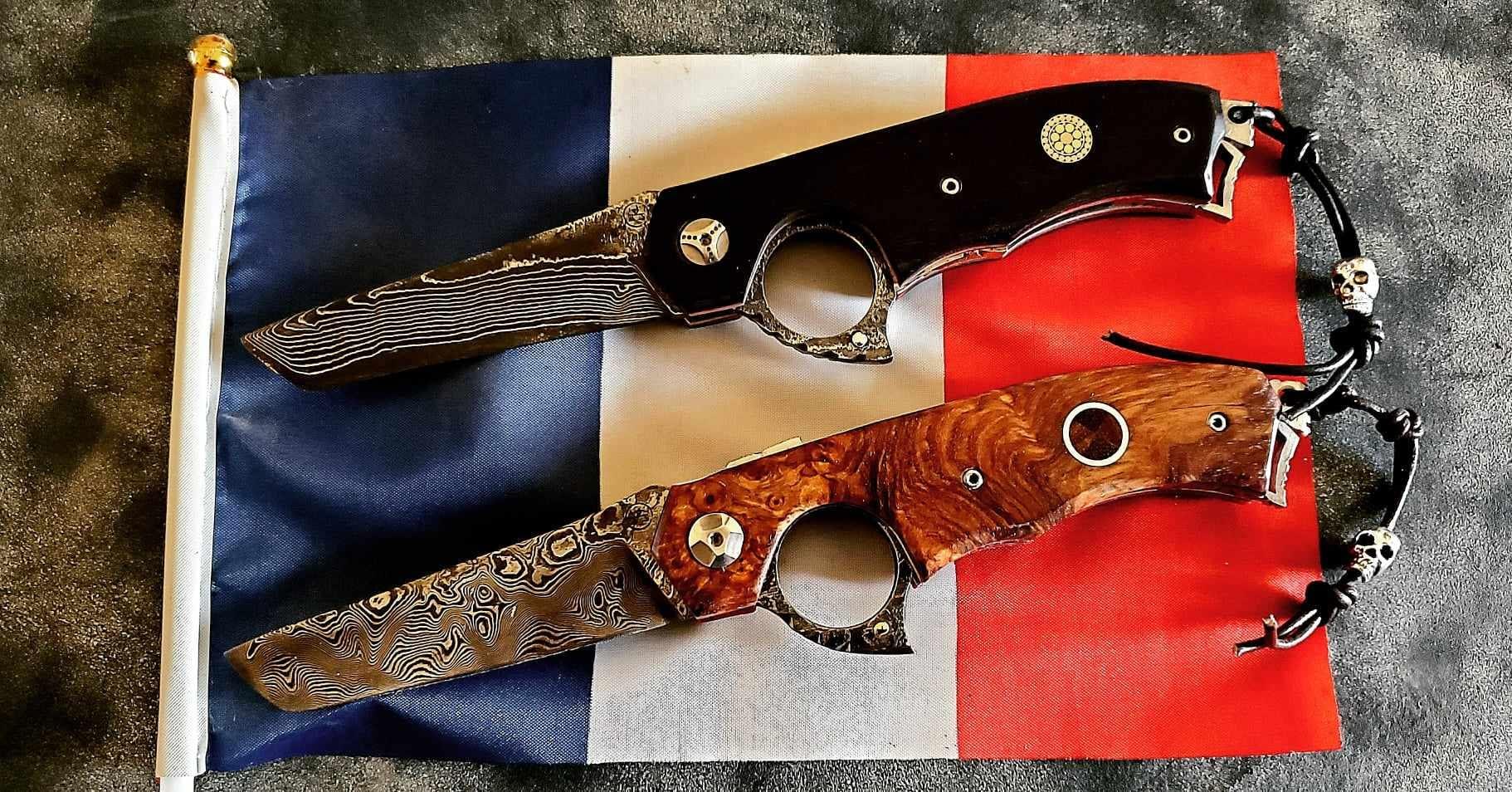
A piece is also kept for what it says about its maker. All eight Résiliants share a reverse-opening mechanism designed and adjusted at the workshop in Thiers, and each model rests on a template developed over months, which the customer does not alter. That is what makes a Résiliant recognisable.
The blade comes out of the top of the handle, cutting edge first, driven by a ring fixed to its heel into which the index finger slips. The lock is a reversed liner lock, and opening remains entirely manual. Reverse opening has its own article; it is adjusted in the vice, piece by piece.
The workshop presents Le Résiliant as the only reverse-opening knife. For a collector, the interest is not the phrase: a mechanism of a workshop's own sets each of its pieces apart, whatever steel or wood it is dressed in.
Each model's template took weeks and months of development: proportions open and closed, safety, thicknesses. The customer chooses the model, the steel or damascus, the handle material; they do not touch the template. The cutler sums it up like this: "I can give the customer the measurements of the knife, they cannot give me theirs."
That is what makes a maker's form: it does not change from one example to the next, while the blade and the handle change with every order. Two Résiliants of the same model differ in their materials; they never differ in their lines.
Use or display: the material decides
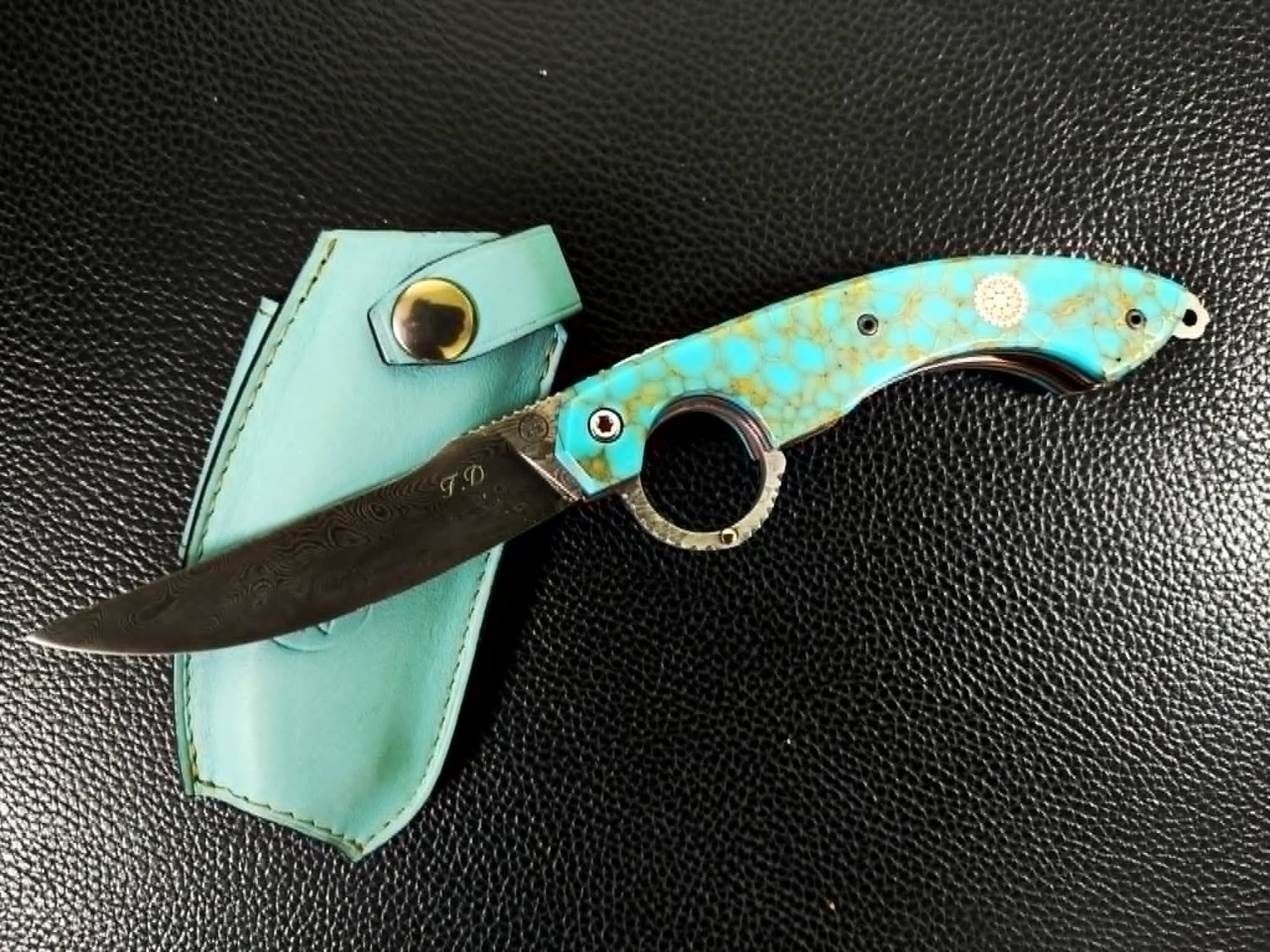
Not every collector's knife is made to be used. At the workshop, handles in reconstituted turquoise, genuine turquoise ground to powder and then bound with resin, are described as beautiful but fragile: collection and display pieces, not for everyday use. Other pieces, on the contrary, are kept by being used.
The cutler describes this material as very pretty but fragile, and keeps it for collection and display knives. As for the starting stone, natural turquoise sits between 5 and 6 on the Mohs scale, only slightly harder than window glass. That benchmark applies to the natural stone only.
At the other end, some pieces are kept because they are used. Le Résiliant 2.0, in 90MCV8, takes on a grey-blue patina as it is used, and its page describes every patina as unique, the memory of the knife, its owner's logbook. There, it is use that makes the piece.
Between the two, the rest is judged material by material: a damascus blade can be used, provided it is cared for like a carbon steel. The question to ask before buying, or before putting away, is not "is this a collector's piece?" but "what is it made of?".
What is kept also has its limits: the workshop categorically refuses ivory and any material that comes from poaching or protected species. The full overview of handle materials is set out in a dedicated article.
Keeping a piece starts with keeping it dry
A damascus blade needs the same care as a carbon steel: wiped after use, kept dry, lightly oiled before it is put away. Precious wood prefers dry air and distance from heat sources. For the edge, a pass on a medium-cut honing steel is enough; the stone only comes in if the edge has truly suffered.
The pages for the damascus pieces agree. L'Archétype's: blade kept dry, a film of oil before resting, and patterns that gain contrast with every cleaning. Le Shotokan's points the same way: a well-kept blade shows its patterns better. Care does not spoil a collector's piece; it is what brings it into view.
Wood asks for less, but not nothing. Le Mancharicou's page sums it up: precious wood likes to stay dry, away from heat sources. A radiator, for instance, is best avoided.
A display case does not excuse that care. A damascus blade needs a carbon steel's attention whether it is used or not; a piece that never comes out should still be checked from time to time, wiped and oiled. The edge is straightened on a medium-cut honing steel, never a diamond one, and the stone only returns if the edge has truly suffered.
That leaves the sheath. A piece in a display case and a piece carried on the belt do not age the same way, and neither does the sheath: caring for the sheath has its own article.
A knife that is passed on keeps an address
Any knife that has left the workshop can be sent back for its edge to be re-established, free of charge: only shipping remains down to its owner. Please get in touch before sending anything. The criterion is where the knife came from, not who owns it: a piece inherited or bought second-hand is treated the same way.
L'Archétype's page says it in one sentence: it is a knife that gets passed on rather than replaced. Passing on a workshop piece means passing on two things: an object, and the workshop it comes from, which recognises it as one of its own.
The edge re-establishment service turns that idea into fact: a collector who buys a Résiliant second-hand, an heir who receives a parent's, can both send it back to the workshop, on the same footing as the person who ordered it.
This service covers the edge, and the edge alone: not the mechanism, not the handle, not the sheath. It does not replace everyday care on the honing steel: it takes over when the edge is truly dead.
For a piece that changes hands, the first step is simple: write to the workshop before sending anything, through the contact form. A knife that is passed on keeps, from one owner to the next, an address to come back to.
- Which Résiliant model is meant for collectors?
- L'Archétype, the workshop's collector's model. It exists only in damascus, the outcome of five years of assembly, adjustment and fitting, and its page addresses it to dedicated collectors. Le Shotokan also comes in artisanal carbon damascus, a version the workshop intends for collectors.
- Should you use a collector's knife?
- It depends on its material. A reconstituted turquoise handle, beautiful but fragile, makes it a display piece rather than an everyday one. A damascus or carbon blade can be used if it is wiped, kept dry and oiled, and the patina of a carbon steel ends up telling the story of its use.
- Is reconstituted turquoise real turquoise?
- Yes. It is genuine turquoise, ground to powder and then bound with resin. The workshop describes it as very pretty but fragile: it is kept for collection and display knives, rather than for a piece carried and used every day.
- How should you store a collector's knife?
- Store it with the blade dry and given a light film of oil before resting, especially if it is damascus or carbon steel. A precious wood handle stays dry, away from heat sources. A display case does not excuse that care: a piece that never comes out should still be checked.
- Can an inherited or second-hand knife be re-sharpened by the workshop?
- Yes. Any knife that has left the workshop can be sent back for its edge to be re-established, free of charge: only shipping remains down to its owner. Please get in touch before sending anything. The criterion is where the knife came from, not who owns it, inherited or second-hand alike.
Sources
- Musée de la coutellerie de Thiers · Wikipédia — Établit la collection du musée : 14 000 objets dont 6 000 couteaux, environ 700 exposés, venus de centres couteliers français et étrangers, du XVIe siècle à aujourd'hui.
- Événement incontournable : la 35e édition de Coutellia · Ville de Thiers — Article de la Ville de Thiers du 16/04/2026 annonçant la 35e édition du festival international du couteau d'art et de tradition, les 16 et 17 mai 2026 à Thiers, avec 300 exposants de 22 pays.
- Turquoise · Wikipedia (EN) — Établit la dureté de la turquoise naturelle, entre 5 et 6 sur l'échelle de Mohs, à peine plus que le verre à vitre.