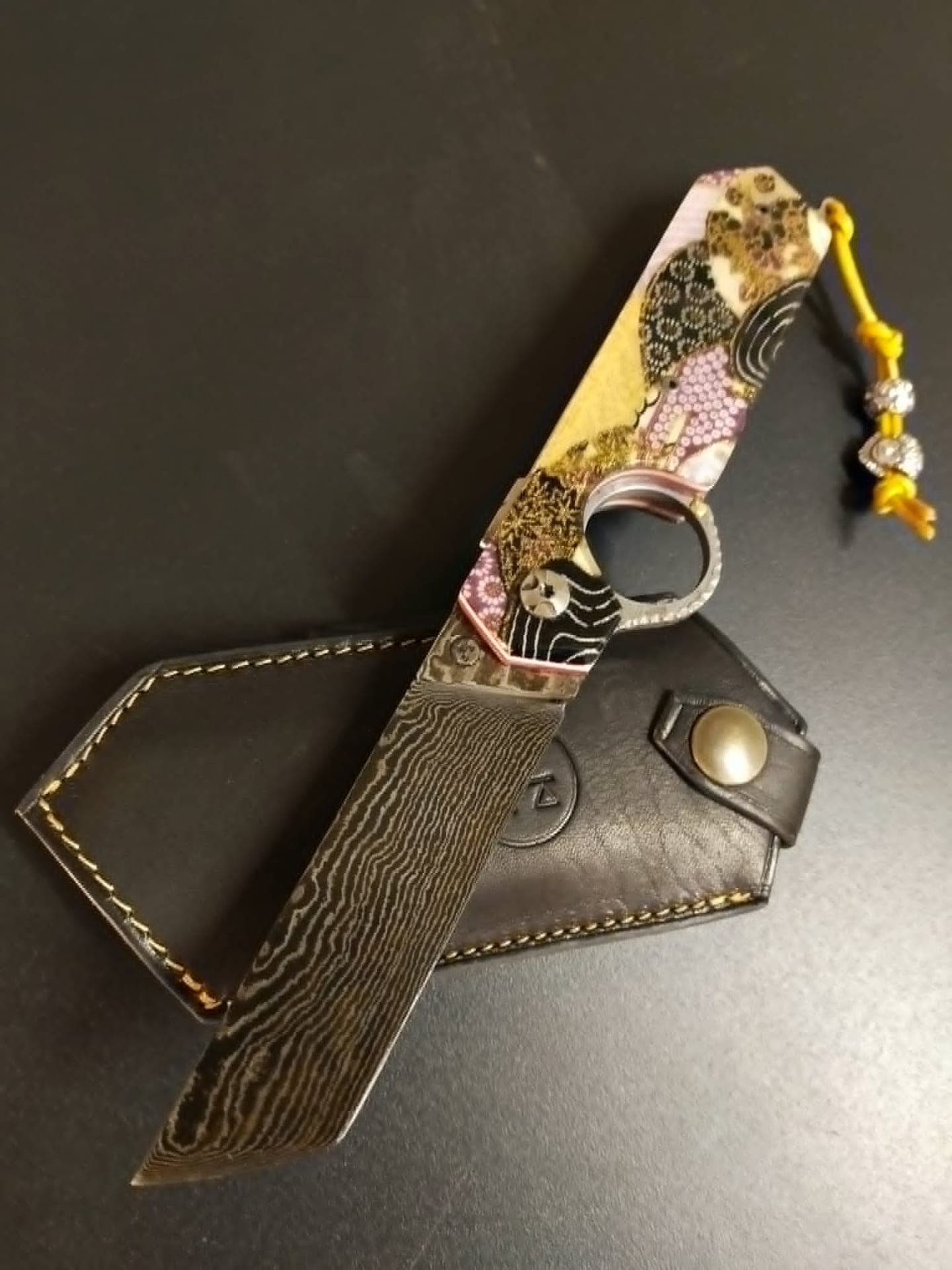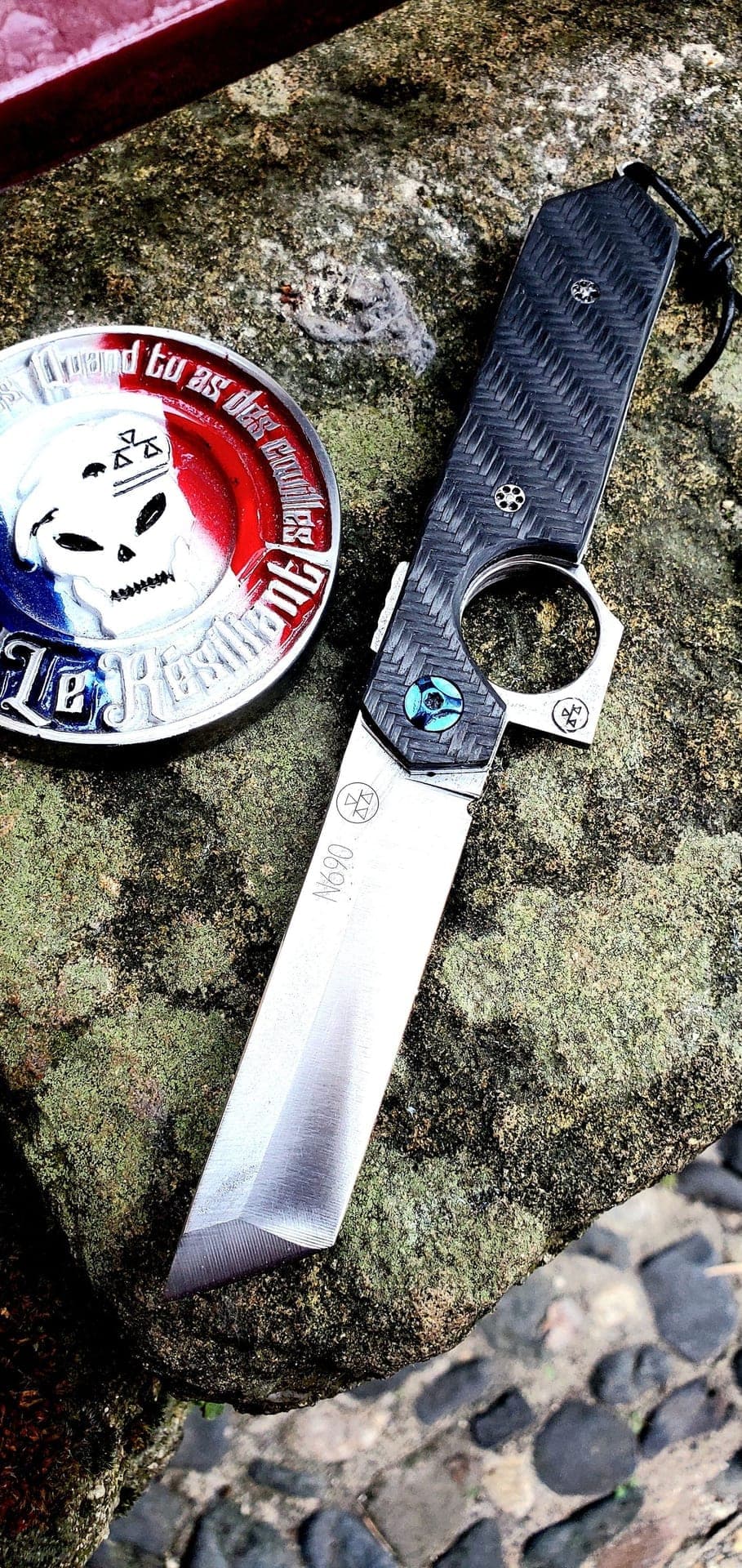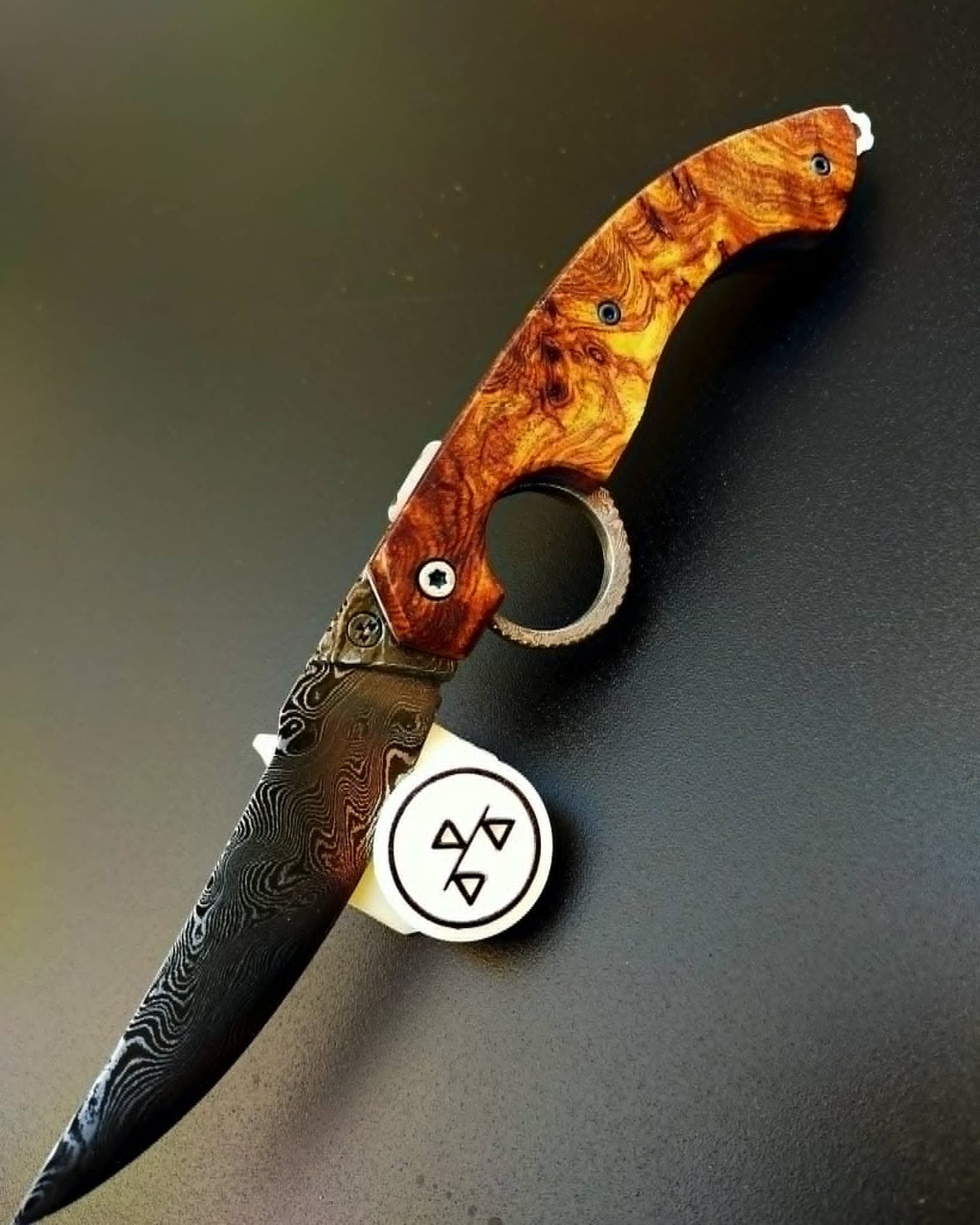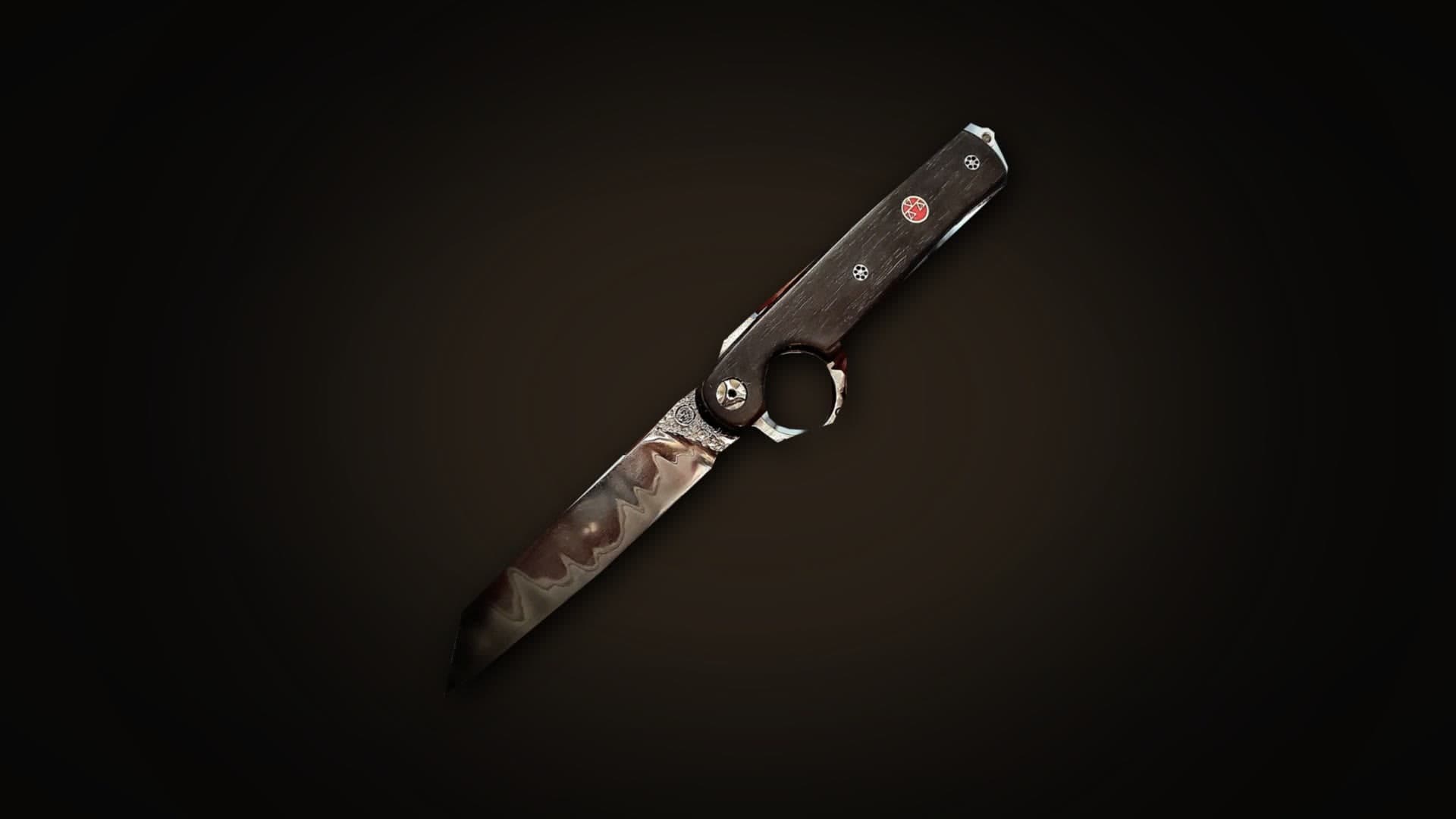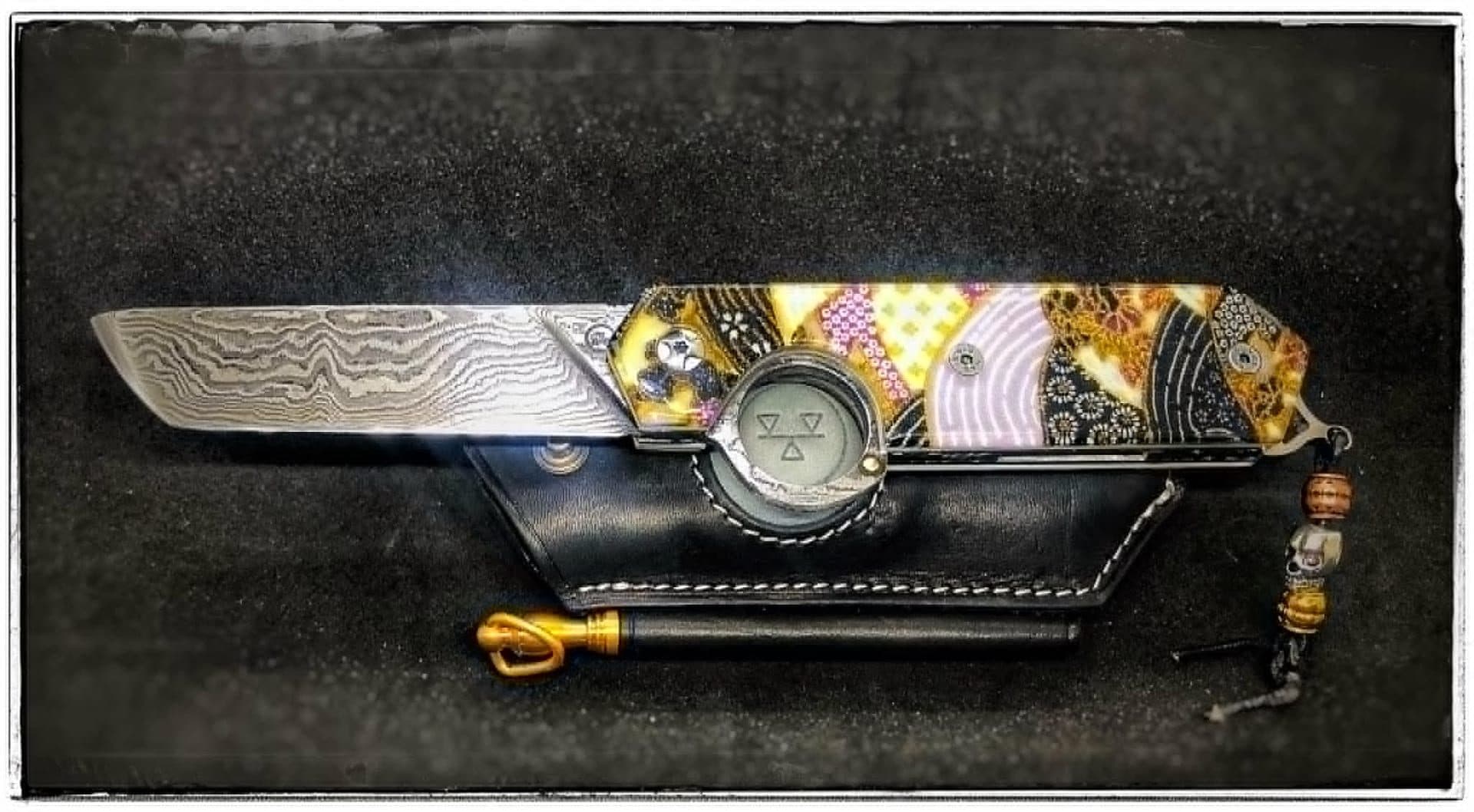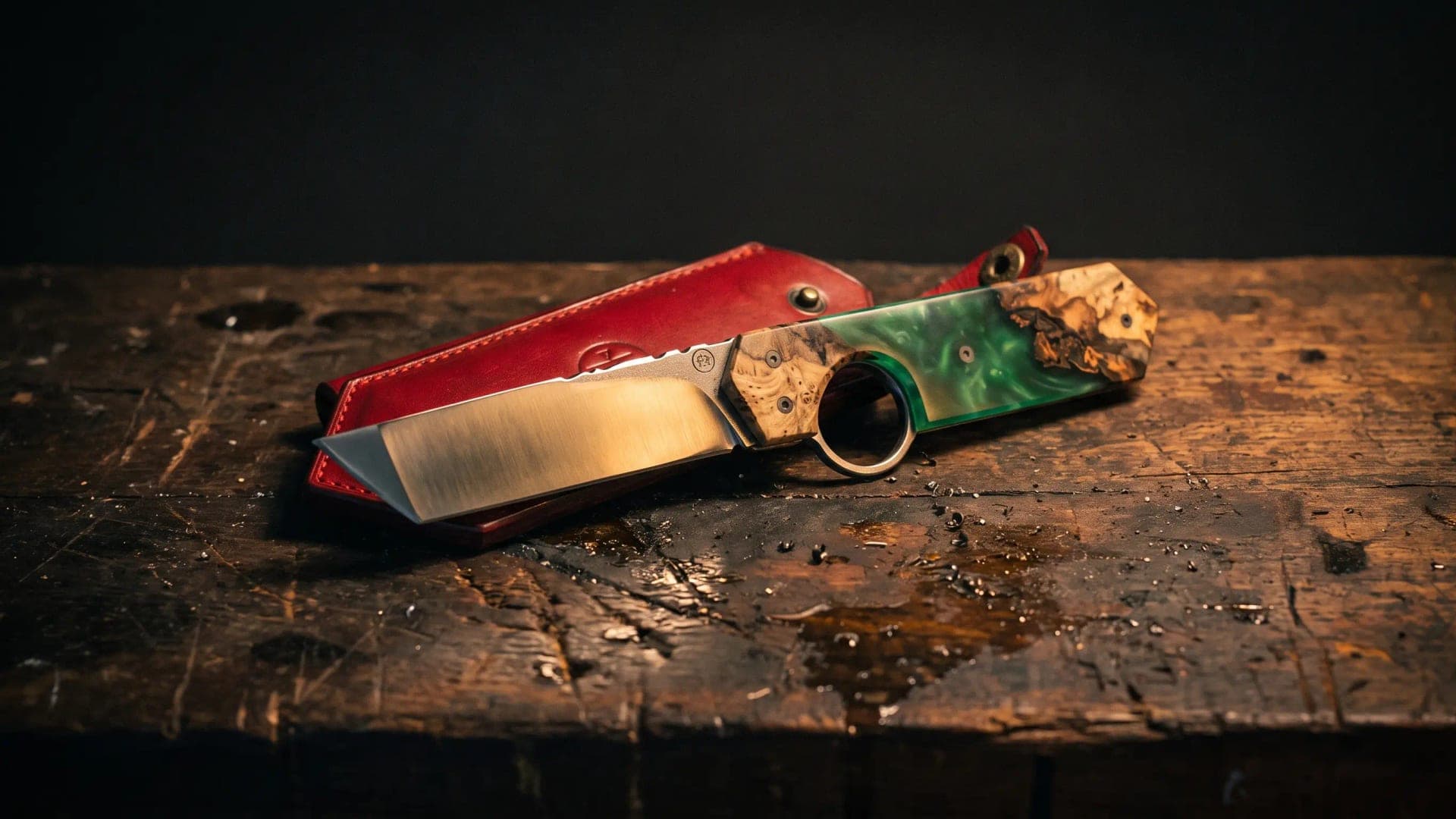
A point that breaks the usual angle of a blade, a spine that stays almost straight down to the edge: the tanto silhouette is recognisable at a glance, even on a knife that has never seen Japan. This isn't a styling choice: it's a geometry built to resist where a classic point gives way, and it now equips knives that have little left in common with the weapon whose name they carry.
The word comes from a short Japanese blade, the tantō, carried for centuries as a secondary weapon, before an American manufacturer reused its point geometry on folding knives in the 1980s. Since then, "tanto" names less a Japanese object than a blade shape, found on collector's pieces as much as on work tools.
This guide traces the Japanese origin of that point, details what it really changes at the cut, introduces the Résiliant Tanto, the workshop's first model and the starting point of the whole collection, places its real use somewhere between a work tool and an everyday knife, and closes on what a tanto blade made in Thiers needs, and what it doesn't.
The tanto point comes from a Japanese tradition
The tanto is originally a short Japanese dagger, straight or slightly curved, carried as a secondary weapon by samurai. Its massive point, reinforced by the spine rising toward the edge, was reused on Western folding knives in the 1980s, giving rise to what is now called a tanto point.
In Japanese history, the tantō names a short dagger with a plain blade, shorter than a wakizashi and nowhere near the length of a katana. Carried at the belt by samurai as a secondary weapon, it backed up the long sword in close combat and later also served as a ceremonial piece or a gift, its mounting sometimes as finely made as a sword's.
What sets its blade apart still shows on the modern knives that borrow its name: a spine that stays almost straight along its whole length, then a sharp angle break just before the point, instead of a gradual curve. That silhouette was reused on folding knives in the United States in the 1980s, in a form built for utility rather than combat: it is this version, the tanto point, that now equips most knives carrying the name.
The name travels faster than the object. A knife with a tanto point today has no direct link to feudal Japan: it's a blade geometry, independent of the opening mechanism or the country where the knife is made. On a Résiliant, it combines with the workshop's own reverse-opening mechanism, detailed in a dedicated article: the tanto point is the shape, not the mechanics.
What the tanto geometry changes at the cut
The tanto geometry thickens the blade just behind the point and straightens the spine line: the point takes a shock or an axial push better than a classic point, thinner and more curved. In exchange, the cutting belly is shorter, less efficient for slicing with a drawing motion: a trade-off, not a superiority.
On a classic point, a drop point or clip point, the spine curves gradually toward the edge: the point stays thin but not very thick. On a tanto point, the spine stays straight almost to the tip, and the angle break leaves more steel right behind the tip, which takes a shock, a twist or a push along the blade's axis better.
That gain has a cost. The belly of the blade, the curved part that lets a knife slice with a rocking motion, ends up reduced: a tanto point slides less naturally into a drawing cut, the one used to peel a piece of fruit or trim a cut of meat. It suits straight, pushed or firmly drawn cuts better than fine, repeated slicing.
The choice is therefore not absolute: a tanto point answers a need for sturdiness and point precision, not a need for all-purpose cutting. It's a deliberate trade-off, one the workshop chose from its very first model, betting on a blade built for tool use rather than for the kitchen or the table.
The Résiliant Tanto, the model that started it all
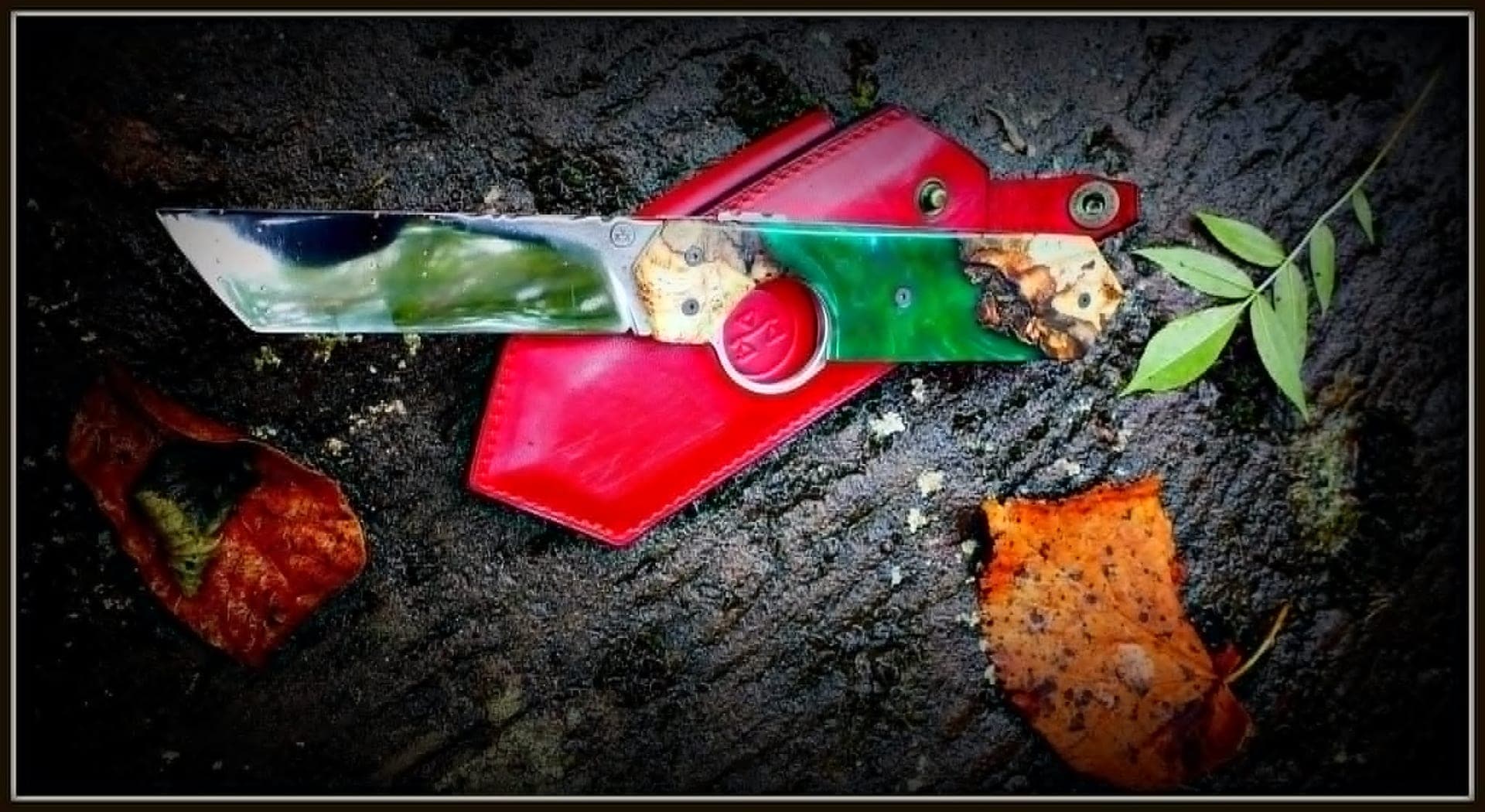
The Résiliant Tanto is the workshop's first model, subtitled "the Patriarch": its D2 steel blade carries the reinforced tanto point that gave its name to the whole range. It is the model through which reverse opening was born, and the workshop's first orders came from Belgium, Switzerland and the United States.
The Résiliant Tanto is the first model to leave the workshop, the one the whole collection started from. Its range carries the subtitle "the original model", and its page presents it as "the original": a cutting tool, a companion for everyday life. Its blade is D2 steel, a semi-stainless tool steel that tolerates moisture without ignoring it, vice-fitted and hand-assembled.
It is through this model that reverse opening was born: the blade rises from the top of the handle, edge first, driven by a ring the index finger slides into, a mechanism detailed in the article devoted to it. The Tanto keeps that founding trace: the rest of the collection, including the models with a classic point, inherits it.
The workshop's first orders came from Belgium, Switzerland and the United States, before the Résiliant even had recognised craftsman status. Today, the steel, the handle material and the finish of the Tanto are chosen at the quote stage, like the seven other models; a leather sheath stitched in Thiers, in plain leather or with a stud matched to the handle, is ordered as an option at the same time. The Tanto also comes in damascus: what a damascus blade costs, and why it replaces the starting price rather than adding to it, is covered in an article of its own.
A knife for use, not a knife for a display case
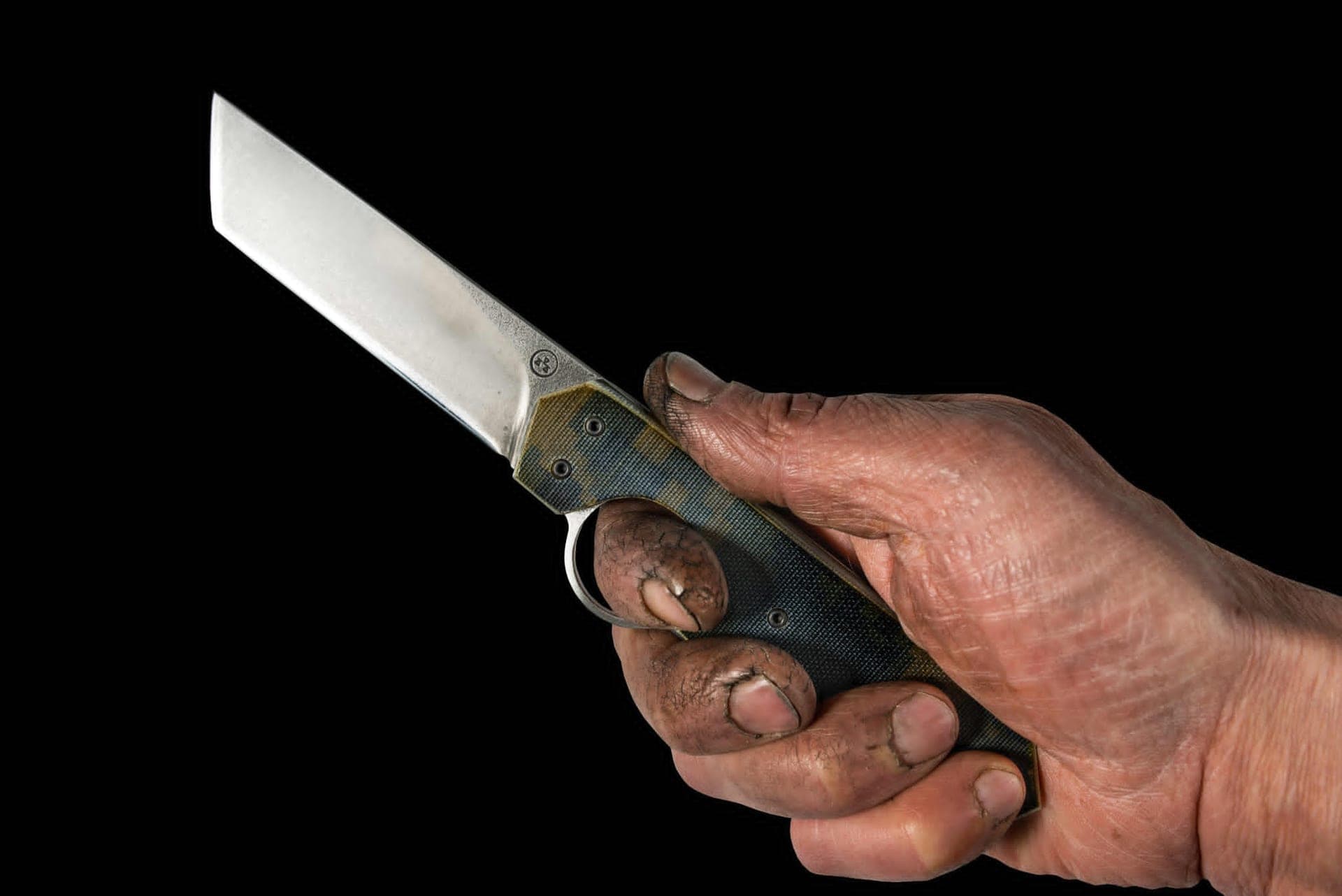
The Résiliant Tanto is worn as a work tool, on the belt, on building sites, roofs or in the workshop: it isn't a pocket knife in the strict sense. The Mini Tanto, a reduced version of the same model, is the only one in the collection that truly slips into a pocket.
The Résiliant Tanto answers a tool use first. It is worn on the belt, like a work knife: on a building site, on a roof, or simply in the workshop. That is what the term EDC covers, short for "everyday carry": a knife kept on hand every day for concrete tasks, not a knife pulled out of a drawer for the occasion. That is also why it gets given: in the workshop's selection of knives to give as a gift, it is the one for someone who works with their hands.
That doesn't make it a pocket knife in the strict sense: most Résiliant knives, the Tanto included, are worn in a sheath on the belt or kept in a display case. Only the Mini Tanto, a reduced version of the same model, truly slips into a pocket: in cryogenically hardened N690 steel, with a carbon-fibre handle and an anodised titanium axle screw, it is described at the workshop as the most carefree of the Résiliants.
Between the two sits Le Mancharicou, more compact and slimmer: it too is worn discreetly in its sheath, but is drawn more readily at the table than as a building-site tool. Three models, three uses, one thing in common: none of them is meant to sit in a display case without ever being used.
What a tanto blade needs, and what it doesn't
Caring for a tanto blade is no different from caring for any other Résiliant: wipe it after use, a drop of oil on the pin, and a butcher's steel to true the edge day to day. The sharpening stone stays a fallback, never a routine. What the tanto geometry doesn't need: a special protocol tied to its point.
Caring for a tanto blade is no different from caring for any other Résiliant. Wiping it after use, a drop of oil on the pin before storing it, and a regular pass on a medium-grooved butcher's steel to true the edge are enough for everyday care. The sharpening stone stays a fallback, for an edge that has genuinely suffered, never a routine; the gesture and the choice of equipment are detailed in the articles devoted to sharpening, to choosing a stone, and to caring for a carbon blade.
Any knife that has left the workshop can be sent back for its edge to be re-established, free of charge: only shipping remains down to its owner. Please get in touch before sending anything.
A tanto shaped in Thiers
The Résiliant Tanto is not forged: its D2 steel blade is shaped by material removal, vice-fitted, hand-assembled and adjusted in Thiers, France's cutlery capital. The steel, the handle and the leather sheath are all chosen at the quote stage, within the limits of this model's fixed template.
The Résiliant Tanto is not forged. Its D2 steel blade is shaped by material removal from a plate already cut to size, then hardened, polished and hand-assembled, at the Résiliant workshop, in Thiers. This method, called stock removal, is detailed in the article devoted to how a Résiliant is made.
In Thiers, France's cutlery capital, this gesture belongs to a tradition several centuries old, but the word "forge" stays reserved for that shared history, never for what the workshop itself does: here, blades are shaped, fitted, adjusted. The Tanto's template is never negotiated; the steel, the handle and the sheath, on the other hand, are chosen at the quote stage.
Seeing the eight models designed and assembled in this workshop shows what the tanto geometry ultimately owes to a place rather than to anything else: a workshop, a town, and a knife that keeps its mark. The name of the town alone proves nothing, though: what makes a Thiers knife authentic is read on the blade and asked of the workshop.
- What is a tanto knife?
- A tanto knife has a blade that borrows its geometry from the Japanese tantō: a spine that stays almost straight to the tip, then a sharp angle break down to the edge. That reinforced point takes a shock or a push better than a thinner, classic point.
- Why does a tanto point hold up better?
- Because the blade keeps more steel right behind the tip: the spine stays thick instead of tapering in a curve, as on a classic point. That extra mass resists bending and side impacts better, at the cost of a shorter cutting belly.
- Is a tanto a good everyday knife?
- Yes, as a tool: the Résiliant Tanto is worn on the belt like a work knife, on building sites, on roofs or in the workshop. It isn't a pocket knife in the strict sense; only the smaller Mini Tanto truly slips into a pocket.
- What's the difference between a Japanese tanto and an American tanto?
- The Japanese tantō is a historic weapon, short-bladed with a lacquered scabbard, carried by samurai. The American tanto keeps only its point geometry, reused on modern folding knives from the 1980s: a blade shape, no longer a weapon or a Japanese object.
- Does the Résiliant Tanto fit in a pocket?
- Yes and no. The Résiliant Tanto is worn in a sheath on the belt or kept on display, not in a pocket. Only the Mini Tanto, a reduced version of the same model, truly slips into a pocket.
Sources
- Wikipédia FR « Tantō » — Établit le tantō comme poignard japonais court, arme secondaire portée à la ceinture par les samouraïs, distinct par sa longueur du wakizashi et du katana.
- Wikipédia EN « Tantō » — Détaille la géométrie de la pointe tanto (dos épais, rupture d'angle nette) et sa reprise sur des couteaux pliants occidentaux à partir des années 1980.
- Knife Steel Nerds — Site technique de référence sur la métallurgie et la géométrie des lames, publié par un docteur en science des matériaux.
- Wikipédia « Coutellerie de Thiers » — Établit Thiers comme centre historique de la coutellerie française, cadre de l'ancrage territorial de l'article.