A knife "made in France" is a knife whose last substantial transformation took place in France, under customs rules: the claim is optional, it is not a label, and it does not say where the steel comes from. "Made in Thiers" has no definition at all: only the detail of the steps is informative.
On packaging, the phrase reassures, and that is the problem. The French Senate said so in an information report published on 18 June 2025: the claim is unclear to consumers, who may believe in a 100% French product. The rule asks for something else, and it does not apply in the same way to every claim.
Here is what each claim actually requires: the customs rule behind "made in France", the Origine France Garantie certification, and the absence of any definition for "made in Thiers". Then a case study: the steps of a workshop in Thiers, what is done there and what comes from elsewhere, set against those rules.
"Made in France" is a free claim, overseen by customs
On a knife, the origin claim is optional and declarative. If it appears, it must comply with the non-preferential rules of origin of the Union Customs Code: a product wholly obtained in France, or one that underwent its last substantial transformation in France. A false claim is a misleading commercial practice.
Declarative means that no body issues the claim before it is printed. Whoever applies it does so on their own responsibility, and the check comes afterwards, from the DGCCRF, the French authority in charge of fraud control.
That check is far from theoretical. In its 2023 investigation, the DGCCRF inspected 1,499 businesses, manufacturers, importers and distributors, online sellers included: 239 were in breach, an anomaly rate of 16%. Among the published examples were cups labelled "Made in France" that had been entirely manufactured and printed by a foreign supplier.
A manufacturer who wants to settle the question before writing the claim can use a customs procedure, optional and free of charge: the IMF, for information sur le made in France, for having a product's origin checked.
The last substantial transformation makes the origin, not the material
The rule does not require every component to be French: it requires the step that gives birth to the product to have taken place in France. The precise criterion depends on the product's customs category. Mere packaging or simple assembly is not enough to confer origin.
Customs speak of substantial transformation when manufacturing results in a new product, or in an advanced stage of manufacture. To check it, the criterion depends on the product's category in the customs nomenclature: depending on the case, a change of tariff heading, a minimum share of added value, or a maximum share of non-originating materials.
For a knife, the consequence is direct: the steel of a blade can come from another country without making the claim false, provided the substantial transformation takes place in France, under the criterion for its category. On its own, then, the claim says nothing about where the steel comes from.
This is where the misunderstanding identified by the Senate lies. Its information report no. 754 (2024-2025), "Fabriqué en France : la compétitivité patriotique" (Made in France: patriotic competitiveness), finds that consumers may believe in a 100% French product where the rule does not require one, and proposes defining the claim more clearly and strengthening checks.
Origine France Garantie, a certification with two conditions
Origine France Garantie is a private certification, run by the association Pro France, not a legal obligation. It requires two cumulative criteria: the product acquires its essential characteristics in France, and at least 50% of its unit cost price is incurred there. An independent body checks both through an audit.
The difference from the free claim lies in the order of operations. "Made in France" is written first, on the responsibility of whoever applies it, and checked afterwards. Origine France Garantie is obtained after an audit: verification comes before the claim instead of after it.
The 50% threshold also shows what the certification does not require. A certified product may contain components from elsewhere, as long as at least half of its unit cost price is incurred in France. For the buyer, the certification gives information about a proportion and a place, not about the origin of each part.
On its website, the Résiliant workshop claims no origin certification and does not describe its pieces as "made in France": it says what it does and what it has done by others. That description of the steps is what the rest of this article sets against the rules.
"Made in Thiers" meets no definition
No text defines the claim "made in Thiers". No geographical indication protects the town's name for knives, and the only rule specific to the area is that of a voluntary collective trademark, Le Thiers®, which covers one precise model. The claim indicates a place, not who carried out which step.
The detail of that trademark, its stamp and what can be read on a blade is covered in the article on the real Thiers knife. What matters here is the consequence: outside that model, nothing governs the use of the word Thiers on a knife, nor what it must cover.
The Thiers area produces close to 80% of the knives made in France, and it has produced them with many hands for centuries. The specialisation of trades there is documented from the 15th century: blacksmiths, grinders, polishers, each at their own post. The article on the history of the Thiers knife recounts that shared work.
"Made in Thiers" therefore long referred to work spread across several workshops in the same area, and nothing today requires anyone to say which one did what. That is why the claim, even when accurate, does not replace the detail of the steps.
At the Résiliant workshop, what is done on site and what comes from elsewhere
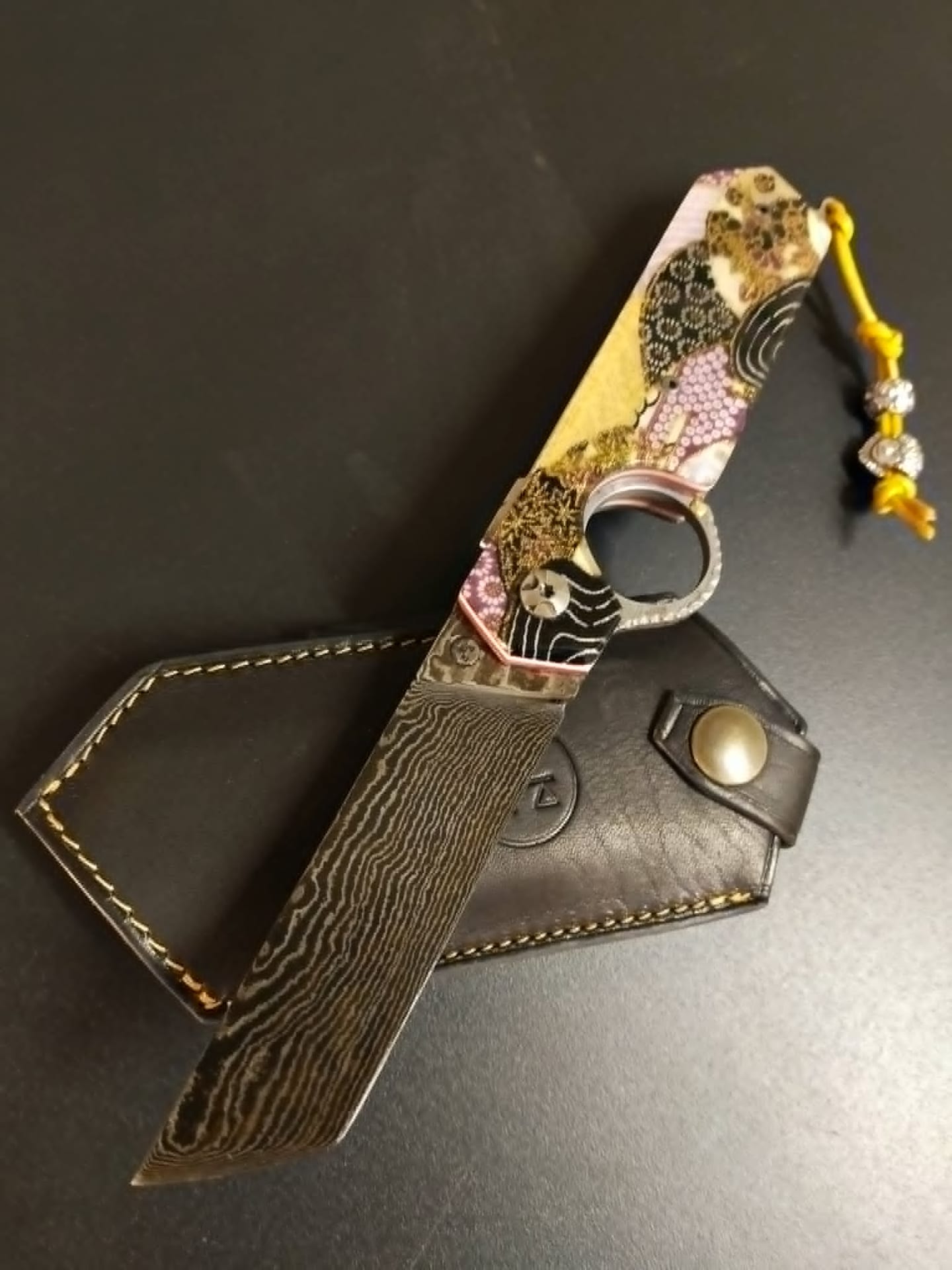
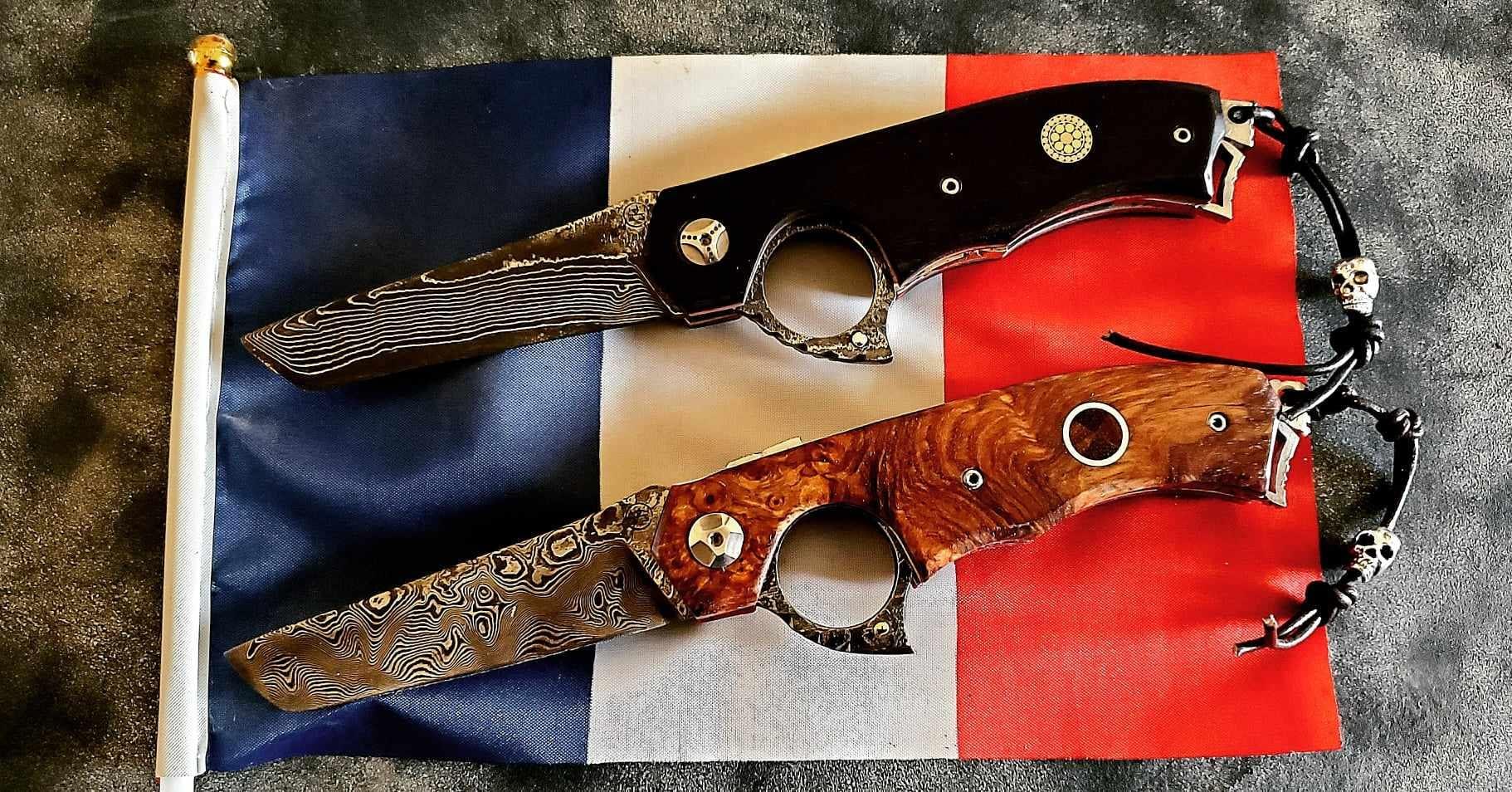
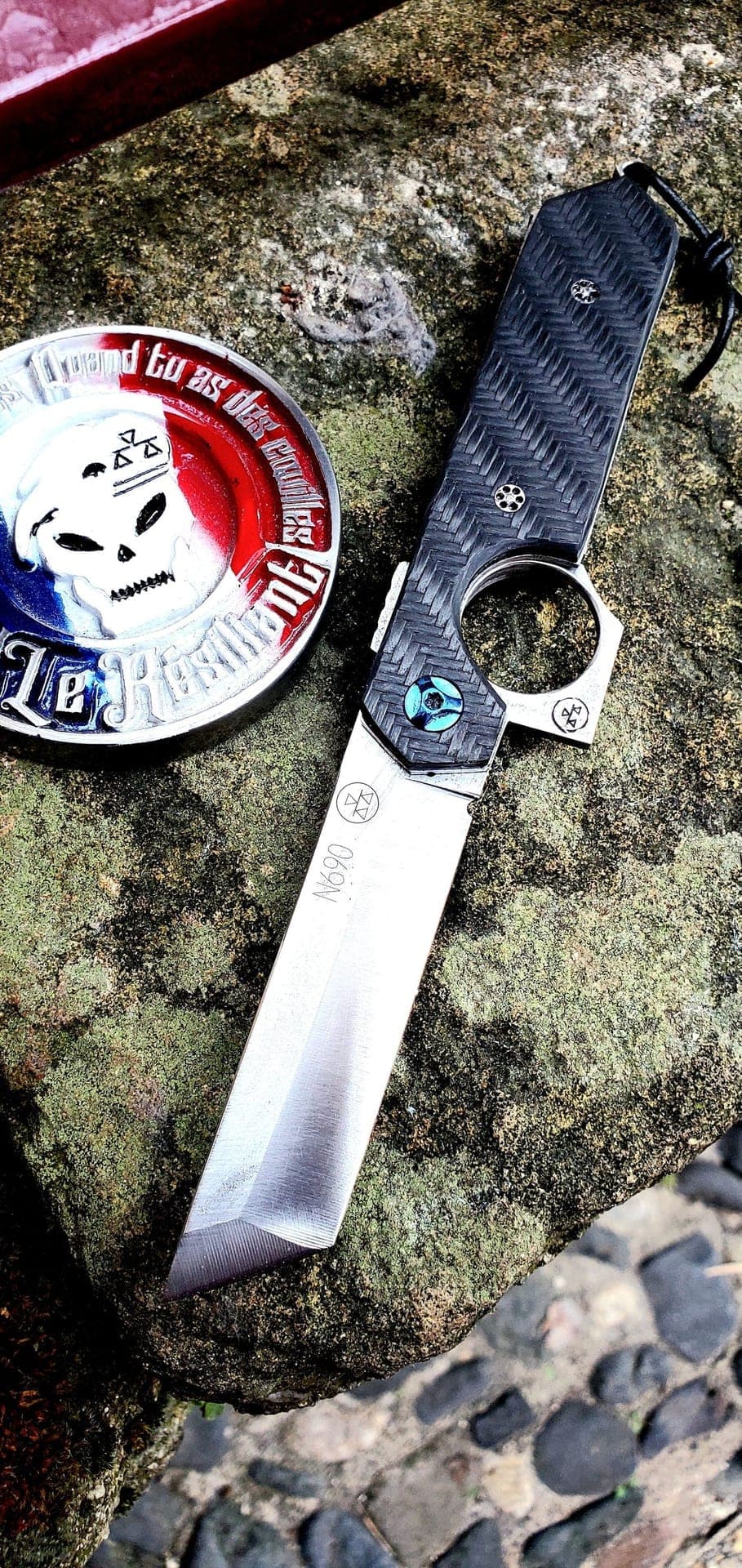
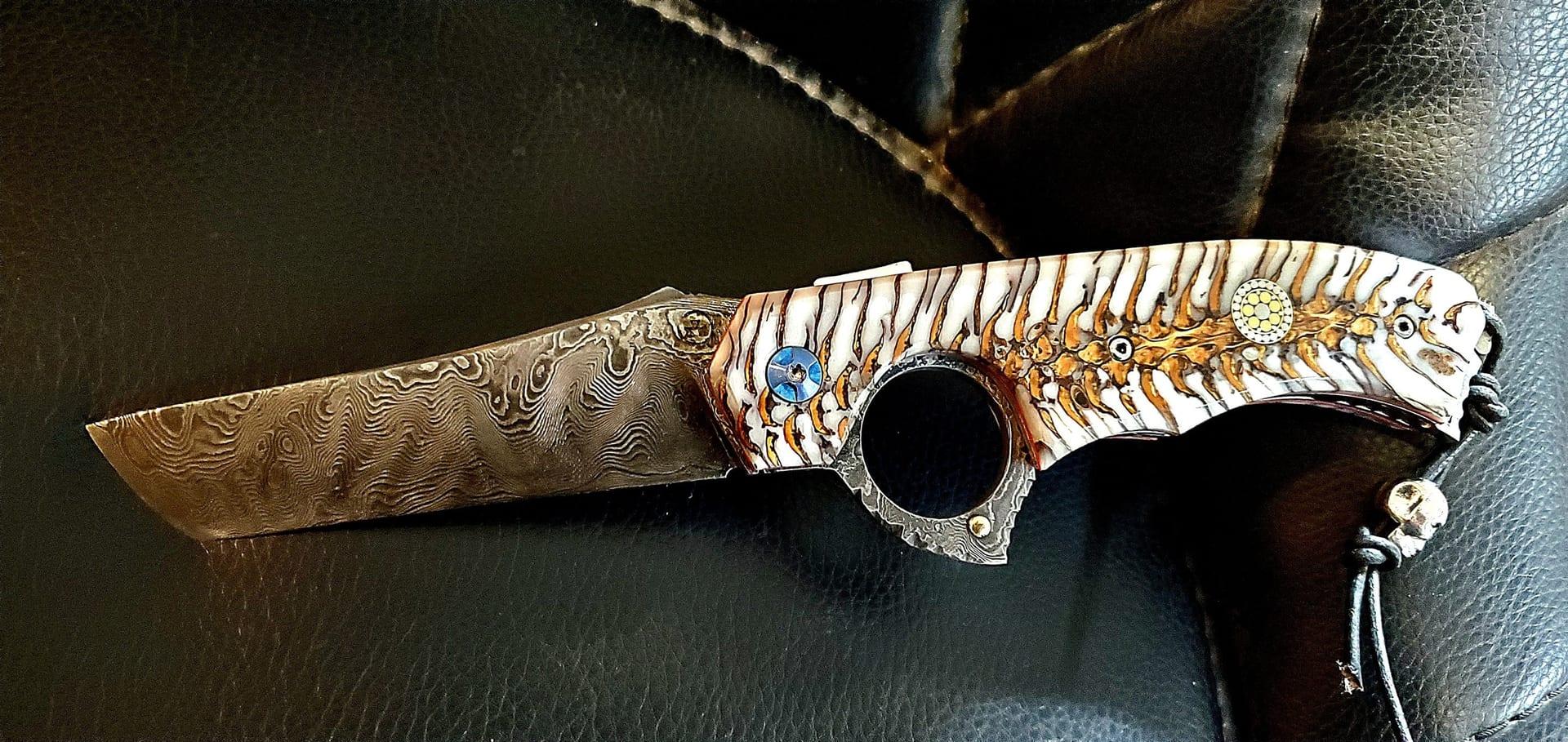
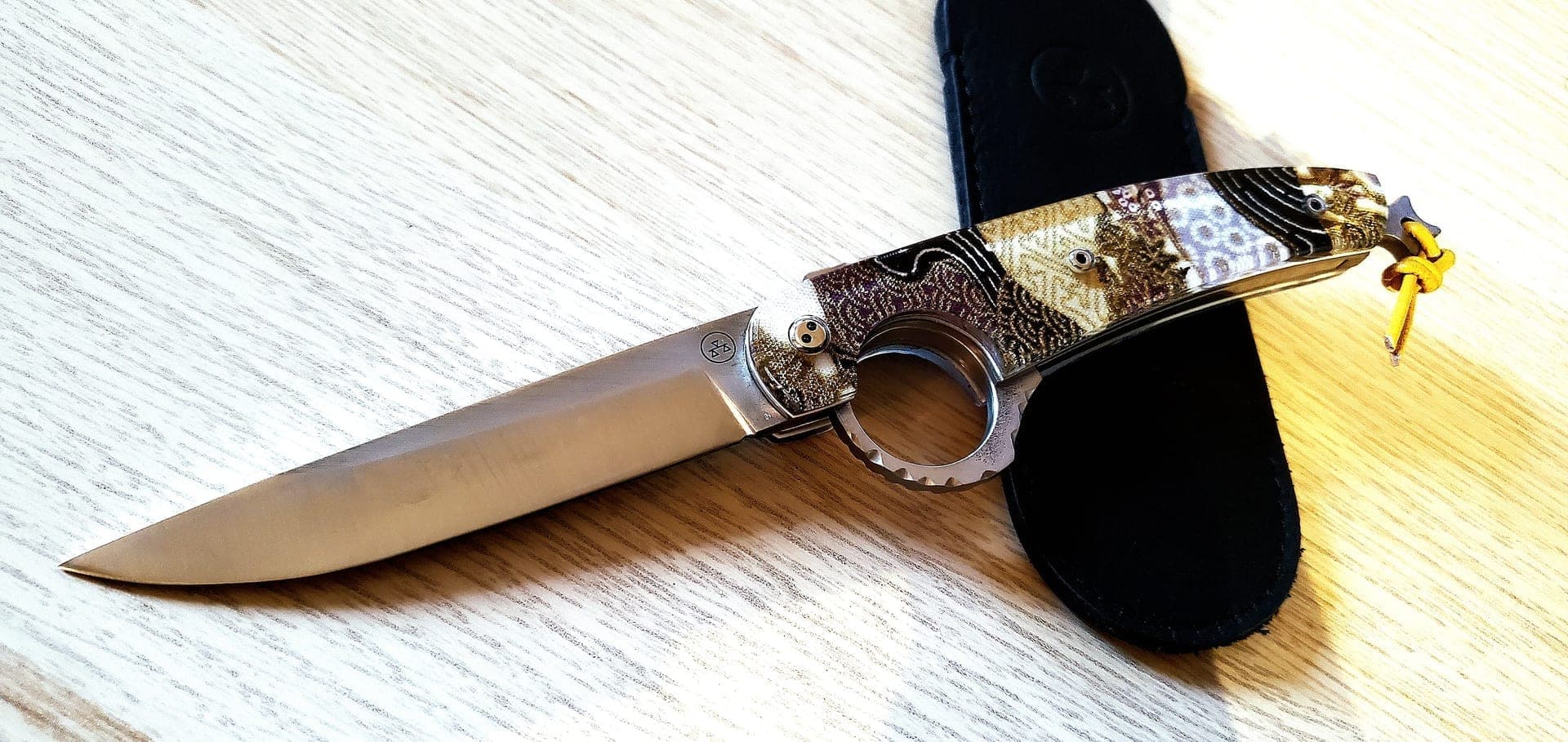
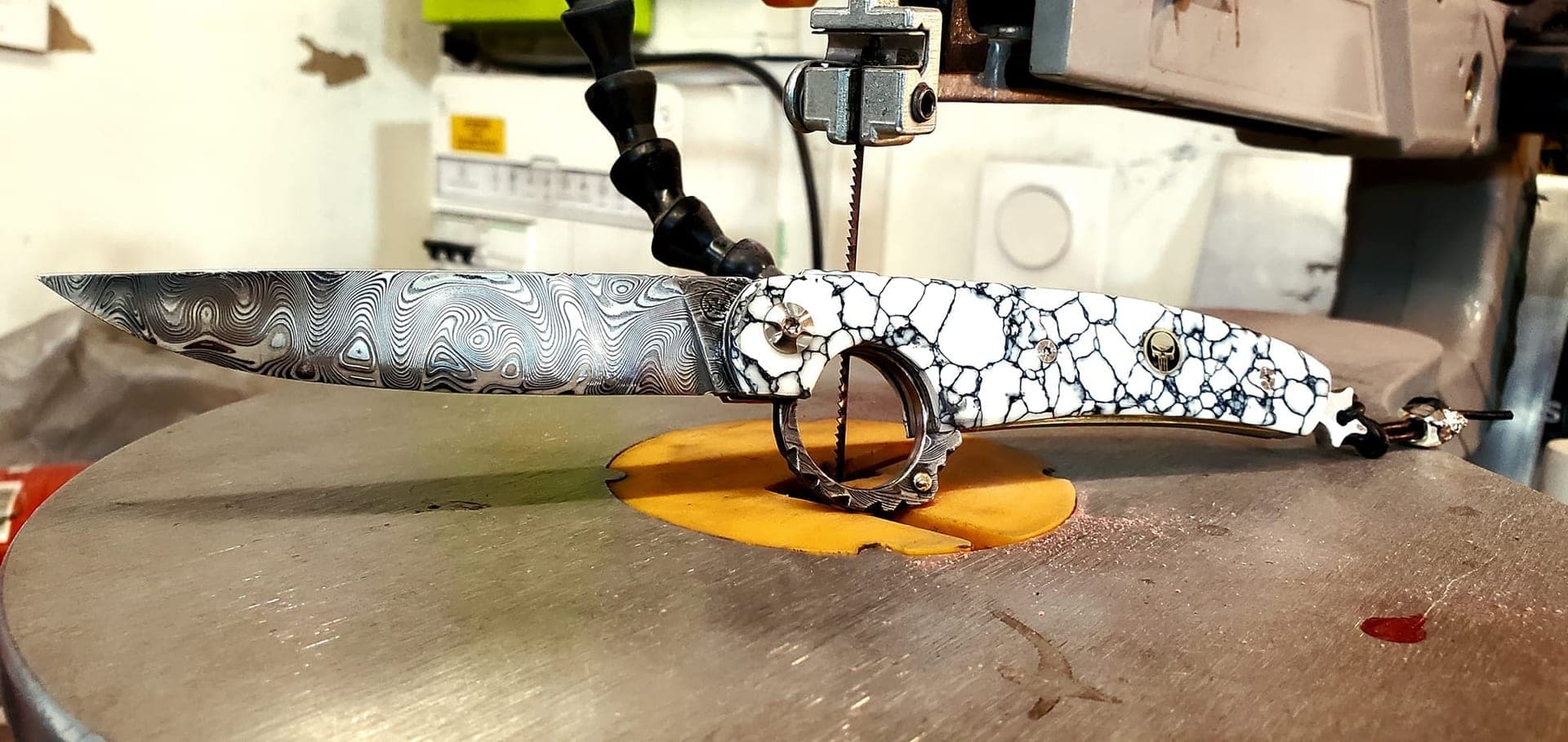
In Thiers, the workshop cuts damascus blades by hand from purchased plates; the D2 series, cut at a factory, are quenched, bevel-ground, polished and assembled there; every mechanism is adjusted in the vice there. On the Mini Tanto and the Tracker, several steps are entrusted to different facilities, and assembly is still done at the workshop.
The material comes from outside: steel and damascus are bought in plates from specialised suppliers. What turns it into a knife happens partly at the workshop and partly outside it, depending on the family of models.
The Mini Tanto and the Tracker follow a different pattern, which the workshop openly acknowledges: their cutting, heat treatment, bevel grinding and handles are entrusted to different facilities, and their cryogenic quench is carried out in industry. Their assembly is done at the workshop.
None of this is hidden behind a claim: the workshop details its steps, including the ones it entrusts to others, and lets everyone judge. The detail of the work, from plate to assembled knife, is told in a separate article.
- Bought in or entrusted: steel and damascus plates; the cutting of the D2 series; the cutting, heat treatment, bevel grinding and handles of the Mini Tanto and the Tracker; their cryogenic quench, in industry; engraving, by a neighbouring engraver; wood stabilisation, by a professional.
- At the workshop, in Thiers: cutting damascus blades by hand; quenching in the electric furnace, bevel grinding and polishing of the damascus blades and the D2 series; assembly of all eight models; adjusting every mechanism in the vice, piece by piece.
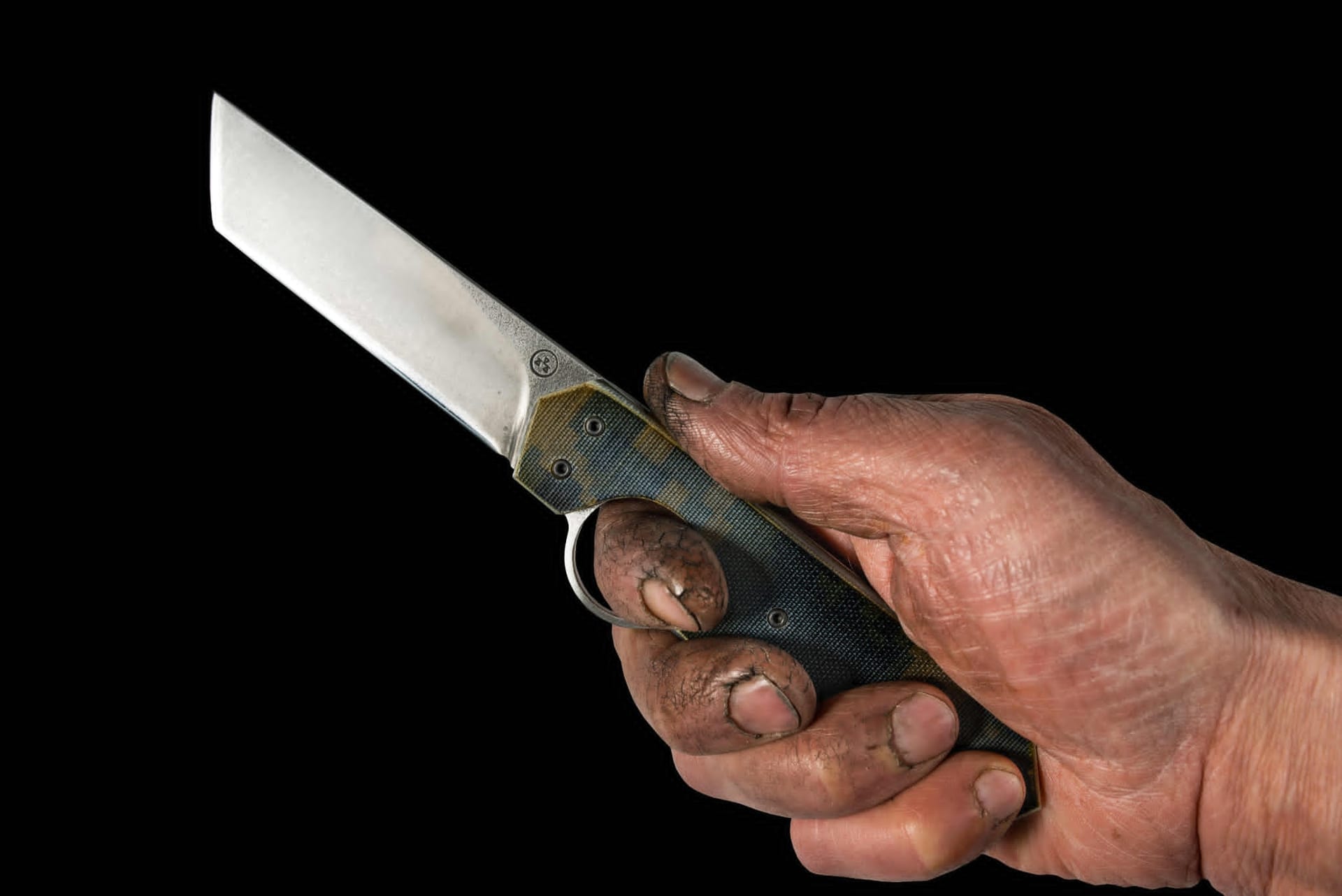
The mechanism and the sheath, the two parts of a Résiliant born in Thiers
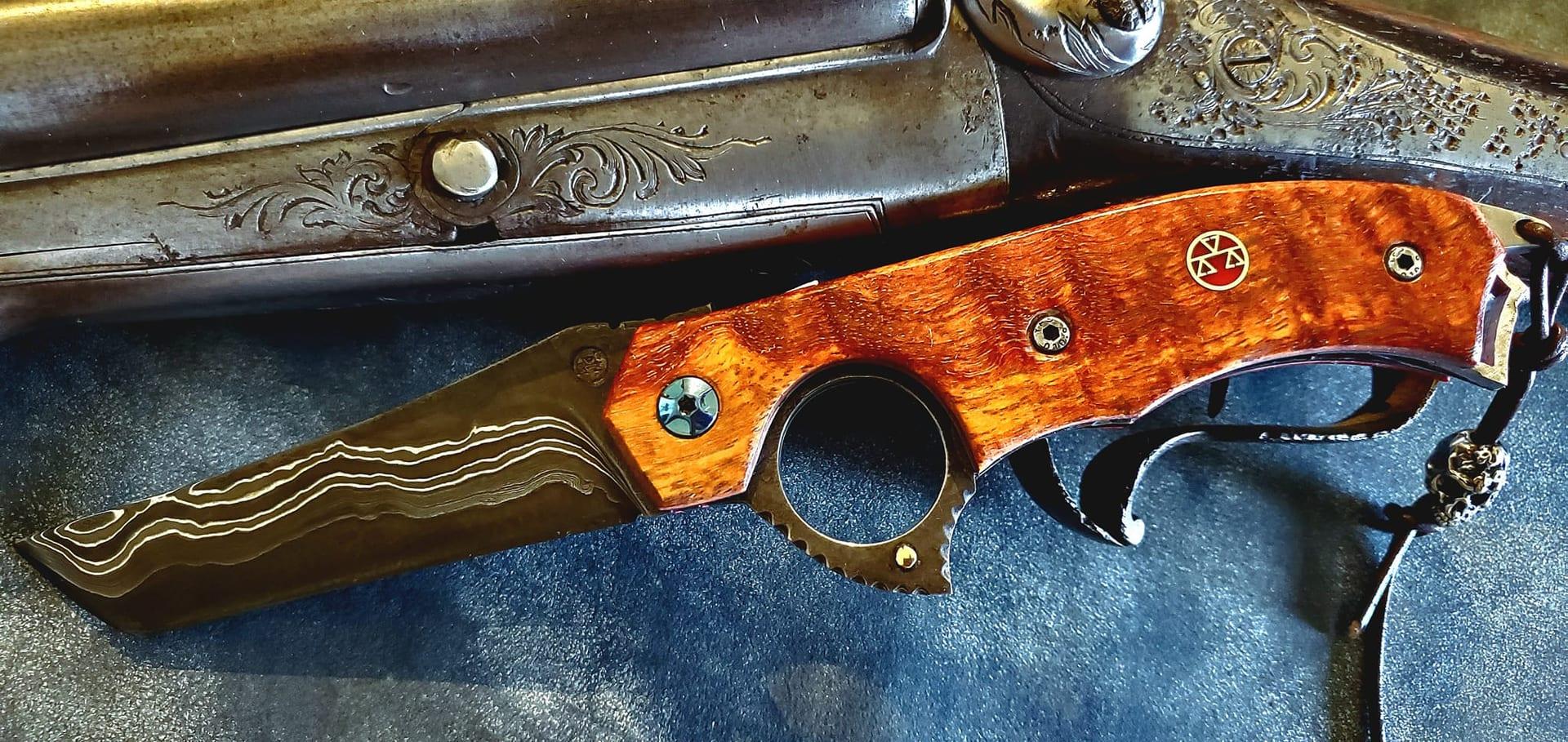
What makes a Résiliant a Résiliant, the reverse-opening mechanism, is adjusted in the vice, in Thiers, on all eight models. The sheath, offered as an option, is stitched in the town centre by the leather workshop VD Cuir: it is the only element the workshop describes as entirely French.
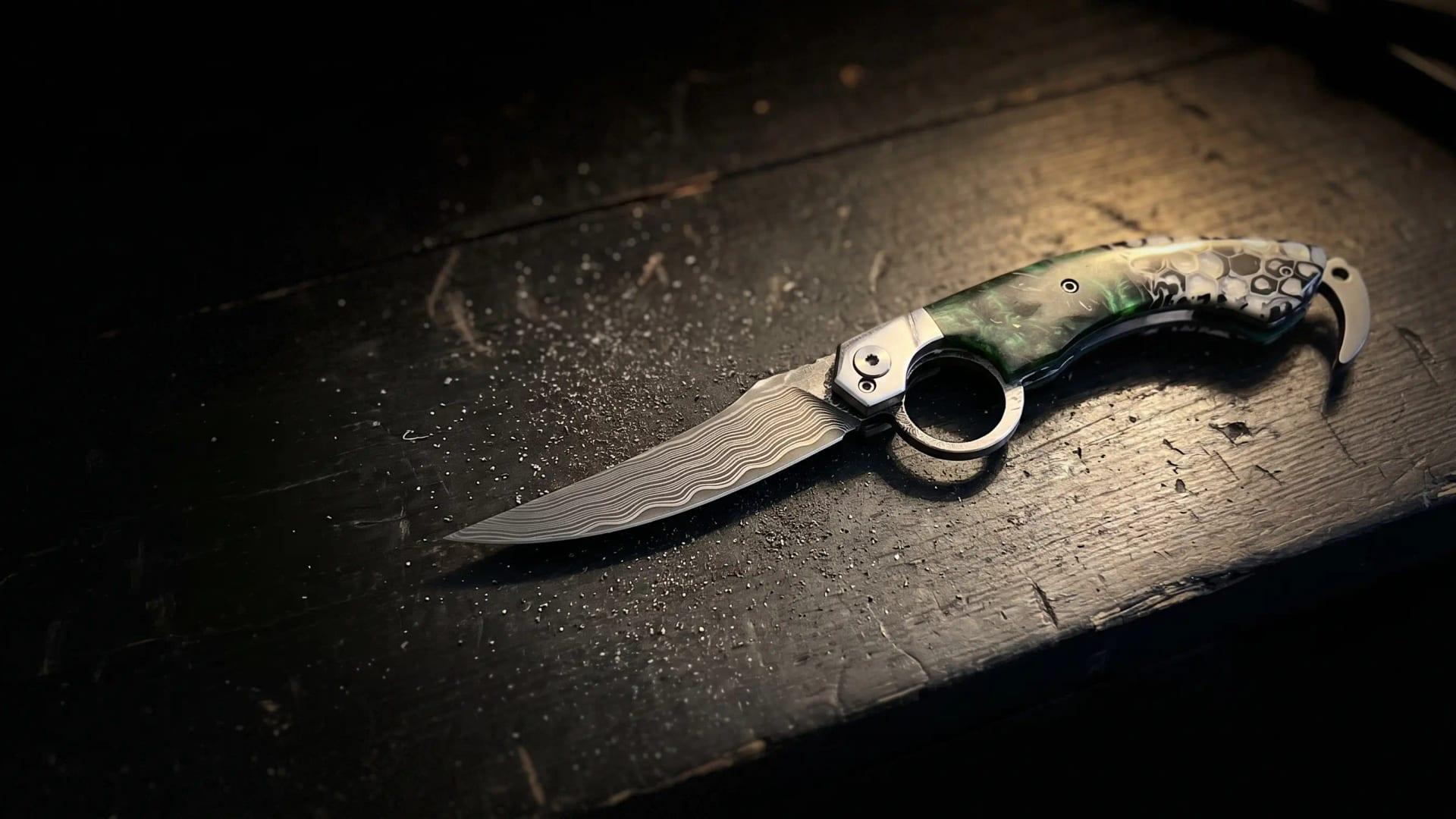
The mechanism is common to all eight models: the blade exits through the top of the handle, driven by a ring for the index finger, and locks with a reversed liner lock, whose liner works at the top of the handle. Opening is 100% manual. Each mechanism is adjusted in the vice, piece by piece. How reverse opening works is explained in a dedicated article.
The sheath takes a different route. It is stitched in Thiers, in the town centre, by the leather workshop VD Cuir, a partner of Le Résiliant for seven years, in vegetable-tanned leather. The accessories page describes it as "100% French work, with nothing sourced abroad". It remains an option, priced in the quote.
The origin of a knife is therefore read step by step, not in a phrase. A claim states a place or a rule that was followed; a workshop that answers on every step says more, and nothing stops you from asking the workshop before ordering.
- When can a knife be labelled "made in France"?
- When the knife was wholly obtained in France, or underwent its last substantial transformation there, under the rules of origin of the Union Customs Code. The claim remains optional. The precise criterion depends on the product's customs category, and a false claim is a misleading commercial practice.
- Where are knives made in France?
- The Thiers area, in Auvergne, produces close to 80% of the knives made in France. The specialisation of cutlery trades there is documented from the 15th century: blacksmiths, grinders, polishers. The rest is made elsewhere in France.
- Does a knife made in France necessarily have French steel?
- No, not necessarily. The rule of origin does not require every component to be French: it concerns the step that gives birth to the product, under the criterion for its customs category. Steel from another country does not, on its own, rule out the claim, and the claim says nothing about the steel.
- What is the difference between "made in France" and Origine France Garantie?
- "Made in France" is an optional, declarative claim, subject to customs rules and checked afterwards by the DGCCRF. Origine France Garantie is a certification from the association Pro France, granted after an independent audit, with two criteria: essential characteristics acquired in France and at least 50% of the unit cost price.
- What is done in Thiers on a Résiliant knife?
- At the workshop in Thiers: cutting damascus blades by hand; quenching, bevel grinding, polishing and assembly of the damascus blades and of the D2 series, cut at a factory; assembly of the Mini Tanto and the Tracker, several of whose steps are entrusted to outside facilities; adjusting the reverse-opening mechanism in the vice.
Sources
- Le fabriqué en France, la garantie de l'origine des produits · DGCCRF — Fiche pratique de la DGCCRF : établit que le marquage d'origine d'un produit non alimentaire est facultatif et déclaratif, qu'il suit les règles d'origine non préférentielle du code des douanes de l'Union (produit entièrement obtenu, ou dernière transformation substantielle), qu'une mention fausse est une pratique commerciale trompeuse, et présente la procédure IMF de la douane.
- « Fabriqué en France » : comment s'y retrouver et éviter les pièges ? · DGCCRF — Bilan de l'enquête de 2023 : 1 499 professionnels contrôlés, fabricants, importateurs et distributeurs, vente en ligne comprise, 239 en irrégularité, soit un taux d'anomalie de 16 %, avec l'exemple de gobelets « Made in France » entièrement fabriqués et imprimés par un fournisseur étranger.
- Le made in France · entreprises.gouv.fr — Site gouvernemental : établit qu'Origine France Garantie est une certification non obligatoire portée par l'association Pro France, fondée sur deux critères cumulatifs (caractéristiques essentielles acquises en France, au moins 50 % du prix de revient unitaire) et sur un audit par un organisme indépendant.
- Fabriqué en France : la compétitivité patriotique, rapport n° 754 · Sénat — Rapport d'information n° 754 (2024-2025) de la délégation aux entreprises, par A.-M. Nédélec et F. Menonville, 18 juin 2025 : établit que la mention est floue pour le consommateur, qui peut croire à un produit 100 % français, et propose de mieux la définir et de renforcer les contrôles.
- Coutellerie de Thiers · Wikipédia — Référence sur le bassin thiernois : établit qu'il produit près de 80 % des couteaux fabriqués en France et que la spécialisation des métiers de la coutellerie (forgerons, émouleurs, polisseurs) y est documentée dès le XVe siècle.